


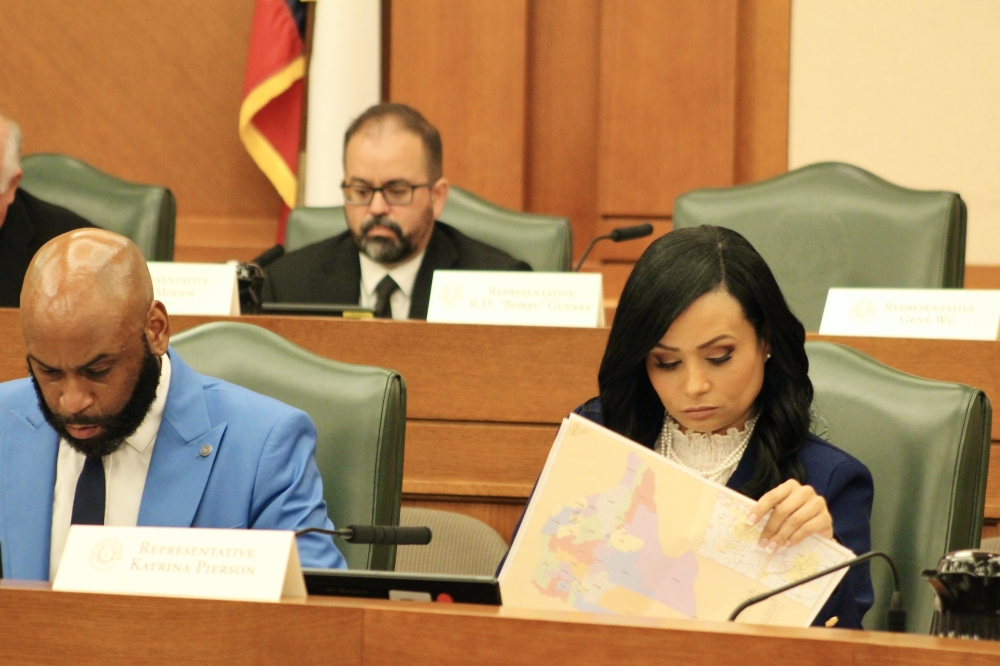
State lawmakers approved the new congressional boundaries this summer, after President Donald Trump asked them to produce a new map in an attempt to help Republicans maintain a narrow majority in the U.S. House, Community Impact previously reported. Texas Republicans have said they hoped the map would help the GOP secure 30 of Texas’ 38 congressional seats, up from 25 Republican-held seats today.
What’s happening
The high court’s ruling overturns a Nov. 18 injunction from an El Paso federal court, which deemed Texas’ redistricting plan "racially gerrymandered” and directed officials to use the state's 2021 congressional map instead.
“The District Court improperly inserted itself into an active primary campaign, causing much confusion and upsetting the delicate federal-state balance in elections,” the Supreme Court said in the unsigned Dec. 4 order.
The order comes just four days before the Dec. 8 deadline for Texas candidates to file to run in the March primary elections.
“Texas needs certainty on which map will govern the 2026 midterm elections,” Justices Samuel Alito, Clarence Thomas and Neil Gorsuch wrote in a roughly one-page concurring opinion.
Justices Elena Kagan, Sonia Sotomayor and Ketanji Brown Jackson issued a 15-page dissent.
Alito wrote that it was “indisputable that the impetus for the adoption of the Texas map... was partisan advantage pure and simple,” rejecting the argument that Texas’ new congressional districts were drawn based on race. The Supreme Court ruled in 2019 that partisan gerrymandering cases were “beyond the reach of the federal courts,” at the time upholding congressional maps in North Carolina and Maryland that the court deemed partisan.
Alito said that if the plaintiffs, which include several civil rights advocacy groups, wanted to prove the new districts were racially gerrymandered, it was “critical” for them to provide an alternate map “that serves the state’s allegedly partisan aim just as well as the map the state adopted.” The plaintiffs did not, Alito noted.
In the dissenting opinion, Kagan wrote that Texas “largely divided its citizens along racial lines... in violation of the Constitution’s Fourteenth and Fifteenth Amendments.”
Kagan also disagreed with the majority opinion that the lower court’s Nov. 18 order came too close to next year’s election, noting that Texas can change the date of its March 3 primary election if needed. She wrote that Texas’ 2021 congressional map, drawn after the 2020 census, was “the status quo,” as it had been used in the 2022 and 2024 congressional elections.
“Until late last summer, everyone expected that map to govern 2026, too,” Kagan said.
What they’re saying
Gov. Greg Abbott, who signed the new congressional map into law in August, celebrated the Dec. 4 ruling, saying in a statement that “Texas is officially—and legally—more red.”
Texas Attorney General Ken Paxton also applauded the Supreme Court in a Dec. 4 statement.
“Texas is paving the way as we take our country back, district by district, state by state,” Paxton said. “This map reflects the political climate of our state and is a massive win for Texas and every conservative who is tired of watching the left try to upend the political system with bogus lawsuits.”
The Texas Democratic Party, meanwhile, condemned the ruling as a loss for voters of color.
“The Supreme Court failed Texas voters today, and they failed American democracy,” Rep. Gene Wu, a Houston Democrat and chair of the Texas House Democratic Caucus, said in a Dec. 4 statement. “This is what the end of the Voting Rights Act looks like: courts that won't protect minority communities even when the evidence is staring them in the face.”
How we got here
At Trump’s request, Texas lawmakers redrew 37 of the state’s 38 congressional districts during a special legislative session this summer.
All states are constitutionally required to redistrict every 10 years, after a census. Mid-decade redistricting is uncommon, but not unprecedented—Texas lawmakers also redrew the state’s congressional boundaries in 2003.
During the special session, Texas Democrats called the redistricting effort unconstitutional and "racially discriminatory," while Republicans asserted that the map "complies with the law" and was designed with partisan, rather than racial, goals in mind.
After state lawmakers approved the congressional map in August, several civil rights groups sued Texas over the new boundaries, which they said places voters “within and without particular districts on the predominant basis of their race in violation of the Fourteenth Amendment.”
A trio of federal judges held a nine-day hearing in October to determine if the new map could be used in next year’s election. On Nov. 18, the panel ruled 2-1 that it could not be used. Days later, Paxton appealed to the Supreme Court, requesting an emergency pause on the lower court’s ruling. Alito quickly granted Paxton's request Nov. 21 as the Supreme Court justices considered the details of the case.
House Bill 4, the state law that creates the new congressional map, took effect Dec. 4. The Supreme Court’s subsequent ruling allows Texas to use its new map in the 2026 elections.
This article is developing and may be updated.