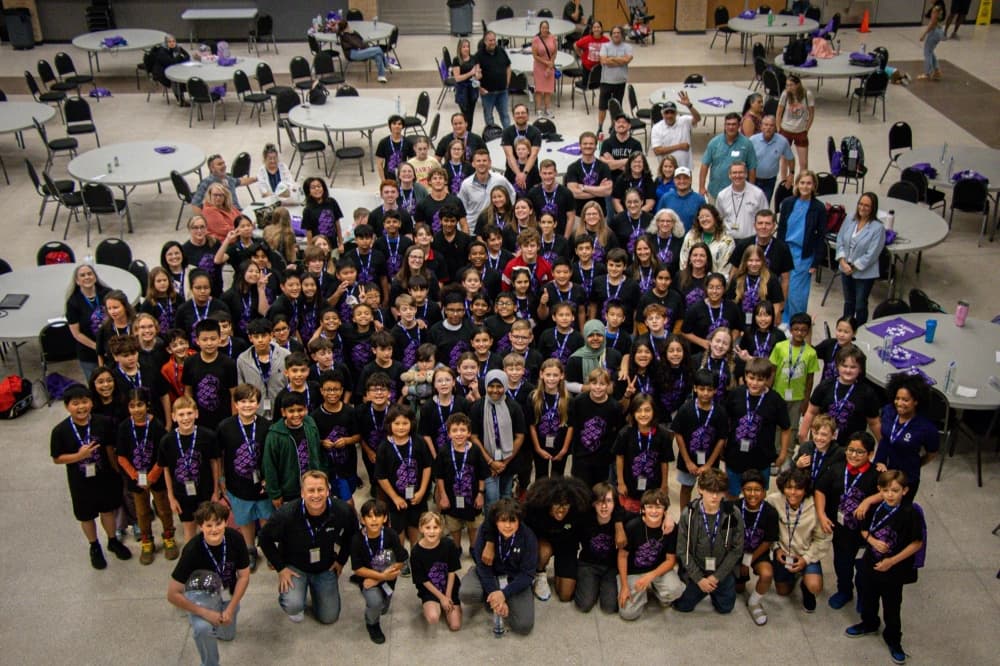
Nearly 200 Clear Creek ISD students in grades 5-8 participated in the inaugural artificial intelligence, or AI, hackathon, hosted by the district on April 11. Students from 27 schools were challenged to work in teams to develop AI-powered apps designed to improve health care, financial literacy and education.
Houston Methodist Clear Lake served as the presenting sponsor for the health care challenge, mentoring students as they used AI tools and coding skills to develop apps that encourage children to be more involved with their health.
For Heidi Reigel, chief operating officer at Houston Methodist Clear Lake, the hackathon demonstrated how quickly students can engage with complex problem-solving.
“These kids were so excited to be able to solve a problem with technology. The excitement in the room was as palpable as being at a sporting event,” she said. “I was so surprised to learn that some of these kids had never used AI or worked with code.”
The event
As a judge for the health care projects, Reigel evaluated student apps based on creativity, teamwork, functionality and how well they addressed real-world health challenges. She said one of the most surprising outcomes was how broadly students defined health.
“I would have never thought that these kids would have understood what healthy habits were,” she said. “But many of them weren’t just nutrition-focused.”
Reigel highlighted a project that took a comprehensive approach to health care.
“It included mental health, spiritual health, nutritional health and financial health all in one app,” she said. “It incorporated a game in which users earned points, and then it would suggest recipes based on users’ preferences. They were very thoughtful on what health meant to them.”
Reigel said she was looking for students who demonstrated resilience, and she saw exactly that during the event. One group, she noted, had their project fail just minutes before presenting but they stayed calm throughout the setback.
“It really demonstrated that it doesn’t matter what age you are,” she said. “That’s a skill that we look for when we’re looking for employees.”
What’s changing?
While the hackathon focused on student innovation, Reigel said it also reflects how AI is already transforming health care.
She explained that Houston Methodist uses AI in preventative analytics and operational efficiency, rather than as a replacement for human work.
In operating rooms, AI systems track workflow patterns, equipment use and patient movement to help improve efficiency and safety, Reigel said.
“It’s not taking work away from us,” she said. “It’s helping us be much more efficient and effective at the work we do.”
Also of note
AI is also being used in patient monitoring through wearable devices that detect subtle changes in vital signs over time, helping to identify potential issues earlier.
“It’s allowing us not to have to wait until they have a physical presentation,” she said. “It’s looking for those slight variations that we wouldn’t necessarily understand are happening ”
One of the biggest shifts is in clinical documentation, Reigel said. AI tools are now helping reduce the time spent charting through “ambient listening” systems that document patient conversations in real time.
“It's actually incredibly time consuming for physicians, nurses and other clinical staff to do documentation. [AI] has taken away so much computer time that they can actually spend more valuable time with the patients,” she said. “Anytime you can let them be a nurse again, it’s a big win for us.”
The future
“AI is happening so fast, and the implementation has to happen as quickly.” she said. “I would say the challenge is not necessarily what the technology is doing for us. It’s how you balance the amount of change your employees can handle.”
At Houston Methodist, Reigel said balance is supported through a “performance excellence” culture built on Lean management principles. The approach encourages frontline staff to identify challenges in their daily work and actively participate in solving them, rather than receiving top-down directives.
“We ask our frontline staff to tell us what the ‘pebbles in your shoe' are, which is essentially the challenge that [students] were given for this app,” she said. “To be able to help a community create that skill is really important.”