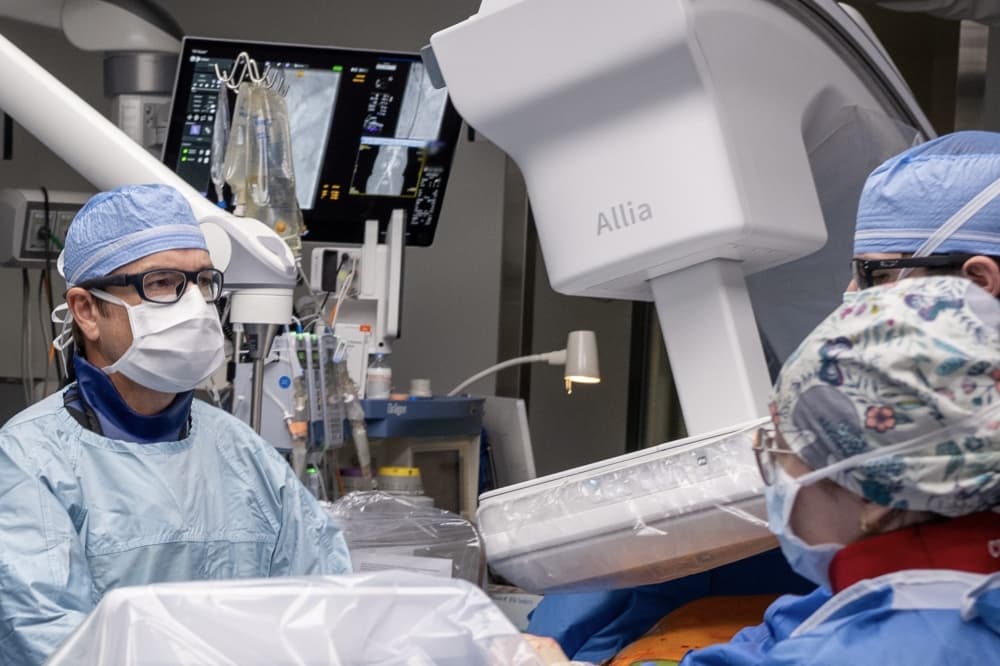
Artificial intelligence in health care may sound futuristic, but doctors at Baylor St. Luke’s Medical Center are already using it behind the scenes to help improve performance during minimally invasive surgeries.
How it works
GE Healthcare’s Allia Moveo acts as a high-tech imaging machine that doctors use during surgery, which helps them see blood vessels and other structures more clearly, according to a news release from GE Healthcare. The machine uses AI to help improve image quality by reducing visual distortions caused by things like breathing or blood flow.
Those improvements use AI, not as a replacement for doctors, but as practical technology to help them work more confidently and efficiently, said Kat Davis, vice president and general manager for GE Healthcare’s interventional solutions business.
“This is not ChatGPT for surgeons,” Davis said. “This is about allowing the physician to make the best possible clinical choices at the point of care.”
Dr. Gustavo Oderich is the chief of vascular and endovascular surgery at Baylor College of Medicine and the director of its aortic center. He said trying to do complex surgeries with regular imaging systems can be difficult because the imaging is not as clear, which could make the procedures go longer.
“Ultimately, it results in bad outcomes,” Oderich said. “At the end of the day, by having sophisticated systems like this one, we can do things at a very high level, performance and quality.”
Looking ahead
For GE Healthcare, Davis said they will continue to look at AI as an opportunity to make complex tasks simpler and more routine.
“Our approach is purpose-built, responsible, clinically relevant and designed to make the clinicians the most effective at the therapies they're delivering,” she said. “The AI is going to be built directly into clinical workflows. So, either for image reconstruction, motion correction, with a breathing automation, or guidance, really designed to help the clinicians work more confidently and efficiently.”
As for Baylor at St. Luke’s Medical Center, Scott Packard, a spokesperson at its parent company CommonSpirit, said AI is already being deployed in many ways, including:
- Using AI to spot strokes faster to help doctors save over 80 minutes in treatment time
- Monitoring patient data for early signs of critical conditions
- Using AI to better detect cancer, including improving breast cancer detection by nearly 30%
- Creating 3D models of patients’ hearts to determine treatment
“The tool and committee allow us to continuously monitor, evaluate and refine our AI deployments and address questions that every health care organization should be asking about their AI,” he said.
Also of note
AI still has governance that is ruled by a committee, Packard added. The committee regulates AI use to ensure there is always a clinician between AI and the patient, and that it never makes decisions without clinician approval.