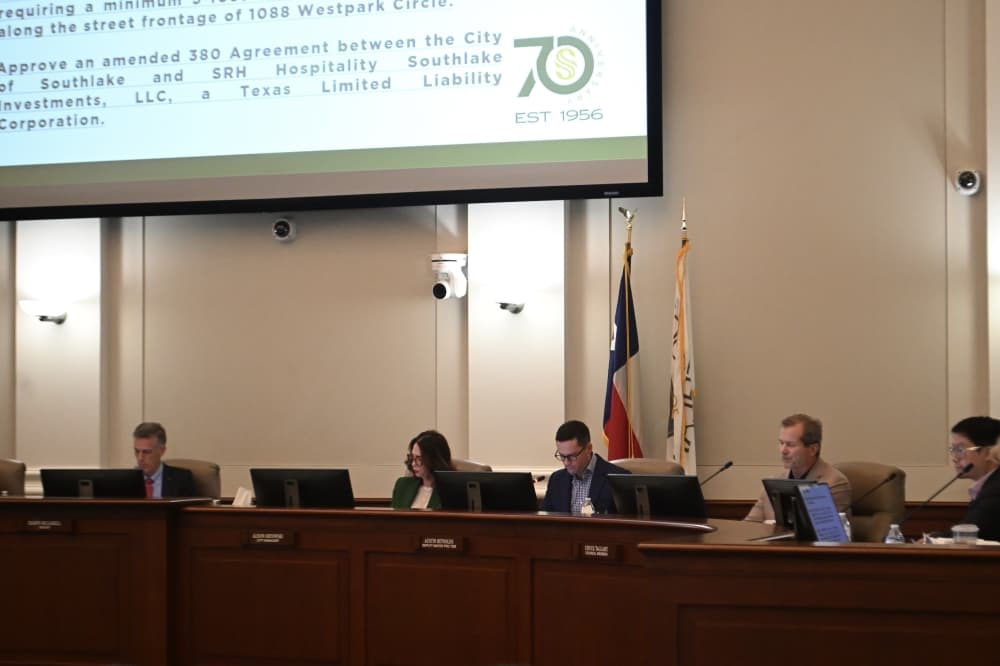
The city of Dallas approved the Dallas Fort Worth International Airport’s $1.63 billion operating budget during the Sept. 9 meeting.
Fort Worth City Council will vote on the budget at the Sept. 15 meeting, after getting briefed on the proposed budget at the Aug. 25 work session.
The details
Brian Butler, executive vice president/chief financial officer for DFW Airport, said his staff has been working on the 2026-27 fiscal year budget since April. The airport’s fiscal year runs from Oct. 1 to Sept. 30, 2027. The budget breakdown is $820.6 million for maintenance and operations, $801.8 million for debt service and $10 million for board contingency, Butler said.
He said the DFW Airport board approved the budget during its meeting on Aug. 6. The next step is for the owner cities, Dallas and Fort Worth, to approve the budget.
“You’re going to see a lot of growth; you’re going to see growth in passengers; you’re going to see growth in revenues and you’re also going to see growth in expenditures,” Butler said. “This was always planned and this budget fulfills our commitment to the airlines to better our financial plan.”
The $1.6 billion budget reflects a 13.2% increase, or $189 million, mainly due to a 67% increase in debt service. Operating expenses are up 8.6%, compared to the fiscal year 2025-26 budget, according to the presentation.
Notable increases were from:
Centralized receiving and distribution center
Terminals A and C maintenance transfer from American Airlines to DFW Airport
Employee-related costs
Fixed contract increases
Continued investment in technology
Butler said the airport will issue $2 billion in debt in January to finance the capital improvement program.
Zooming in
Butler mentioned the growth in passengers has been stagnant, but with the opening of the Terminal A pier and portions of Terminal F opening in the summer of 2027, that number could rise. Butler said that customers who use Terminal F will have to use the Skylink station in Terminal D to access ticketing and gates until the future phases are open.
DFW is planning for 87.7 million passengers, a 2.6% increase compared to the current fiscal year. Butler said American Airlines will add between 10 to 12 new gates.
The airline’s cost is $835.7 million, up 12.6%, due to the debt service increases from DFW Forward. The $12 billion project is addressing expansion of a new terminal, renovation of existing terminals and roadways.
The cost per enplanement for the upcoming fiscal year is $18.69 per passenger, up $1.83.
The non-airline revenues show a record $646.6 million, a 2.5% increase, according to the Fort Worth council presentation. Butler said that includes parking, ground transportation, food, beverages and retail.
He said DFW non-airline net revenues are projected to be $298.4 million. Of that, $145 million is for capital projects and $152 million will be redistributed to the airlines to help reduce landing fees and terminal rent.
Butler said tax revenue is shared between host cities Grapevine, Euless, Irving and Coppell and the owner cities, Dallas and Fort Worth. The host cities receive one-third of the taxes, while owner cities collect two-thirds. Butler said Fort Worth received $13 million in 2025, while Dallas’ portion was $17.8 million.
What else?
Kevin Haas, vice president of commercial development at DFW International Airport, discussed the Public Facility Improvement Corporation’s plan to purchase three buildings totaling 563,000 square feet of space and 770,000 square feet of cargo ramp space.
The buildings, currently owned by Prologis, are located at 1639 and 1640 W. 23rd St. and 2520 W. Airfield Drive. The purchase price is not to exceed $99.8 million. Part of the deal is also extending leases on Prologis’ other 10 buildings on airport property for a term that may exceed 40 years, Haas said.
Butler said that a study the airport did in 2024 shows the economic impact of the airport was $78 billion to North Texas, with $42 billion directly attributed to cargo.
Additionally, the airport would take over the existing leases at the three buildings, which include Lufthansa Cargo, Menzies Aviation, Cargolux, Korean Air Cargo, Nippon Cargo Airlines, Air General, WFS World Flight Services, China Airlines Cargo, EVA Airways Corp. and Integrated Airlines.
Haas said the rent from the buildings would be another revenue stream for the airport.
One more thing
The DFW Airport board voted to purchase the Hyatt Regency for $193.6 million at the Aug. 6 meeting, according to previous reporting.
The Dallas council passed it, but asked questions about the hotel purchase.
Paula C. Blackmon, District 9, asked if the income generated from the hotel is shared with the owner cities and Haas said the federal revenue diversion regulation means revenue generated by the airport remains as airport revenue.
“I’m hoping that maybe somebody’s creative enough to figure out how to monetize this for our city, because I know Fort Worth is probably needing it too,” Blackmon said. “We keep looking under every cushion and it’s no fault to you guys. It would be helpful to give something to mama and daddy along the way.”
Dallas District 14 Council Member Paul Ridley questioned why a hotel that is 50 years old costs nearly $200 million. Haas said it was a market value appraisal and the term of the remaining ground lease, which is 59 years, was factored in. Haas said the plan is to refurbish the hotel and bring it up to the DFW Airport standard.
Ridley suggested the Dallas city attorney look into the process of changing the terms of the agreement between the airport and the owner cities.