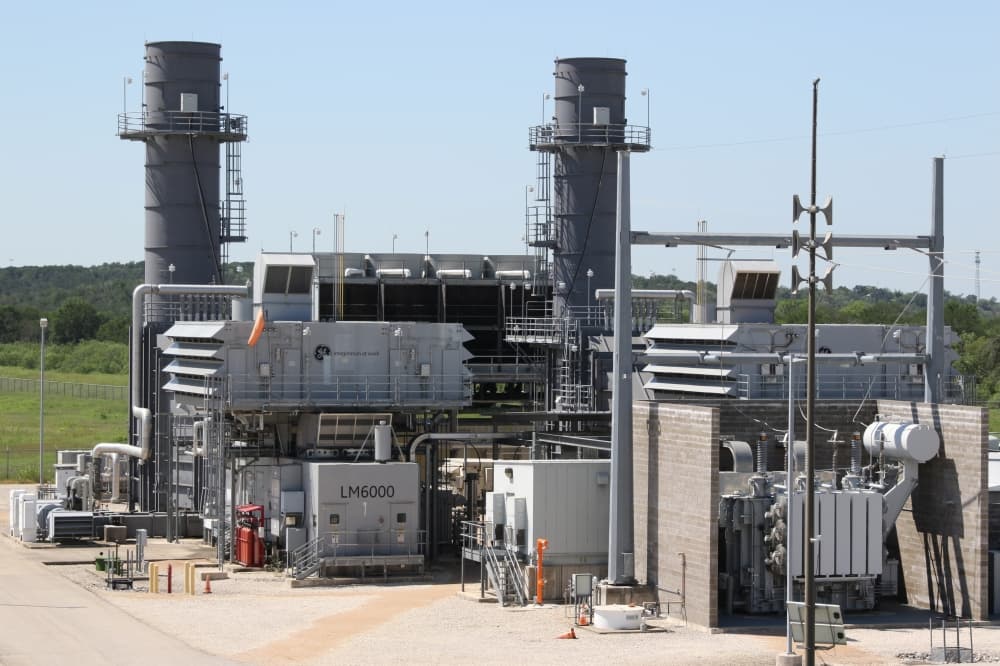
Austin Energy operates single cycle peaker units at the Sand Hill Energy Center. (Courtesy Austin Energy)
Austin Energy will add hundreds of megawatts of new power generation and storage capacity under contracts approved May 21, and pursue the more controversial implementation of natural gas "peaker" units intended to stabilize the local grid.
City officials previously advanced several renewable projects this spring like nearly 40 MW of solar installations on city property and an agreement for up to 40 MW battery storage capacity. That measure was finalized this month and follows a separate 100 MW storage deal. One megawatt can serve about 250 households, AE estimates.
City Council, which serves as AE's board of directors, authorized several more renewable and reliability measures in May including:
Implementing 400 MW of natural gas peaker units.
Agreements for 299 MW of wind power capacity in Mills and Dickens counties, totaling $340 million over a decade
A 100 MW battery storage agreement, worth up to $165 million over 20 years
AE General Manager Stuart Reilly said the additions come in response to the city's rapid growth, and long-range utility planning for rising energy demands and resilience measures.
“Council’s decision today means we will continue investing in renewable energy and battery storage while ensuring we can keep the lights on during extreme weather and periods of grid stress," he said in a statement.
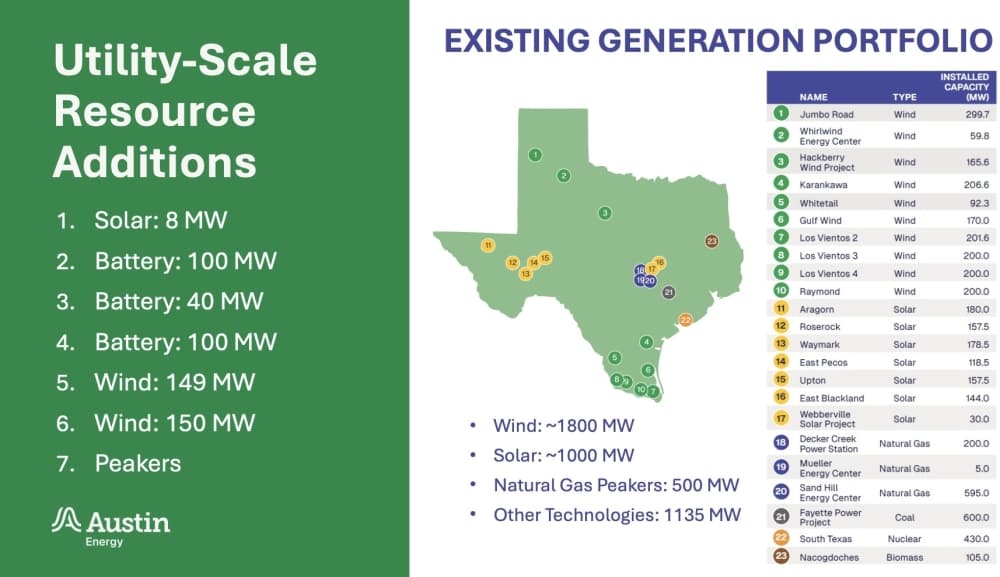
Austin Energy is adding hundreds of megawatts of power generation and storage capacity to its existing statewide resources. (Courtesy city of Austin)
Zooming in
The addition of new natural gas peakers to AE's system drew some scrutiny and opposition ahead of council's review, with concerns raised about transparency around the project as well as climate and air quality impacts. AE already operates peakers with hundreds of megawatts of capacity in far East Austin.
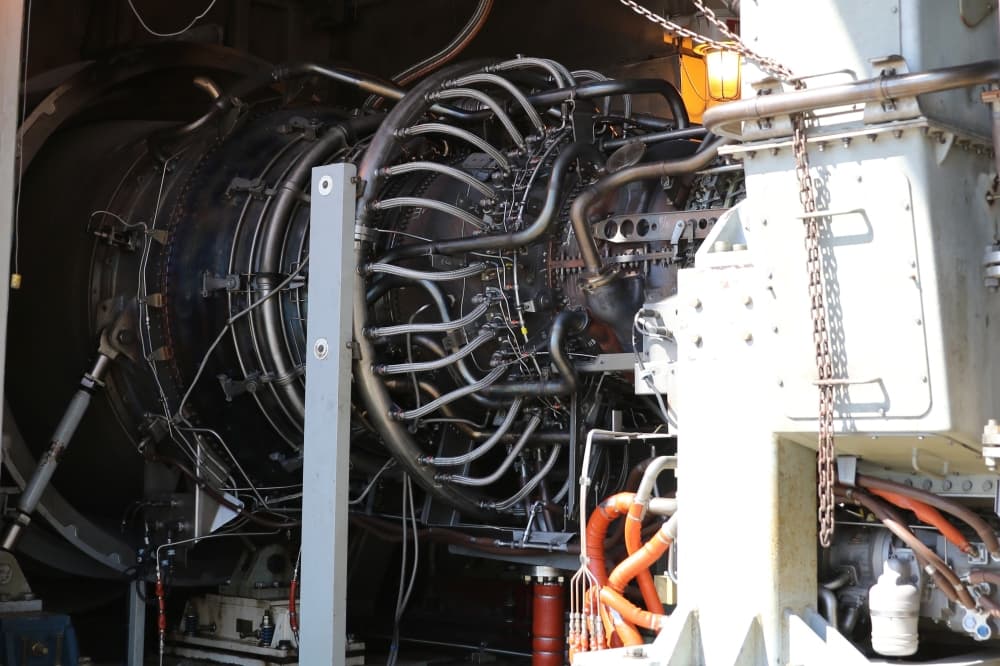
Peakers, likened to jet engines, are described by utility officials as an "insurance policy" in case of extreme weather and other heightened energy needs, including statewide grid blackouts. The units don't run constantly, and only come online to supplement power needs during periods of peak demand. New units could last at least 30-40 years.
AE officials say peakers are a necessary addition to the utility's energy portfolio in a complex power market that will help keep the lights on during its planned energy transition. Adding local generation would also better set up Austin to eventually phase out the aging east-side peakers, and reach the longtime goal of exiting a coal power project in Fayette County.
“The question is not whether we support a carbon-free future, we absolutely do. The question is how we will get there responsibly," Reilly told council.
Austin Energy operates single cycle peaker units at the Sand Hill Energy Center. (Courtesy Austin Energy)
AE Chief Operating Officer Lisa Martin noted the utility has yet to offset hundreds of megawatts of older capacity retired since 2021's Winter Storm Uri, which caused extensive outages and scores of deaths statewide. Meanwhile, population growth continues to impact local and statewide power grids while climate and extreme weather concerns remain.
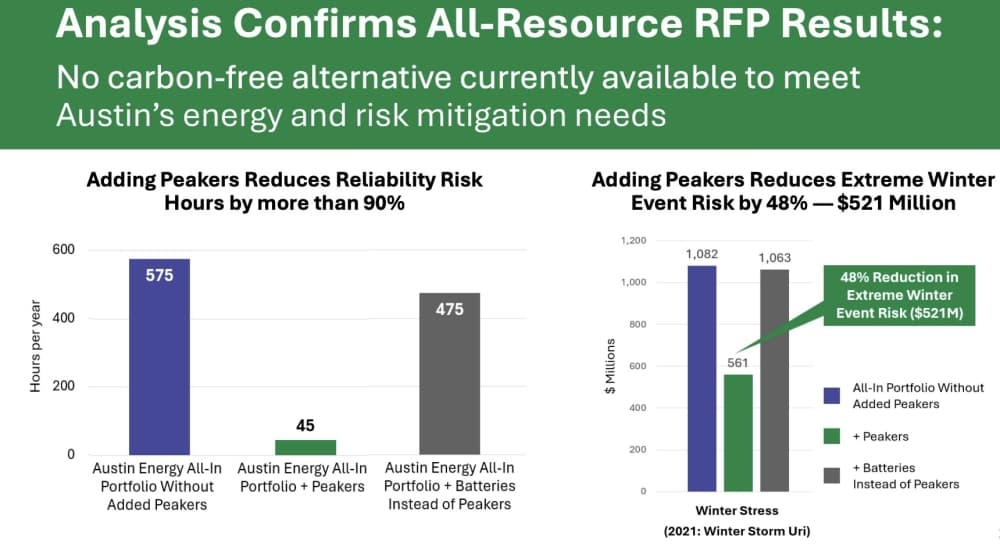
Even with new solar, wind and battery additions under the utility's 2035 goals, Martin said carbon-free alternatives to peakers aren't currently viable. The potential for power outages could be significantly higher if new peakers aren't installed, AE projections show.
“We need to be prepared for that heat wave event, that winter storm event. And not just insurance from a reliability purpose, but also so that we don’t wind up $150 million in the hole after a very bad week," said Mayor Pro Tem Chito Vela, who chairs council's AE oversight committee.
Austin Energy officials say the local power grid will be vulnerable to significant disruptions without new natural gas peaker units. (Courtesy city of Austin)
The approach
The peaker plans faced criticism this spring due to reliance on new fossil fuel facilities and environmental impacts, and limited public review so far.
Unlike other AE generation contracts like the wind and battery items also on council's May 21 agenda, the peaker initiative's cost, vendor and other details weren't publicly identified. Officials also didn't detail what action was taken; Mayor Kirk Watson only said council members considered real estate and utility competitive matters in a private executive session before approving a resolution.
Several residents raised concern with the approach that included final council deliberations behind closed doors. Officials defended the process and potential project costs as the utility's best path forward in a competitive market.
AE typically solicits public proposals for other power generation resources, but peakers are now in such high demand that manufacturers don't respond to such requests. Instead, Reilly said AE must bring itself to the table for negotiations that can't be disclosed due to issues like private pricing information.
Watson likened council's utility governance—as allowed under state law—to that of a private entity, which he noted "may not be consistent" with typical city procurement.
“We are in a highly competitive market. ... We will not be able to get the best price if, in this set of circumstances, we don’t act like an electric utility," he said. "We have to act like we are the board of directors of an electric utility, and that means we want to get the best prices."
Despite new peaker costs now at all-time highs, Martin said utility modeling shows they're a cost-effective option for AE ratepayers and will "essentially pay for themselves" in the long run—especially if they're used during a major disruption.
Some residents also worried that new nitrogen oxide-emitting peakers will be located near existing natural gas facilities in East Austin, adding to its history of disparate environmental and land-use outcomes.
AE says its current units account for less than 1% of those emissions across the Austin area, and that new units include technology to limit emissions and wouldn't significantly add to that share. The utility's 2035 plan has emissions guardrails that would apply to the peakers, which Reilly said would improve from the older and "dirtier" facilities.
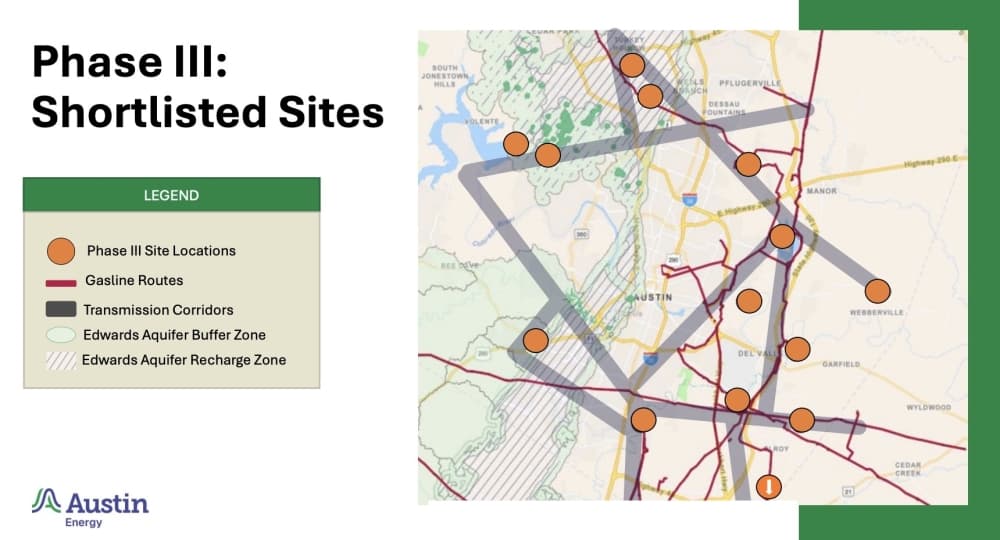
It also remains to be seen if new peakers will end up on the east side. The utility is aware of community concerns about the historic pressures on those communities, Reilly said, and the power system could benefit from placing new units to other parts of town. Locations across Austin are being considered.
Austin Energy has a shortlist of potential locations to install new natural gas peaker units. (Courtesy city of Austin)
Council member Ryan Alter urged officials to consider whether they'd want peakers in their own neighborhoods before voting for the project. Watson disagreed, saying negative grid impacts like power outages affect residents citywide.
"This is not a question about your district, this is a question about the future of Austin Energy," he said.
Community outreach about the plans, site selection process and resident concerns was conducted by AE before the spring vote. Engagement will continue as the project moves forward, officials said.