In an effort to meet affordable housing demand and alleviate cost burdens, Denton City Council changed the city's requirements to support housing developments with the intent to bring deeper rent reductions.
In November, city leaders updated a policy to incentivize developers to build affordable housing projects within the city. Officials said this will help current residents save money and improve quality of life, with an ideal of adding 8,700 affordable housing units within four years.
What’s happening
Denton city leaders adopted new affordability criteria for Denton City Council to approve federally funded tax credits at a Nov. 18 work session. The new requirements introduced a rubric that emphasizes units for 50% and 30% annual median income earners to help eligible residents pay for affordable housing.
In Denton, the median rent for one-bedroom and two-bedroom multifamily units has risen over time, with two-bedroom rent rising from a median rate of $941 in 2015 to $1,598 in 2024, according to U.S. Census Bureau data.
Denton Community Services Director Jesse Kent said federal and state agencies determine the area median income and the affordable rent in Denton, but use the entire Dallas-Fort Worth region to calculate the area median income and what rates are affordable.
The region includes higher-income areas, which skews the rate to higher rent pricing than what is affordable for Denton, Kent said.
Affordable housing is defined as housing priced for renters to pay less than 30% of their monthly income on rent and uses area median income to determine those rent numbers, Kent’s report states.
Residents who spend more than 30% of their income on housing are considered cost burdened, and residents who spend more than 50% are considered severely cost burdened, according to Kent’s report.
Area median income, or AMI, is determined annually by the U.S. Department of Housing and Urban Development and used to measure local housing affordability.
Denton officials consider affordable rent to be priced for 50% and well below DFW’s area median income.
The U.S. Department of Housing and Urban Development calculates AMI with data from the U.S. Census Bureau, Kent said. Housing and Urban Development officials examine the incomes for families of four and find the median income, where half of the families earn a higher income and the other half earn less than the median.
Housing and Urban Development then scales that income to family size to determine the AMI for households of different sizes, Kent said.
As of 2025, Housing and Urban Development data shows the Dallas region’s AMI for a family of four is $117,300 annually, while Denton’s AMI is $80,900, according to city data. When the state and federal agencies set affordable housing prices in Denton, it’s based on what’s affordable for the Dallas area’s median income, not Denton’s.
“The [Dallas] area median income is significantly higher than Denton’s median income,” Kent said. “When the state [and] federal governments are defining affordability in our community, they’re using that much higher income to do it. That doesn’t translate well to the city of Denton.”
Why it matters
Data shows that workers in seven of Denton’s 10 most-common jobs don’t earn enough to afford the median rate for a one-bedroom apartment in the city.
These jobs include cashiers, customer service representatives, food service workers, retail salespeople, restaurant servers, office clerks and material movers.
Kent said when renters are cost burdened or severely cost burdened and spend more than half of their monthly income on housing, it makes it difficult to put money away for other basic necessities.
“If half of every paycheck is going to your apartment, it’s hard to save money. It’s hard to pay for health care costs, to take your kids on vacation, to do those things that enrich the lives of you and your family, to seek higher education and increase your income,” Kent said.
By the numbers
Out of Denton’s roughly 34,000 multifamily units, 624 are priced and reserved for renters earning 50% AMI or less, which the city classifies as affordable for Denton.
Median market rate rent in Denton is $1,598 for a two-bedroom apartment, and $1,308 for a one-bedroom unit.
To afford a market rate one-bedroom apartment in Denton without being cost burdened, a renter would need to earn about $4,360 a month.
The impact
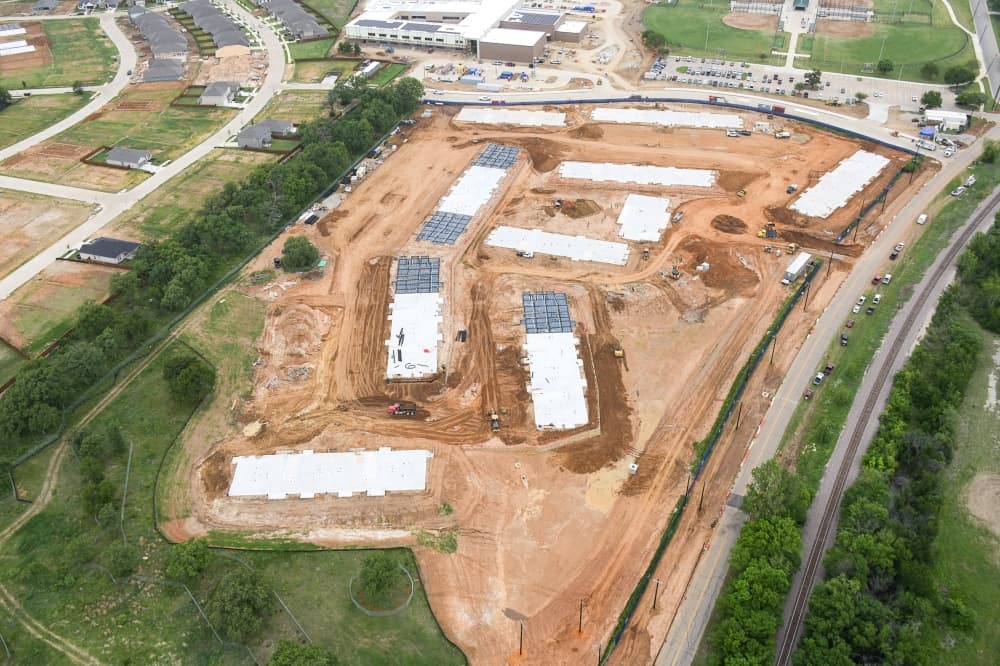
Arbor Ranch, a 297-unit apartment complex on Roselawn Drive near Denia Park, broke ground March 19 and will offer 45 units at 50% of the area’s median income or lower, according to city documents.
Council approved a tax credit, paid by the federal government, to developer The NRP Group to cover 30% of Arbor Ranch’s construction costs in February 2025. Nick Walsh, The NRP Group’s vice president of development, said the complex would not exist without the federal tax credits.
“Without these incentives, those monthly savings wouldn’t exist for Denton families,” Walsh said. “These 297 units would likely never be built.”
City data shows there are 35 housing developments with units priced for 50% area median income earners and under.
Zooming in
Kent said developers can apply for low-income housing tax credits to help cover construction costs in exchange for lower rent rates. The credits come from the federal government, and the Texas Department of Housing and Community Affairs administers the program. The tax credits can cover up to 70% of the construction costs, Kent said.
To receive the tax credits, City Council must approve the developer’s tax credit application. City staff uses a scoring rubric as part of the application that scores more points if the developers reserve more units for 30% and 50% AMI earners.
The application also requires the developer to host a meeting with residents who live near the new housing development.
By lowering construction costs, the developer can pass the savings on to renters through lower rates. The federal government mandates the developer keep affordable rates for a set period.
“The IRS says you have to maintain the affordability for 30 years [for the program],” Kent said.
Looking ahead
Currently, 2,205 income restricted multifamily units are under construction in Denton, including 80% AMI. Of those units, about 200 are priced at 50% or less than the area median income, which is considered affordable for Denton, Kent said.
Of the 8,700 anticipated affordable units needed based on projections from Kent, about 6,700 units will need to serve renters earning 30% AMI, and the remaining 2,000 units will need to supply 50% AMI earners.
Another initiative is McAdams Haven, a complex developed by the Denton Affordable Housing Corp. that is currently in the city’s planning and zoning process. McAdams Haven will provide housing for residents who have disabilities and have been unhoused for more than a year, said Carrie Baugus, the corporation’s CEO.
McAdams Haven is expected to break ground late this summer and open by the end of 2027.
A news release from The NRP Group said Arbor Ranch will open to renters in early 2027. Initial rent will range from $565-$2,200 monthly.
“We’re trying to make it to where people are not spending a significant portion of their income every month and paying for the cost of housing,” Kent said. “We want them to be able to spend money in ways that help them, their families and improve the quality of their life.”