


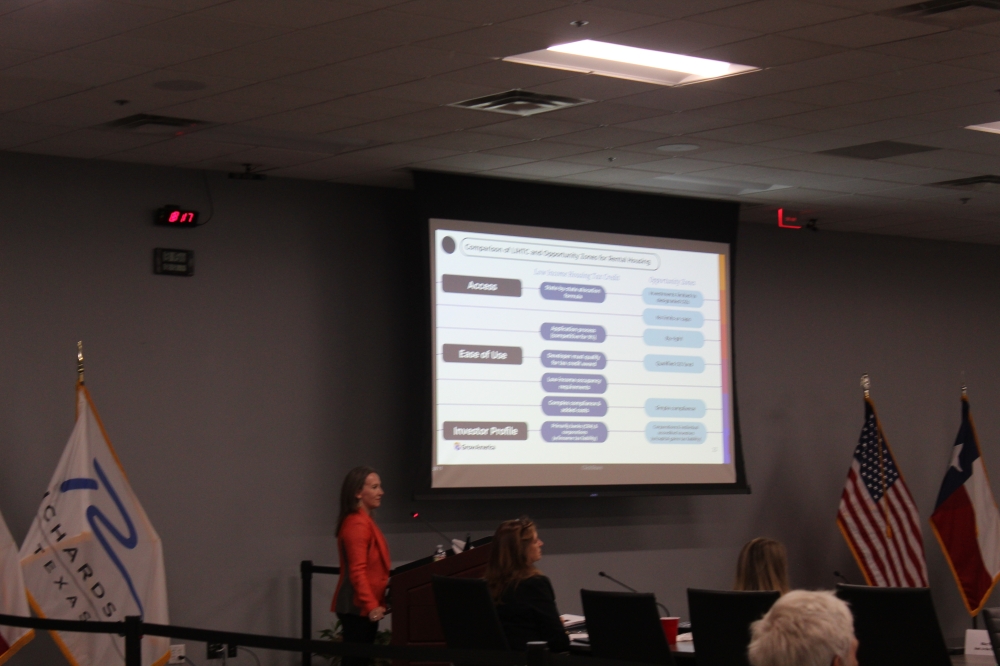
Grow America field director Maureen Milligan presented several housing initiatives to City Council on Jan. 12, including strategies to access federal funding, encourage affordable development and introduce a home repair program.
The big picture
The city commissioned a housing needs assessment and strategy from Grow America last year to guide Richardson’s future programs. This was Milligan’s second council briefing after an Oct. 27 report where council discussed the city’s housing priorities.
Based on those goals, Milligan identified three priority housing needs:
- Enable older, low-income homeowners to safely age in place
- More reasonably priced for-sale housing units to accommodate families with children
- More well-maintained rental housing units that are affordable for lower-wage workers
On top of that, the supply of lower-priced homes in Richardson is shrinking, and an increasing number of residents are housing cost-burdened, which means they spend over 30% of their gross income on housing costs.
Breaking it down
Fewer young professionals and middle-aged adults are purchasing homes due to low availability and high prices, the assessment found, so Milligan recommended strategies to develop more reasonably priced “missing middle” housing.
Also a key part of the Envision Richardson plan, missing middle housing includes units like townhomes or duplexes that bridge the gap between large apartment complexes and single-family homes.
The zoning in most areas in Richardson does not currently support these housing types. City staff is already preparing to review the comprehensive zoning ordinance and development standards, Milligan said, in order to propose changes that would allow more missing middle housing development.
“By completely revamping the comprehensive zoning ordinance and making it a more modern, contemporary document, we can address many of the action items that [Envision Richardson] had forecast for us,” City Manager Don Magner said. “Most importantly, we’ll make it easier for developers and businesses to do business in the city.”
Richardson can also proactively rezone areas, create preapproved plans for specific housing types and sponsor pilot projects to encourage more missing middle development, Milligan said.
Another approach
Rising housing costs have impacted both homeowners and renters, but renters have felt the increase to a greater degree, the housing assessment found. According to the report, Richardson has an “acute undersupply” of affordable rental housing units.
To address this, Milligan recommended that the city advocate for the Texas governor to designate some of Richardson’s five eligible census tracts as opportunity zones, which are identified by meeting median family income and poverty rate criteria. The program facilitates tax incentives for investors to spur economic development, including the development of affordable apartment complexes.
“The whole purpose of this program is to increase the flow of capital into communities that were seen as too risky due to lower incomes,” Milligan said.
Magner said the city plans to submit its application for opportunity zones within the next month.
Milligan also suggested that the city create nonprofit entities—a housing finance corporation and a public facility corporation—to partner with developers and facilitate affordable housing projects.
Also of note
Nearly 5,000 homes in Richardson were built prior to 1980 and are currently owned by a resident 65 years or older, the assessment found. Many of these homeowners may be unable to maintain their home due to age-related health issues or financial restraints, according to the report.
Milligan said the city could develop a home repair program to provide assistance to low-income seniors, funded by the federal Community Development Block Grant. Richardson would receive a little under $700,000 a year from the grant if the city pursued this initiative.
“Adminstrations change and their policies change, and we’ve seen a lot of cities that have taken federal dollars that are now taking hits because they are no longer getting those federal dollars,” council member Jennifer Justice said. “I would really like us to understand the implication of taking those dollars.”
Magner said the Community Development Block Grant has been less volatile than other federal grant programs, but the city could focus the funding on shorter-term projects to protect against consequences from loss of funding.
“We’re the only entitled city in the state of Texas that doesn't accept a dollar, so my thinking is, if Frisco can do it ... then Richardson can do it,” Magner said.
Looking ahead
After City Council’s approval for staff to move forward with the recommendations, Magner said the city will focus on securing opportunity zone designations and reviewing the city’s comprehensive zoning ordinance. City Council will receive further briefings on each of the recommended initiatives throughout 2026, Milligan said, in order to create more specific plans.