Texas' rising home insurance costs have been caused by severe weather, high inflationary costs impacting home repairs and "the concentration of risk" in the insurance market. (Zach Thoms/Community Impact)
The average annual insurance premium for a Texas homeowner rose 79% in six years, from less than $2,000 in 2020 to more than $3,500 this year, Texas Insurance Commissioner Amanda Crawford told state lawmakers Oct. 5.
"We need to acknowledge that the past few years have been very, very difficult for Texans," she said.
The rise in home insurance costs has been caused by severe weather, high inflationary costs impacting home repairs and "the concentration of risk" in the insurance market, Crawford told the House Insurance Committee. Hardening homes against severe weather could help reduce expensive losses from disasters, resulting in lower insurance premiums, experts said during the Oct. 5 hearing.
"Weather and building costs drive claims, claims drive losses, and losses drive rates," said Chelsea Stallings, a regional vice president for the National Association of Mutual Insurance Companies. "If you want premiums to come down, losses have to come down first. In Texas, a lot of those losses come down to roofs, which make up 70%-90% of residential catastrophe losses."
What's happening
Since 2020, average coverage amounts for Texas homes have grown by 51% due to rising home values, Crawford said. The cost of insurance claims has also gone up, with annual losses for homeowners averaging at $5.5 billion from 2015-20 and rising to $9.1 billion from 2021-25.
Texans also paid the nation's fourth-highest home insurance premiums last year, data shows: The average Texas homeowners' premium was $3,506 in 2025, nearly doubling from $1,791 in 2016.
"The cost of insurance is becoming a significant barrier to homeownership," said Trey Summers, chief operating officer for the Corpus Christi homebuilder Hogan Homes. "Insurance doesn't just make it more expensive after you buy it, but it determines whether you can afford to buy the house today. ... It's a cost-of-living issue and it touches the home at every stage: During construction, at closing and every day that that family owns the home."
Last year, homeowners were paid $5.8 billion for losses due to wind and hail damage, per TDI data.
During the Oct. 5 hearing, lawmakers and invited witnesses discussed FORTIFIED, a program that includes standards designed to protect homes against severe weather with certain roofing and construction techniques. Gov. Greg Abbott has said he wants the Texas Department of Insurance to require insurers to consider a homeowner’s participation in roof fortification programs when setting rates, while the TDI asked lawmakers to consider creating a grant program to help Texans weather-proof their homes and participate in programs like FORTIFIED.
Proponents of home-hardening incentives have pointed to their success in other Gulf Coast states like Alabama, which offers grants and premium discounts to homeowners who meet certain fortification requirements. Texas consumer advocacy groups and the insurance industry backed proposals to create a similar grant program during the 2025 legislative session, according to previous Community Impact reporting, but those measures did not pass.
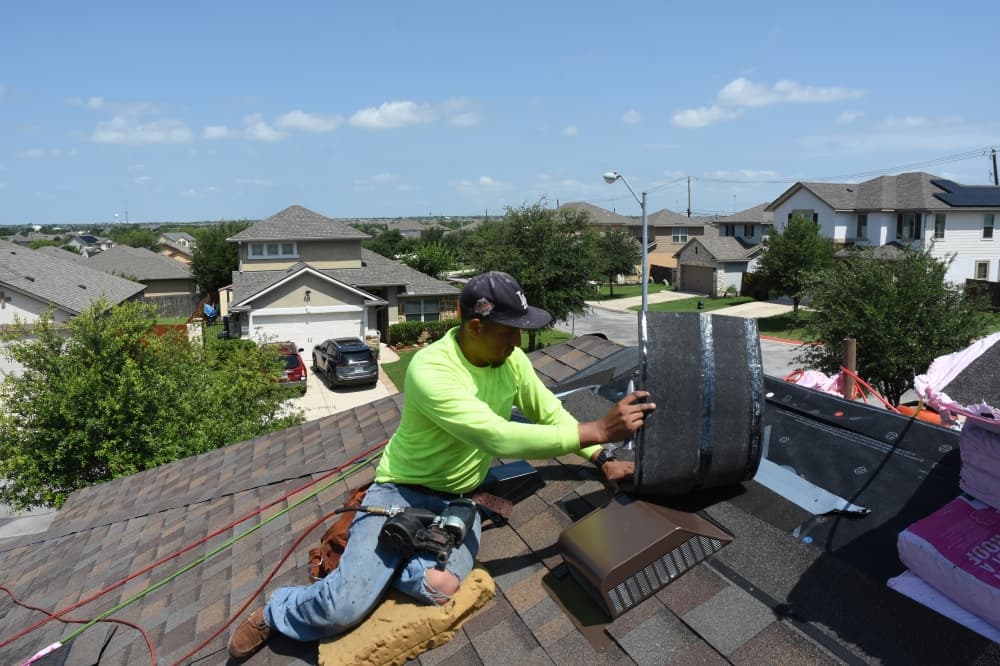
A roofer with Regenesis Roofing and Restoration works on a home in Travis County.Community Impact staff
Zooming in
Stallings, who spoke in favor of home fortification programs, cited estimates from the Insurance Institute for Business and Home Safety that "one inch of rain can send nine bathtubs of water into a home through a damaged roof."
Stallings said a "high-wind fortified roof" would cost the average Texas household about 15% more than a standard roof. In Austin, it typically costs about $12,000-$15,000 to replace an existing roof, according to Austin Roofing Company.
Insurance experts said that lawmakers could also consider exempting certain roofing materials from state sales taxes and creating catastrophe savings accounts, which are used in some states to help homeowners cover out-of-pocket costs from a disaster.
"Resilience helps homeowners long before it shows up in an insurance bill because a stronger home holds up better when the storm comes," Stallings told lawmakers. "It is the most direct way to bring down [the cost of risk] in Texas."
More details
Crawford told the committee that the department is working to make Texas' insurance market "as transparent as possible" and foster competition among insurance providers.
Under Texas' "file-and-use" system, insurers can set their own effective dates for rates newly filed with the TDI, allowing companies to begin using those rates immediately, regardless of whether the state has reviewed them.
Crawford estimated Oct. 5 that about one-third of insurance rates in Texas take effect immediately. Three weeks earlier, in a letter detailing the agency's actions and legislative recommendations to reduce home insurance costs, Crawford suggested that the legislature consider "adding a delay between a rate filing and its use in the market."
Delaying the implementation of new rates would give the TDI more time to review the changes, she wrote. That recommendation was not discussed during the Oct. 5 hearing, although lawmakers may consider it during next year's legislative session, which begins in mid-January.