Editor's note: This article was edited to reflect the different modalities available for the training course.
Any adult who spends time around kids, like teachers, bus drivers, coaches, cafeteria workers and parents, can now get free training to recognize when a young person is struggling and start a conversation that helps.
Travis County mental health authority Integral Care has trained 394 people in Youth Mental Health First Aid training so far this fiscal year. Certification takes a single session and meets Texas school staff requirements under House Bill 3.
Why now
The training comes as students head back to school and as demand for youth mental health support keeps climbing, according to Integral Care CEO Jeff Richardson.
Richardson said the share of kids describing their own mental health as poor has continued to rise since the pandemic, and that the adults best positioned to catch an early warning sign are usually not mental health professionals; they're the family members, school staff and community members a child already sees every day.
The course is also one of the trainings the state recognizes for meeting House Bill 3, the 2023 law requiring Texas schools to train staff in mental health, according to the Texas Education Agency. That mandate phases in over several years, with districts required to have 50% of applicable staff trained by the start of the 2026-27 school year, per the agency.
Who it’s for
The training is built on the idea that the adult best positioned to help a struggling child often isn't a professional, it's whoever that child already trusts, said Emily Hammer, mental health liaison and trainer for Integral Care.
She calls it a "gatekeeper training," designed for anyone who is child- or student-facing. That means teachers and administrators, but also cafeteria workers, custodians, bus drivers and parents. The shy student who sits behind the same bus driver every day may not open up to another adult, she said, but a trained driver can notice a change and ask what's going on.
Both she and Richardson strongly recommend parents take the course too, with Richardson adding that Integral Care regularly hears from families who wish they'd had the tools sooner.
How it works
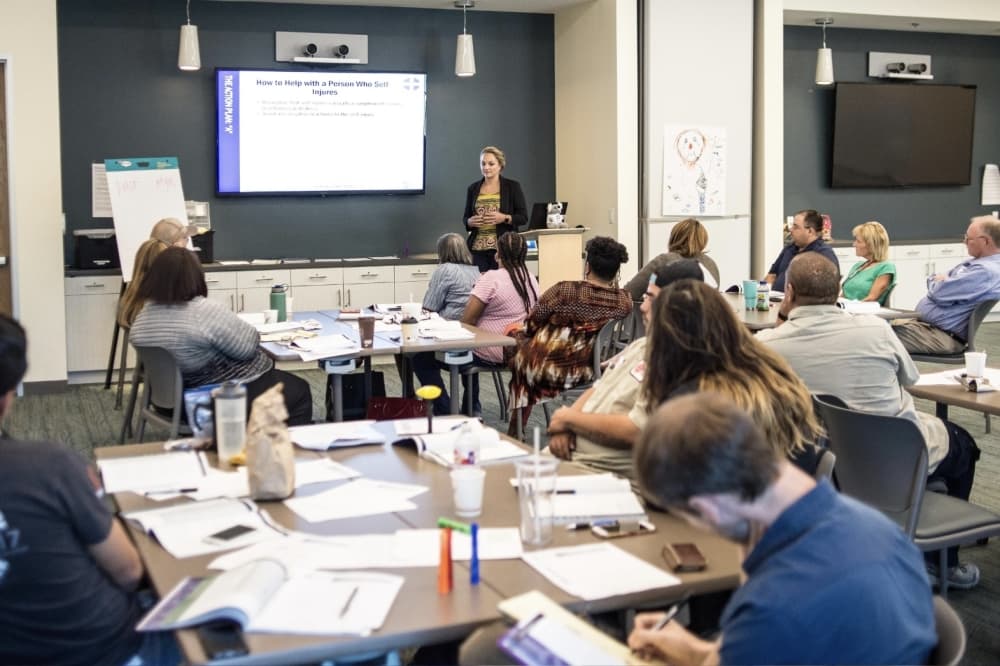
The course runs about four and a half hours in a single session, and participants leave certified, Hammer said, adding that it caps at 30 people so the group stays small enough for people to speak openly. Participation is not optional, and cameras must stay on for virtual sessions, she said. It is offered in multiple formats, including a blended version with self-paced pre-work and a full day option with no pre-work, as well as options for both virtual or in person.
The curriculum, developed by the National Council for Mental Wellbeing centers on a five-step action plan known as ALGEE, Hammer said: assess risk, listen non-judgmentally, give reassurance and information, encourage appropriate professional help, and encourage self-help.
Before the session, participants complete self-paced coursework on different mental health challenges, how common they are, and risk and protective factors, Hammer said. The session itself walks through video scenarios and role-plays, including sections on suicide and on substance use, where trainers offer warnings and space to step away, she said.
Because the training is state-recognized, a single session satisfies an educator's HB 3 training requirement, and the certificate counts even years later.
Certification is good for three years, with a shorter refresher available after that, per the national council.
Who's providing it
Integral Care is Travis County's local mental health authority and has offered Mental Health First Aid since 2010, according to its website.
As of a March 2026 announcement from the Community Advancement Network, which recognized the organization's training team, Integral Care had trained more than 19,000 Central Texans, including 4,800 in the youth course.
The nonprofit told Community Impact on July 30 that of the 394 people it trained in the free youth course this fiscal year, 58 are teachers, and 129 are other school staff such as administrators, mental health professionals and support staff.
A few other organizations in the area also deliver the nationally standardized course, Richardson said, but few at Integral Care's scale.
What's next
Adult Mental Health First Aid moved to a fee-based model Jan. 1, 2026, though it stays free for K-12 and higher-education employees, veterans and military members, and attorneys, judges and first responders, according to the organization’s registration page.
Youth Mental Health First Aid will remain free to everyone as long as funding allows, Richardson said, pointing to a broader squeeze on mental health dollars at the federal and state levels.
The current county contract expires Sept. 30, but whether the youth training stays free beyond that depends on renewed funding—and Integral Care has kept it free before even without a dedicated source, according to Richardson; that contract, a third modification approved by Travis County commissioners July 21, brought total funding to about $222,000 in federal pandemic recovery dollars.
Any renewal of county funding would go before Travis County Commissioners Court, and Integral Care said it is also working with the state on additional support. Richardson said the Raising Travis County initiative could potentially help fund the training as well, though no such arrangement has been announced.
Community resources
Integral Care offers the free Youth Mental Health First Aid course several times over the coming months, with upcoming virtual sessions scheduled for Aug. 19, Sept. 9, Oct. 16 and Nov. 12, each running from 8 a.m. to 12:30 p.m.
Community members can register for the training through Integral Care's Eventbrite page, where registration links are typically posted one to two months ahead.
For families looking to start more conversations around mental health, Hammer recommended "Ask, Listen, Talk" conversation cards, available in English and Spanish at asklistentalk.org.
For anyone in crisis or seeking support, Integral Care operates a 24/7 mental health helpline at 512-472-HELP (4357).