Austin leaders are pursuing restrictions on future data center development across the city. (Ben Thompson/Community Impact)
Local leaders are aiming to limit the spread of data centers with new standards for the development of smaller facilities in Austin, and a complete ban on larger and more resource-intensive projects.
The big picture
City officials are gearing up for a review of data center development policy that could conclude by next spring. The process is the result of a recent council request intended to balance Austin's economic strategy with community values and well-being.
As of today, the city can't directly track and govern data center development. Austin Energy and Austin Water may identify high-volume users and the public utilities report some data centers are operating in Austin, but no specific policies for the projects are on the books.
City Council appears ready to unanimously pass a resolution on Aug. 27 that would kick off changes to city development standards to define data centers and control their growth. The changes could limit where data centers are allowed, restrict their size and placement, and mandate some design elements. Data centers could also be required to submit water and power usage plans to the city before they're built.
“The idea was that we would propose a framework for preventing and regulating data centers in Austin, utilizing all of the available tools that we have as a municipality to protect our residents and our natural resources," Mayor Kirk Watson said Aug. 25. "We all want to make sure we end up with a framework that creates legal, durable and enforceable rules that protect quality of life issues."
Zooming in
The presence of data centers in Austin is not new, and some city officials said they have no issue with smaller "edge" or enterprise facilities with relatively low power use that can be used by financial centers, hospitals and universities. However, they said the city and residents should be more aware of those projects and involved in their planning.
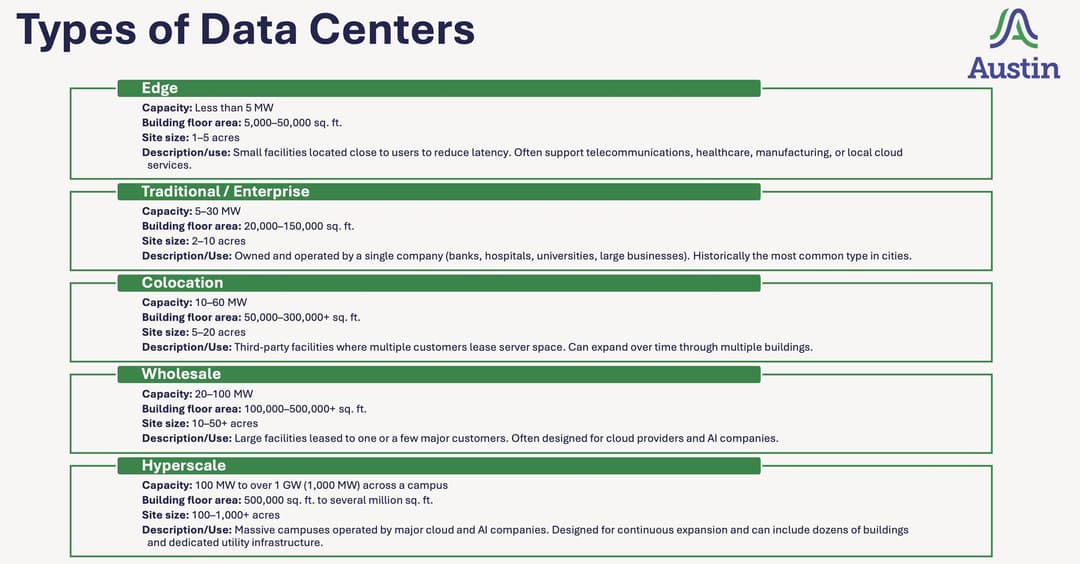
City departments identified several categories of data centers that could be subject to new regulations in the coming months. (Courtesy city of Austin)
At issue are the wholesale and hyperscale facilities, or larger data centers that can span hundreds of acres and use tens or hundreds of megawatts of power to operate. A majority of Austin council members expressed complete opposition to those projects ahead of their August vote.
“We cannot and we will not support the presence of hyperscale data centers within the city," council member José Velásquez said. "Major data centers bring too many unknown and undefined environmental and social impacts, and my concern is that this would again inequitably affect low-income and historically underserved communities that have faced the realities of environmental injustice for far too long in Austin, Texas.”
There are at least 10 identified data centers around the city today, utilities reported, which use at or below 20 MW of power and are mostly clustered in Southeast Austin. Council member Vanessa Fuentes, who represents that area, said she has yet to receive any constituent complaints about the facilities but that Austin must find a way to balance future growth and avoid negative outcomes.
"In Virginia, data center development increased utility bills by up to 290%—that is a three-fold increase—and in Wyoming just a month ago, a rushed data center construction contaminated the community’s water supply," she said. "This isn’t sustainable, and we won’t wait for a crisis to happen here, which is why today we are pursuing a full ban on large-scale data centers in Austin."The framework
Approval of the data centers resolution this month will launch amendments to the city's land development code. Through that public process, code amendments will be proposed by staff then sent to several land-use commissions for further review before City Council finalizes any regulations next year.
Amendments could restrict data centers to certain types of property, require a public permitting process for any individual projects to advance, or block them completely. Various site development standards like screening, sound and light mitigation would also be included, and city staff recommended setting performance standards to address data centers' noise, heat, energy and water usage, and related civic enforcement.
Staff also suggested that Austin shouldn't hand out any economic incentives for data center projects, a practice that's been frequently used across Texas.
Watson said he wants to ensure the new rules don't contain loopholes or allow "bad actors" to skirt public oversight, although potential penalties are still to be determined.
“None of us want to have anybody try to play the system in a way where we’re not able to protect our citizens," he said.
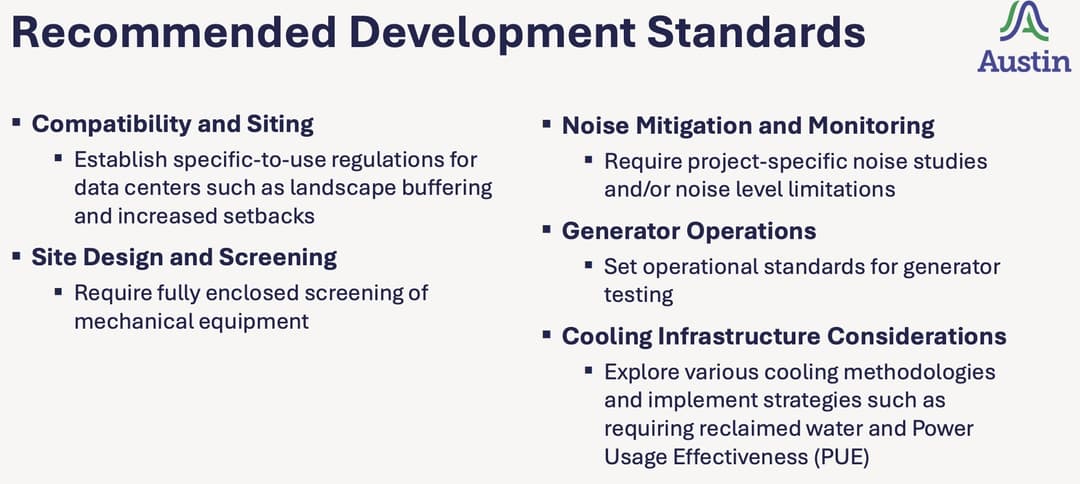
Austin could enact development standards for all new data center projects. (Courtesy city of Austin)
Data center development will also be frozen while that months-long initiative plays out. City departments won't process any project applications that could lead to the creation of a data center within city limits, the city's extraterritorial jurisdiction, or utility service areas.
Austin's approach comes as state leaders also move for more scrutiny of data center projects, which Austin Energy General Manager Stuart Reilly said have trended larger and larger over time. Local rules could go into place next year as the Texas Legislature considers new statewide data center policies.
What they're saying
With most or all of City Council onboard with the new framework, several officials held a press conference after their Aug. 25 discussion to lay out their views. Council member Mike Siegel said the city must act as state and federal leaders haven't yet tackled the "fundamental injustice" of large-scale data centers' rapid expansion.
"When we are jacking up electric rates and water rates, when we are driving up land prices to purchase these facilities, when we are negatively impacting peoples’ quality of life with noise and vibrations and light and other negative impacts, who are we doing this for? Fundamentally, this is to benefit the billionaires, the very few. It’s not to benefit humans, it’s not to benefit our environment," he said.
Council member Zo Qadri agreed, calling the projects' growth "alarming" and saying the city must protect its residents and resources. And council member Ryan Alter said Austin's rules should be updated to match modern issues, and that he'd favor a ban on the largest facilities in town.
"I have heard from resident after resident who’ve said, ‘We don’t want them to come here and make our electricity more expensive. We don’t want them to come here and suck us dry when we’re already in drought. We don’t want them here in Austin.’ And so that’s what we’re doing: We are taking action to make sure that our community is protected from the exploitation of these large data centers," he said.
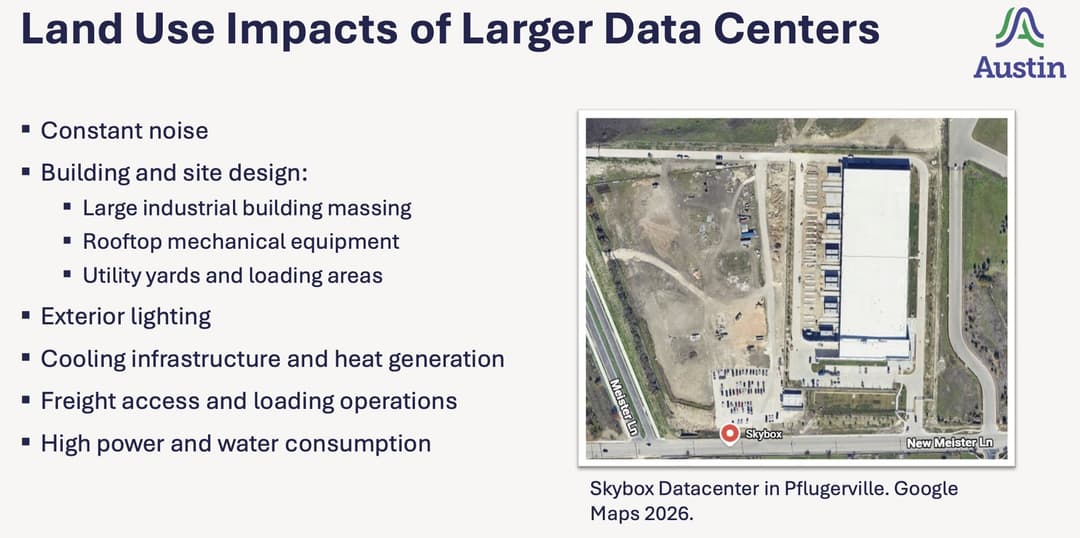
Austin officials have raised concerns about data center impacts. (Courtesy city of Austin)
Fuentes and council member Krista Laine both said new regulations should conserve land and resources, in Austin and neighboring jurisdictions.
"The consequences don’t just start and end within our city limits; our water supply doesn’t just belong to Austin, our power grid doesn’t exist in isolation," Fuentes said. "A data center anywhere in the region will still strain the very resources and the utility rates that we fight to protect. That is why we must also coordinate with our neighboring counties and ensure that we’re not just pushing the problem next door.”