A recent city audit found some deficient results in Austin's nonprofit contracting. (Ben Thompson/Community Impact)
Nonprofits contracted by the city often failed to provide agreed upon services or results, while Austin generally paid their expenses in full regardless of whether performance targets were met, a new internal audit found.
Austin officials stressed those findings may not apply to all local organizations contracted for family and social services, on which the city spent roughly $100 million annually, and instead reflect faults with government oversight. City management agreed to process reforms that are now in the works.
“This is first and foremost about the people we’re trying to serve, but it is really an indictment of our ability to manage that service, not to paint a broad brush and say every one of our partners is doing a bad job," council member Ryan Alter said.
The review of nonprofit spending stemmed from a previous auditing request from Alter and Mayor Kirk Watson, and followed an initial report released last summer.
The new audit covered 24 randomly selected contracts within Austin's social services portfolio across several departments, plus two auditors said were specifically chosen due to "risks we became aware of during the audit." The nonprofits, which weren't identified in the report, had contracts totaling about $30 million during Austin's fiscal year 2024-25.
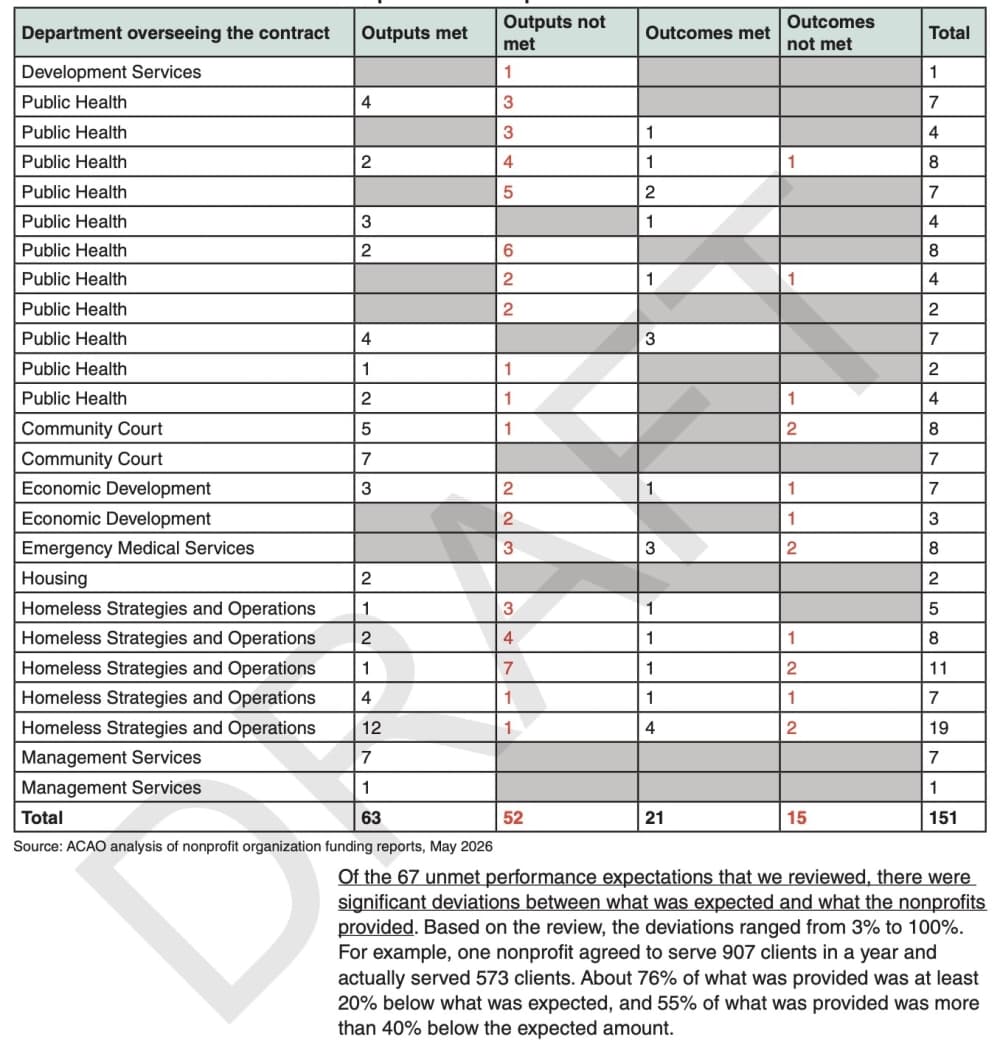
A new audit found city-funded nonprofits regularly failed to meet performance expectations, with "significant deviations" between targets and actual service delivery. (Courtesy city of Austin)
Within that sample, auditors found the nonprofits "do not consistently provide agreed upon services" but "are generally paid for expenses regardless of outcomes." The findings were based on a review of city policies, contract spending and performance reporting, internal and external interviews, nonprofit site visits, and other materials.
Zooming in
The audit tracked nonprofits' outputs, or service delivery results, as well as outcomes, or the impact of services provided. Less than one-fourth of the sampled nonprofits met all city performance expectations.
Out of more than 151 specific output and outcome goals in their contracts, more than 44% underperformed. Most of those unmet targets had "significant deviations" between expected results and what was provided.
While frequent shortcomings were identified, auditors also noted Austin "does not enforce consequences" for underperformance and routinely paid nonprofits in full. In two examples, nonprofits were paid despite falling short of service goals by hundreds of clients and failing to reach Austin's standards for contracted program outcomes.
"Although nonprofits must explain why they missed their targets, there are no consistent corrective actions or penalties in place to encourage better performance. As a result, the City fully paid nonprofits that did not meet most of their performance expectations," auditors wrote.
Nonprofits reported challenges related to funding, staffing and clients' unwillingness to participate in some programs. Watson also said Austin may have set expectations too high or not provided enough funding to complete the contracted work.
“If the city created unrealistic requirements or failed to manage those agreements properly, the city must take responsibility and correct those failures. But, none of those possibilities supports a system in which expectations can be missed repeatedly without consistent review, without corrective action, or without consequences," he said. "Good fiscal stewardship and strong social services are not competing goals."
The action taken
Auditors recommended several improvements, all of which are being put into place. They include:
Requiring documented performance reviews of nonprofit contract and grant recipients under new evaluation criteria
Determining how performance reviews should impact future contracting
Establishing cross-department sharing of post-contract reviews
Regularly evaluating Austin's overall social services contracting model
Several fiscal efficiency processes are already underway citywide including possible social service spending cuts that will be solidified this summer. In response to the audit, City Manager T.C. Broadnax reported that Austin's procurement manual is now being updated with new standards for contracts and grants, and that future solicitations will have new performance evaluation requirements in place. Contract compliance is also being centralized under Austin Financial Services.
Those changes, and others, will result in "improved management and reporting, and reduced duplication of services and dollars," Broadnax wrote in an audit response memo.
City audit and finance leaders said the audit findings shouldn't be used to represent all Austin nonprofits, and that results reflected more on city processes than organizations' performance. Elected officials defended the audit as an example of positive oversight and also said it shouldn't serve as a reflection on local nonprofits or their worth.
“Maybe there would be political advantage to not doing audits and ignoring problems, but that’s not good governance," said Mayor Pro Tem Chito Vela. "We always have to be reviewing for good practices, for best practices, making sure that we’re being efficient and effective. And I think this is just a natural part of it.”
Watson said the city isn't aiming to punish nonprofits for missing targets, and that it has a duty to ensure contracts are designed and funded fairly to achieve results for the public.
“Progressive government shouldn’t merely spend money for compassionate purposes. It should make sure compassion produces results. And in fact ... caring deeply about these services requires us to care deeply about whether they’re delivered, delivered to the people that we say we want served," he said.
WilCo Elections to process 18,000 delayed voter registration records, officials say