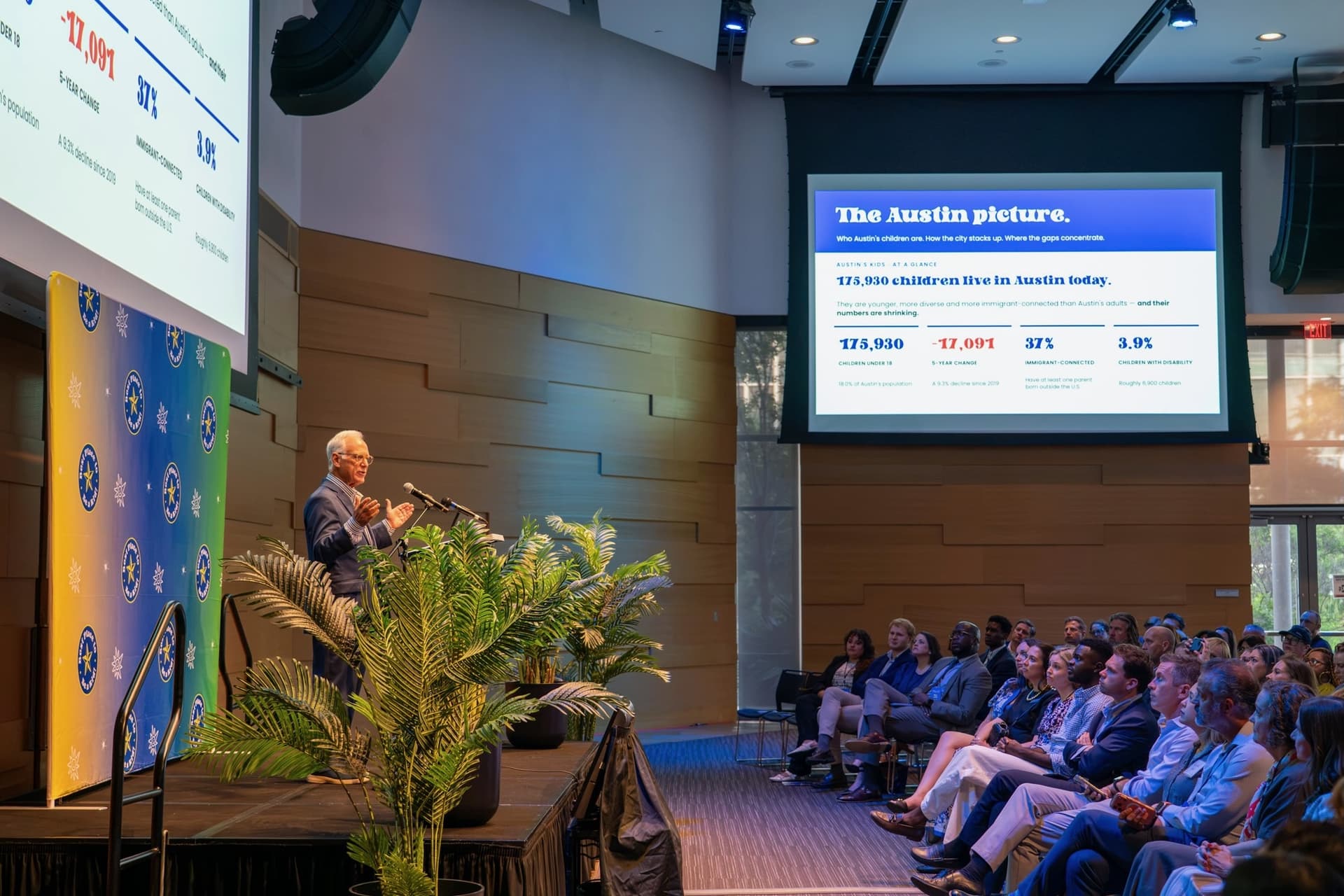
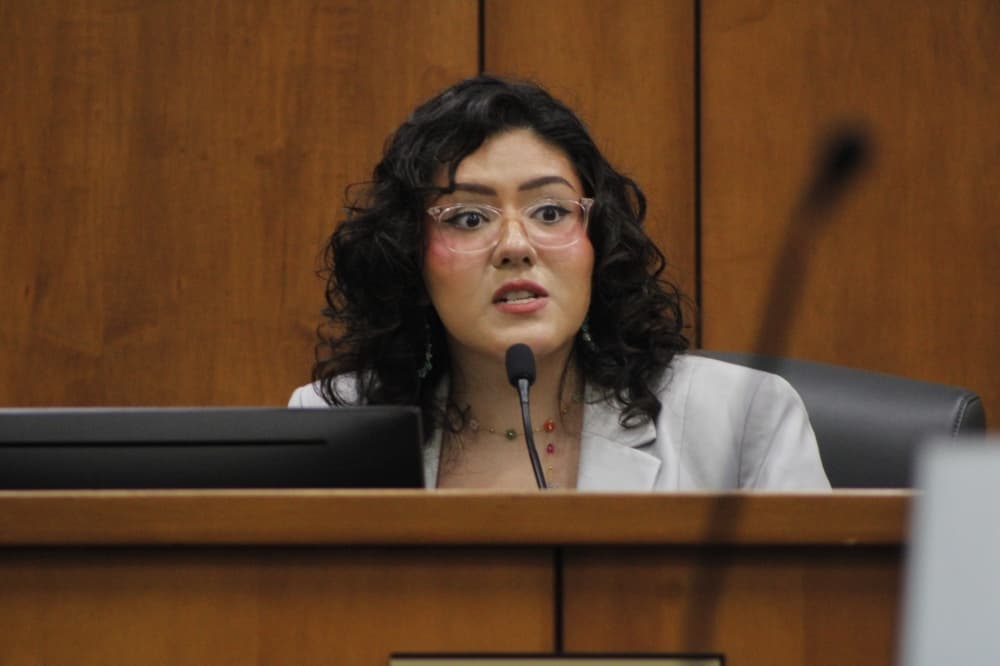
Mayor Kirk Watson, a backer of the Generation ATX initiative, spoke about new findings on local childhood well-being trends Aug. 20. (Courtesy GenATX)
A child well-being initiative backed by Mayor Kirk Watson and other local groups is advancing this summer following a comprehensive review of local childhood trends and outcomes. The new research will inform a multi-year plan intended to make Austin "the best place in America to be a kid."
"Austin has strong organizations doing important work for kids, but too often that work happens in separate systems that families are left to navigate on their own," Watson said in a statement. "The next five years are about aligning those organizations around the same goals, closing the gaps between them and measuring whether we're making life better for Austin's children."
Since then, GenATX conducted a benchmark analysis of the local child population and Austin's national ranking across dozens of performance indicators. Those results were presented Aug. 20 and will be used for the five-year push to improve children's access to healthcare and mental health support, food, housing, career training and public spaces.
More than 60 local leaders working in business, nonprofits, education and healthcare were involved in the initial research. The initiative is now proceeding under the leadership of United Way for Greater Austin and other organizations, and will include new measures of success and progress tracking as work continues.
"Austin doesn't need to start from scratch. We already have organizations with deep expertise and trusted relationships serving children and families across our community," Ingrid Taylor, United Way for Greater Austin's CEO, said in a statement. "Our role is to connect that work, align partners around shared outcomes and help turn the GenATX roadmap into coordinated action."
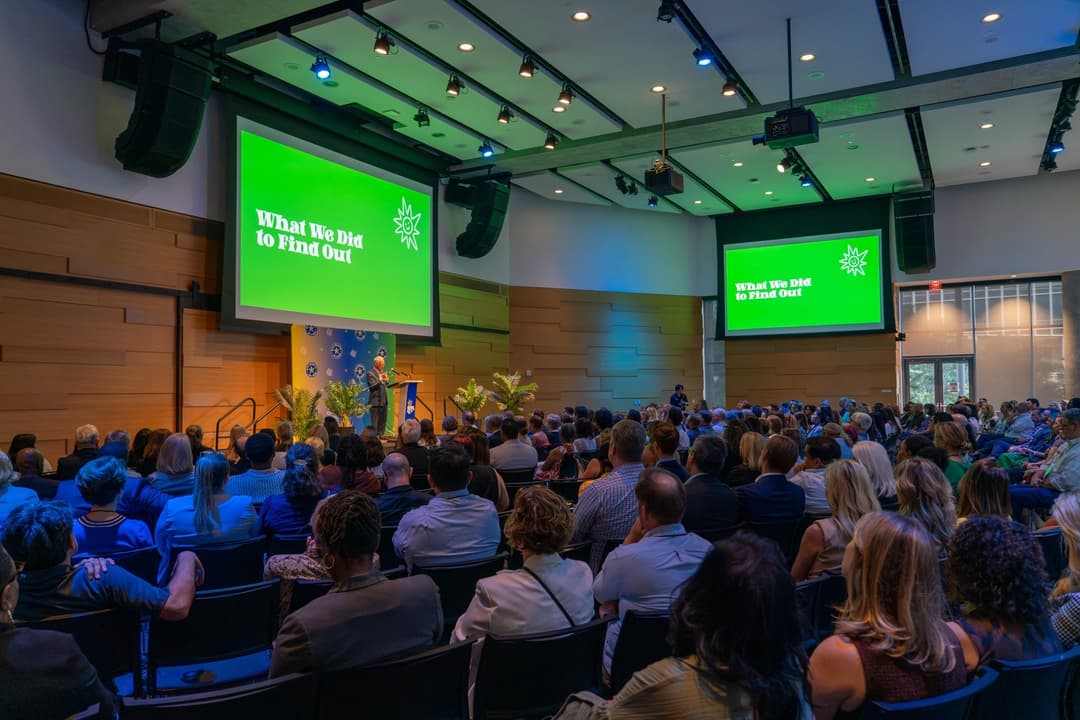
The Generation ATX initiative presented a childhood well-being benchmark report on Aug. 20 at the Central Library. (Courtesy GenATX)
To date, Taylor said United Way has served as the "fiscal backbone" of GenATX in collaboration with other childhood groups and is now developing the approach for the next five years. That includes working with the Success By 6 coalition and Early Matters Greater Austin on the initiative's future targets.
Research so far was funded by the FirstDay Foundation, H-E-B, Texas Mutual Insurance Company and Wells Fargo. Going forward, GenATX will be privately funded without using city dollars. Watson said he's pleased with the philanthropic support it's received so far and views it as a community-wide, rather than City Hall-led, initiative.
By the numbers
For the GenATX plan, an extensive analysis was conducted to measure Austin's status among the 50 largest cities nationwide and in Texas, and 10 technology and knowledge-economy peers. Results were mixed, with Austin ranking highly in several areas and relatively low in others.
A variety of government and institutional data show Austin has:
A relatively small child population that's more diverse than its adults, and that's declined amid recent economic growth
Better child well-being than Texas peers and many U.S. cities, but worse outcomes than most tech city peers
Healthy early childhood outcomes like infant mortality and birth weight
High child safety outcomes in terms of violence and traffic fatalities
Higher median family incomes but worse family homelessness trends than other large Texas cities
High levels of neighborhood opportunity nationally, and middling results compared to tech peers
Among the lowest child Medicaid and Supplemental Nutrition Assistance Program, or SNAP, enrollment rates in the U.S.
Underinvestment in support systems for public school students
Teenagers who are more engaged in school and work than in most American cities, but less so than in other tech cities
Less access to parks, playgrounds and recreation centers than most comparable cities
Relatively high child food insecurity
The strongest mental health system in Texas, but the weakest among peer tech cities
Wide racial gaps in trends like child poverty rates, school absenteeism, health insurance coverage and neighborhood opportunity
"A Black child in this city is more than twice as likely to grow up in poverty as a white child. A Hispanic child is less likely to have health insurance. And depending on where a child lives, the chances that their family is struggling to make ends meet can look completely different from one neighborhood to the next," Watson wrote in his Aug. 21 newsletter. "[Y]ou can have a city where some numbers look strong and still have children who are experiencing something very different in their daily lives. If the work we are doing only improves the average, but doesn’t reach every kid, then we can’t claim success."
The study also found that no measurements currently exist for key indicators related to children's sense of belonging, a top GenATX focus area. Comparison data on mental health, youth life satisfaction and early childhood development isn't available for Austin or cities nationwide.
Put in perspective
Based on the new benchmark analysis, Watson said one of the most striking findings about Austin was the city's declining share of children despite years of rapid population growth overall.
"Our city grew. Our economy grew. Incomes rose. By almost every measure we use to define progress, Austin kept moving forward. But the number of kids living here went the other direction. That’s not just a statistic. It’s a signal. And it’s a warning," he said. "Families are feeling the pressure: affordability is a key issue—the cost of housing, the cost of childcare, and the strain on people who are doing everything right, working hard and contributing to this community, while finding it harder to make it all fit together."
Watson said the findings and other reporting will now inform childhood investments in health, housing, and education resources; investments in public spaces; and the development of more career pathways.
Taylor said the new information framed around childhood health and well-being serves as a foundation for the upcoming citywide effort to improve targeted outcomes.
"It helps us—the community as a whole—understand the broader context of the assets of our community and the challenges we can work on together on behalf of a targeted population, our children," she said in an email. "The data highlights the challenges that our region faces with affordability and economic mobility, and invites us to action if we want to continue to make Austin a place where young families can make ends meet."
The approach
In Texas, Austin was compared to Arlington, Dallas, El Paso, Fort Worth, Houston and San Antonio. Peers in the tech and knowledge-economy group included Boston, Denver, Minneapolis, Portland, Raleigh, San Diego, San Francisco, San Jose, Seattle and Washington. National rankings were based on 50 cities with populations of around 400,000 or more.
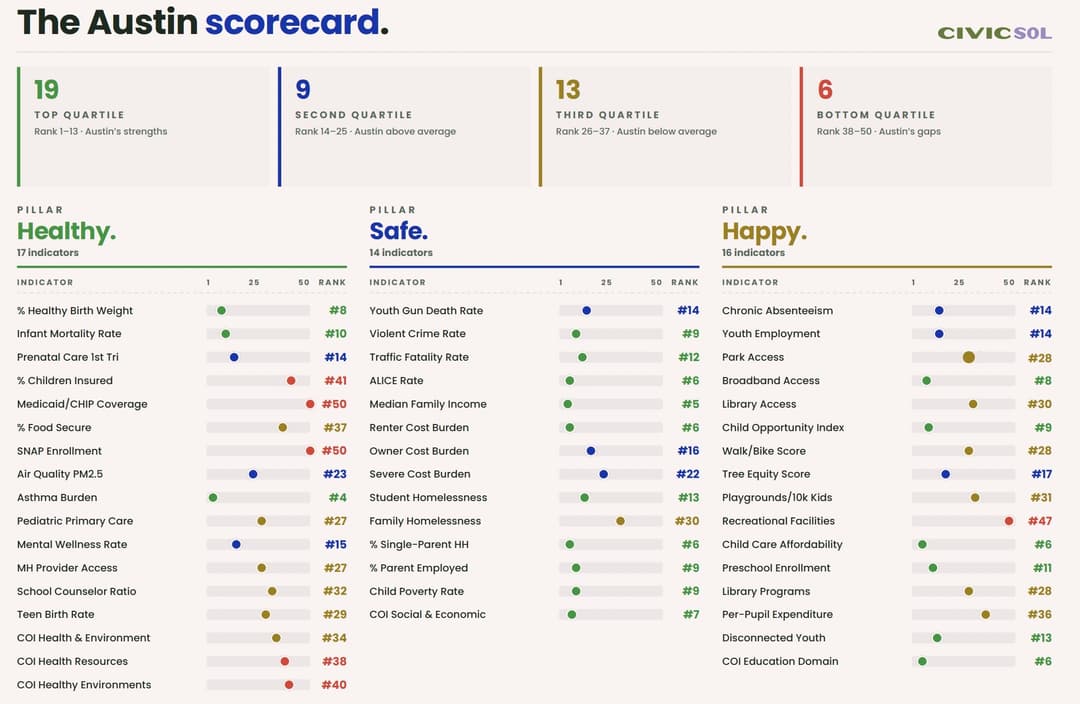
Austin ranked at various levels compared to other major U.S. cities across a variety of childhood outcomes. (Courtesy GenATX)
Information was prepared by Austin-based strategy firm CivicSol in partnership with Watson's office and United Way. Publicly available data was pulled from sources like federal government agencies, universities and nonprofits and used to make consistent comparisons across all peer cities.
In addition to the research project, other GenATX funders include the Austin Community Foundation, Cisco, Couch Family Foundation, Google, the Reissa Foundation, Sooch Foundation, St. David's Foundation and Webber Family Foundation.