Austin's budget planning process will continue through the summer. (Ben Thompson/Community Impact)
Budget planning for Austin's upcoming fiscal year 2026-27 is underway. City officials are weighing funding reductions while addressing rising costs and slowing revenue.
The overview
The city's 2025 budgeting process was more demanding than in recent years. It resulted in a tighter spending plan with some cuts after a tax rate election to raise more than $100 million in new revenue was voted down.
While the city isn't planning to invest in any major new programs, Austin's general fund—the largely tax-supported portion of the budget covering most public-facing services—is expected to grow about 3% in FY 2026-27. Some drivers include stabilizing city reserves, contractual obligations like rent and utilities, and several personnel-related expenses like health care, pension and wages. No pay increases are planned for civilian city employees; sworn police, fire and emergency medical personnel will all see raises under each of their previously approved labor agreements.
Council member Ryan Alter said the city's budget growth is largely in line with inflation and costs outside officials' control.
"Things are getting more expensive, and we’re not even keeping up with that," he said. "I think it’s also important context as we’re talking about this that the city’s expenditures aren’t growing because we’re getting more bloated. We are barely, if at all, keeping up with what we’re already doing.”
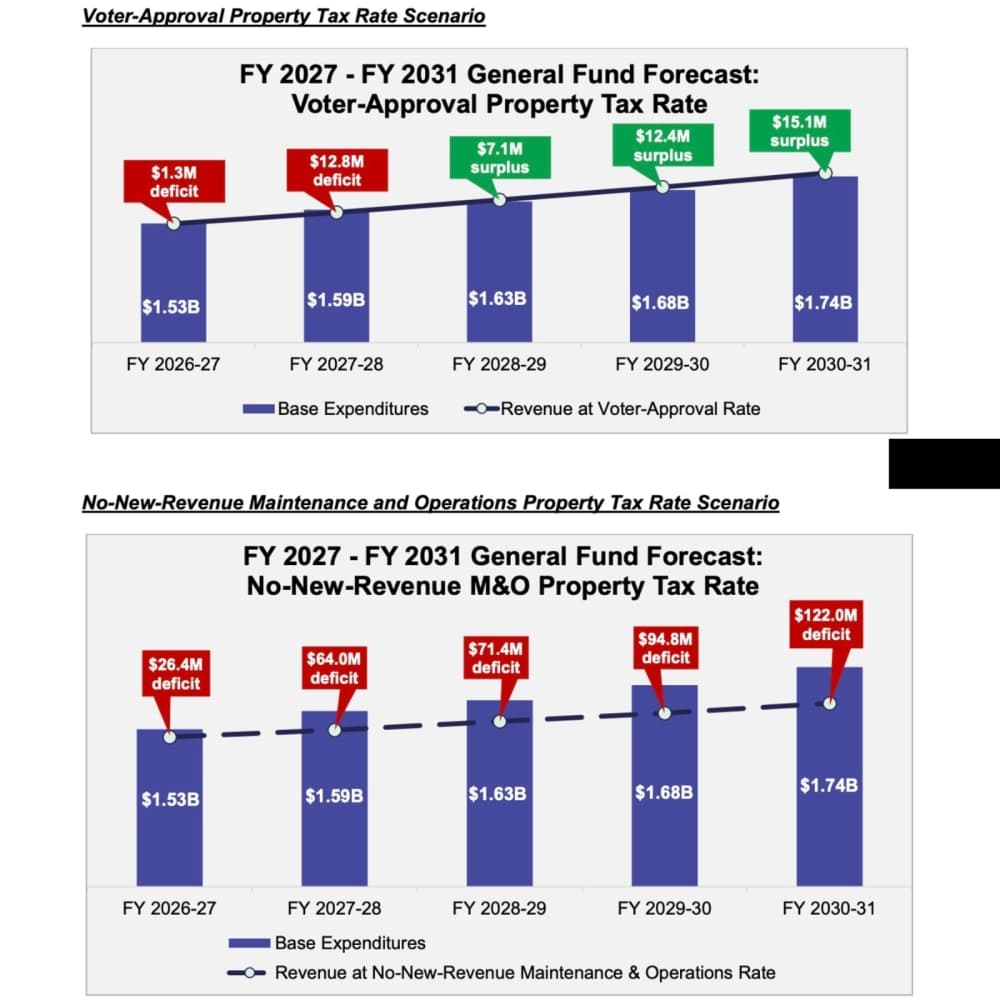
To balance the next spending plan, city financial staff have forecast several million dollars in reductions and still project a more than $1 million gap needs to be closed. Some planned changes include:
Consolidating technology staff and applications, initiatives that are expected to save nearly $30 million over the next five years
Making roughly $17 million in cuts to the city's tens of millions of dollars in social service contracts
Eliminating about $20 million in total transfers to the city's affordable housing and facility rehabilitation funds
The cause
The city's financial situation is due in part to slowing tax revenue partially caused by broader economic factors. Deputy budget director Erik Nelson pointed to national impacts like "stubbornly high" inflation, war-related energy price shocks and high interest rates that are affecting consumer activity and new development.
“In Austin specifically, economic growth is slowing particularly in the technology sector. We are seeing occupancy challenges in office and multifamily properties. Household debt is at record levels and there’s a high degree of consumer uncertainty about the future direction of the economy," Nelson told council. "In short, there are no strong drivers of economic growth and therefore the expectation is that sales tax growth should roughly track growth in price levels.”
The city is also anticipating revenue impacts from declining property values and tax appraisal protests, rising business tax exemptions, and a lack of new construction that adds value to local tax rolls.
The impact
The city's budget forecast includes a roughly 7.4%, or $155, annual increase to the typical Austinite's property tax bill. Estimates are based on a median-valued home in the city projected at about $485,000 for the year ahead.
Those totals assume increasing taxes up to the maximum level allowed under the voter-approval rate. State law limits cities' year-over-year revenue gains from the same taxed property at 3.5% without calling an election for a hike beyond that cap.
This spring, Mayor Kirk Watson also asked city finance staff for calculations based around the lower "no-new-revenue" rate. That level would still see the typical Austin homeowner's tax bill jump 4.6%, or just under $100, while the city would face a more significant budget deficit.
Without budget cuts, city projections show Austin's tax rate will need to increase to avoid future deficits. (Courtesy city of Austin)
Watson said he sought those projections as a comparison only to give officials and the public a better view of funding specifics during budget development.
"If there is a tax rate increase, it will be more likely done where the public can see specifically what the increase was for, which should help provide justification for any increase," he wrote in his newsletter.
A tax rate anywhere between the no-new-revenue and voter approval levels could be set this summer; city policy generally prohibits another tax rate election above the 3.5% cap for four years.
The approach
Staff's initial outline doesn't represent Austin's final FY 2026-27 spending plan, and council members will spent the next few months reviewing budget details and proposing their own edits.
While more detailed amendments and funding strategies will be considered over the next few months, some council members said an early priority is maintaining some of the nearly $9 million in affordable housing funding set to be eliminated. A large portion of that allocation goes toward housing vouchers for tenants exiting homelessness through permanent supportive housing, or PSH, programs—subsidized apartments that offer personal case management with health, career and other services.
Vouchers cover some rent for tenants in PSH residences, which Austin has recently spent tens of millions of dollars on citywide. Austin Housing Director Deletta Dean said hundreds of people could be displaced with the proposed reduction.
“We can’t let that happen. Both for our projects and for the people that are in them, we need to have stable PSH projects," Mayor Pro Tem Chito Vela said. "We definitely don’t need to put 300-350 additional folks back on the streets, especially if they’re hopefully getting stabilized and looking toward a better future."
Council's next budget review will take place in May, and City Manager T.C. Broadnax will present his proposed budget July 16. That will be followed by weeks of public hearings and deliberations before budget adoption mid-August.