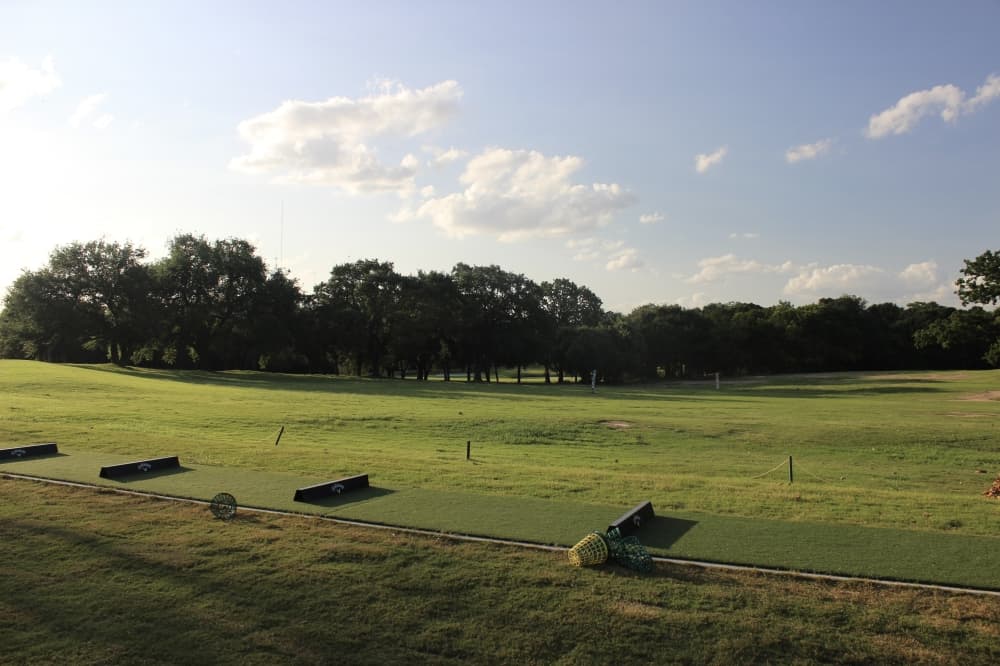
Austin and The University of Texas are nearing a deal for the future of the Lions Municipal Golf Course property. (Ben Thompson/Community Impact)
A deal between the city and The University of Texas at Austin to preserve Lions Municipal Golf Course, or Muny, is in sight, backed by significant anonymous donations and following years of local efforts to maintain the historic property.
"We finally have something that for generations and decades we’ve been working to try to achieve. And that is, how do we save that important, wonderful green space, that golf course, that we all know as Muny," Mayor Kirk Watson told media Oct. 14. “It’s been something we’ve been working on for a long time, but there was never a good, clear path. Today we’ve been able to announce that we have come up with a good, clear path."
The big picture
The 141-acre Muny property at 2901 Enfield Road, Austin, is one piece of extensive university-owned land along the Colorado River known as the Brackenridge tract. Hundreds of acres there were donated to UT by philanthropist and former regent George W. Brackenridge in the early 1900s with the requirement that the land benefit the university.
Portions of the tract now include Muny, West Austin Youth Association facilities, apartment complexes, the Lower Colorado River Authority headquarters, and retailers like the Lake Austin H-E-B, Mozart's Coffee Roasters and Hula Hut.
The Muny course opened in 1924 and has been leased by Austin since the late 1930s. In 1950, Muny was recognized as the first golf course in the South to integrate and is listed in the National Register of Historic Places as a civil rights landmark. The public course now hosts more than 75,000 rounds of golf every year, according to the city, while Austin pays UT just under $500,000 for its annual lease.
Debate over the property's use and how to preserve the historic course has stretched on for decades. The site had been used as a bargaining chip by the university in past negotiations with the city, and was included in a proposal to completely redevelop the Brackenridge tract as a dense mixed-use community in 2009.
Dense redevelopment of the entire Brackenridge Tract, including Muny, was proposed in the 2000s.Courtesy The University of Texas System
Watson, then a state senator, sponsored legislation in 2019 that created the Save Historic Muny District to secure the course's preservation; lawmakers have since extended the body multiple times without a resolution. And the city launched a rezoning project covering multiple UT sites around town including Muny in 2021 to resolve a land-use "stalemate" and potentially decide Muny's future—a process that quickly stalled out without a result.
What's happening
On Oct. 14, Watson announced that donations from several longtime Austinites would allow for a new deal between the city and UT to maintain Muny as an 18-hole golf course while opening the university's surrounding land for future development. A final agreement will require approvals by Austin City Council and UT's Board of Regents.
The 155-acre property containing Muny and WAYA's campus is currently appraised at more than $680 million. The donors and their total contributions are unknown.
"What it says about them is they really love our town, and they care deeply enough to make what is a very large contribution so that there will be a benefit to the university and to the campus and the students at the university, and it creates this opportunity to preserve that and to preserve WAYA," Watson said. "It is an enormous demonstration of love and generosity.”
With the donation, Muny could be conveyed to Austin for preservation while WAYA's campus would be transferred to the recreation nonprofit. To complete the transaction, city officials will need to update the Brackenridge Development Agreement that controls UT's use of 190 acres along Lake Austin Boulevard.
The university hasn't determined any development plans yet. Austin leaders will soon consider a regulating plan for future residential and retail projects as well as tax increment financing to support new infrastructure there.
Updated rules could cap building height at 65 feet, require at least 200-foot setbacks from Lady Bird Lake and limit how much of the land can be covered with new construction. UT's existing Brackenridge Apartments on Lake Austin would also remain for the near future, housing that could be relocated and rebuilt in a new location once redevelopment begins.
In addition to those planning updates, Austin would turn over some rights-of-way on UT's campuses to university oversight. And UT's ground lease for land in Mueller near the Dell Pediatric Research Institute—several acres at 1400 Barbara Jordan Blvd.—would be updated to allow for future student and faculty housing there.
Changes to the Brackenridge agreement will be presented to the Environmental Commission Oct. 21 and Planning Commission Oct. 27, before going to City Council for approval Nov. 19. Regulating and financing plans will then be drafted over several months and brought for council consideration in the spring following more public review.
“We now have the opportunity to have the door open. We need to go through that door and get this transaction completed," Watson said.
What they're saying
City Manager T.C. Broadnax said the new plan represents a long-awaited and exciting opportunity for the community.
“Development in this special area, along Lady Bird Lake, must be thoughtful and executed with the deepest care," he said in a statement. "The agreement will enable both the City and the University to guide development in a way that accomplishes each of our goals. I appreciate and value our partnership with UT that has allowed us to reach this important milestone.”
A statement from UT Austin acknowledged its collaboration with the city to reach a long-awaited resolution.
“The University of Texas at Austin is working with the City to define a path forward for the University’s future development and use of the Brackenridge tract in west Austin that honors our fiduciary responsibilities and stewardship obligations, which we will ultimately take to our Board of Regents for consideration," UT said. "We are immensely grateful to anonymous donors who have stepped in with a generous gift proposal to UT Austin to help facilitate a resolution that serves our students, the Austin community and Texas for years to come.”
Ken Tiemann, Save Historic Muny District chair, also thanked the anonymous donors for their "extraordinary generosity" and said Austinites owe them a lasting debt of gratitude for facilitating Muny's preservation.
"The SHMD fully and enthusiastically supports this proposed agreement and respectfully urges the Austin City Council and The University of Texas System Board of Regents to approve it. It represents the outcome generations of Muny supporters have worked toward, and it would secure one of Austin’s most treasured public spaces," Tiemann wrote in a statement of support for the plan.
Watson credited UT Austin leaders including President Jim Davis for their willingness to collaborate on a plan for Muny and the Brackenridge land, which he said will benefit all Austinites.
"Part of my happiness with this is we’re preserving green space. Here we are a city that values its green space, and we’re going to be able to keep that green space, really at no cost to the taxpayer," he said. "Additionally, it speaks to our belief in civil rights and our belief in our history. But also just the day-to-day operation of our city, and having a place that brings the entire community together at that golf course."
The Muny Conservancy, created in 2019 to raise funds to help secure the course's preservation, also hailed the proposed deal. Calling it an "extraordinary day" for Austin, co-chairs Scotty Sayers and Ben Crenshaw thanked stakeholders and urged residents to support the outlined deal.
"Muny is so much more than a golf course. It is a piece of Austin's heart and soul, a place where people from every walk of life have come together for more than a century. To see a path forward that could preserve all 18 holes for future generations is deeply moving," Crenshaw said in a statement. "But this is not the time to let up. We need our entire community to stand together, speak up, and help carry this effort to the very end."