

Setting the scene
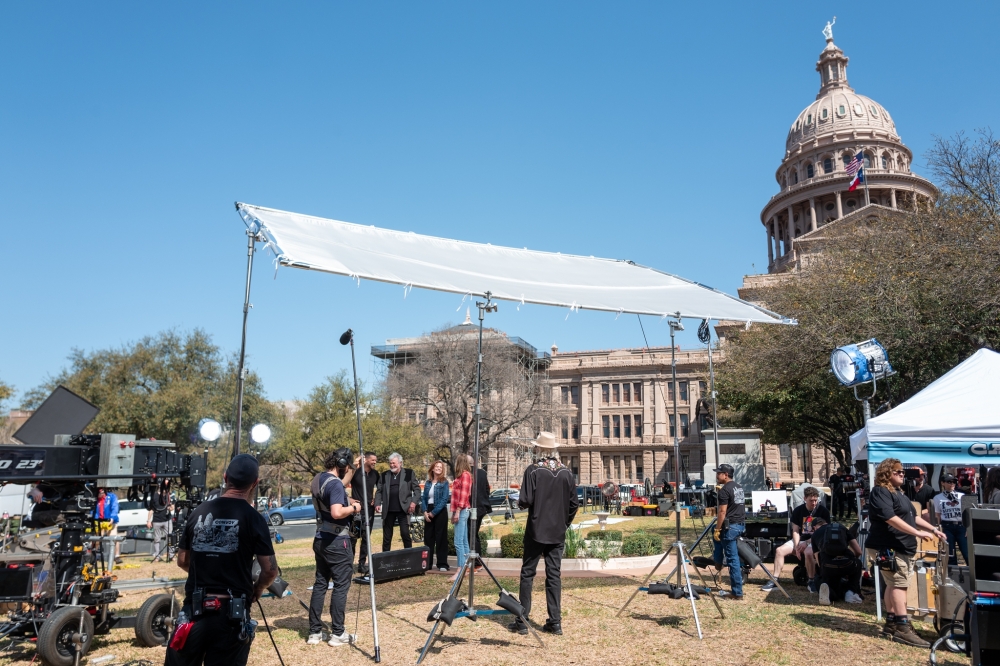
Through 2035, $1.5 billion in state incentives will be available for movies, television shows, documentaries, video games and other moving image projects created in Texas. Under Senate Bill 22, film and television productions that launch after Sept. 1 and spend at least $250,000 in the state are eligible for a reimbursement of up to 31% of their qualified in-state spending.
“This enables Texans who want to work in the [film] industry, ... to get a high-paying, stable and interesting job opportunity here in Texas,” Musslewhite told Community Impact on Jan. 14. “[The program also] invests hundreds of millions of dollars into the state by pouring all of this money, that production spend, on a daily, weekly, monthly basis into local communities.”
Texas-based filmmakers and actors—including Uvalde native Matthew McConaughey, Austin native Glen Powell, Fort Worth native Taylor Sheridan and Houston native Dennis Quaid—advocated for expanded film incentive funding during last year’s state legislative session and have recently celebrated Texas’ 10-year commitment to the industry.
Sheridan has filmed several shows in Texas. He told lawmakers in late 2024 that despite his desire to work in the Lone Star State, funding ultimately determines where projects are shot.
“These networks ... cannot and will not finance a film without an incentive—they will not do it,” Sheridan said during an October 2024 committee hearing. “I have lost shows because we were maxed out here. ... That’s the harsh reality of my business. It is completely dependent upon incentives and it will override the creative every time.”
The background
Under SB 22, $300 million will be available through the Texas Moving Image Industry Incentive Program, or TMIIIP, every two years. Lawmakers can renew or change the funding amount during the 2035 legislative session.
The program was created in 2007, and funding fluctuated significantly every legislative session. Texas budgeted $45 million for film incentives in the 2022-23 biennium, followed by $200 million in the 2024-25 budget.
Musslewhite said uncertain funding made it difficult for filmmakers and studios to plan their projects and deterred some from doing work in Texas.
“We saw how difficult it was for productions to make long-term decisions, to host multiple-season shows in Texas and really plan for the future,” Musslewhite said Jan. 14. “Feature films sometimes take over a year to develop and get off the ground—so this two-year limitation ... really hindered major productions from coming to Texas.”
Without the state’s film incentives, crews who cannot afford to work in Texas will “just go make a bad version of Texas in New Mexico,” Sheridan said in October 2024.
Zooming in
Media for Texas co-founder Grant Wood told Community Impact last year that the state film incentive program “is designed to put money back in the pockets of Texans.”
“If a film production comes to town, ... they will [spend], at times, millions of dollars in just a few days,” Wood said April 25. “They will stay at your hotel, they will eat at your restaurants. They will hire your local law enforcement, your medics, carpenters, electricians. All this money being incentivized by the state is then being poured into local communities.”
To be eligible for the program funding, at least 35% of a production’s cast and crew must live in Texas and at least 60% of the work must be done in-state, according to the Texas Film Commission. Grant reimbursements start at 5% and go up to 31%, depending on how much a production spends and other aspects of the project.
For every dollar of grant funding, TMIIIP grantees have spent $4.69 in Texas, according to Adriana Cruz, executive director of the Texas Economic Development and Tourism office. Since 2007, projects have injected $2.52 billion into the state economy and created over 189,000 jobs, Community Impact previously reported.
“If Texas were our own country, we would be the eighth-largest economy in the world, and we also rank as the nation's top exporting state,” Cruz told state lawmakers April 23. “The moving image industry allows us to export perhaps our most important commodity, our Texan culture, our Texas stories and our Texas communities.”
More context
At the state capitol last year, some Texans debated what kind of productions should be eligible for the film production grants.
Sen. Paul Bettencourt, R-Houston, said he was concerned that some projects receiving state funds would feature inappropriate topics or offensive language, citing profanity in “Landman.” Sheridan’s television series is set in West Texas and was filmed largely in North Texas.
“We’ve got to have a standard that sets the tone for the state of Texas and what we’re going to support, what we’re not going to support. ... It’s not something I want to see on television and I certainly don’t want to put our money behind it,” Bettencourt said during a March committee hearing.
The law states that the Texas Film Commission is not required to act on all grant applications and may deny an application if the proposed project contains “inappropriate content or content that portrays Texas or Texans in a negative fashion.”
Under SB 22, productions may receive an additional 2.5% incentive, capped at 31% total, if:
- At least 35% of the project is filmed in a rural Texas community
- At least 5% of the production’s cast and crew are veterans who live in Texas
- The project is faith-based, as determined by the commission
- The production is filmed at Texas historic sites
- The production company partners with a Texas college or university for the project
- The production promotes family values and “portrays Texas and Texans in a positive fashion”
After SB 22 became law Sept. 1, some local governments across Texas expanded or launched their own film incentive programs.
Austin leaders voted Sept. 25 to revise the city’s incentive program for the first time since its creation in 2014 to capitalize on the state-level changes, Community Impact reported. The city now projects increased activity within the film, animation and video game sectors, bringing expected benefits for the "creative and overall economy," Austin Economic Development spokesperson Carlos Soto said.
In October, Community Impact reported that Houston First Corporation launched a new local film incentive program designed to attract film and television productions to the region.
The Houston program offers a 10% rebate on local spending, capped at $100,000 per qualifying project, with a total of $400,000 available annually, per the news release. Officials said the initiative, the most competitive of its kind in Texas, aims to boost local job creation and strengthen Houston’s position as a film production hub.
San Antonio increased the city’s base film incentive funding, added incentives for productions that hire local talent and veterans, and expanded program eligibility requirements in November, Community Impact reported.
“With expanded eligibility and new workforce development opportunities, we’re empowering local artists, crew members, and emerging talent—including students—to take part in and benefit from the remarkable growth of our film industry right here in San Antonio,” Krystal Jones, director of the Department of Arts & Culture, said in a November news release.