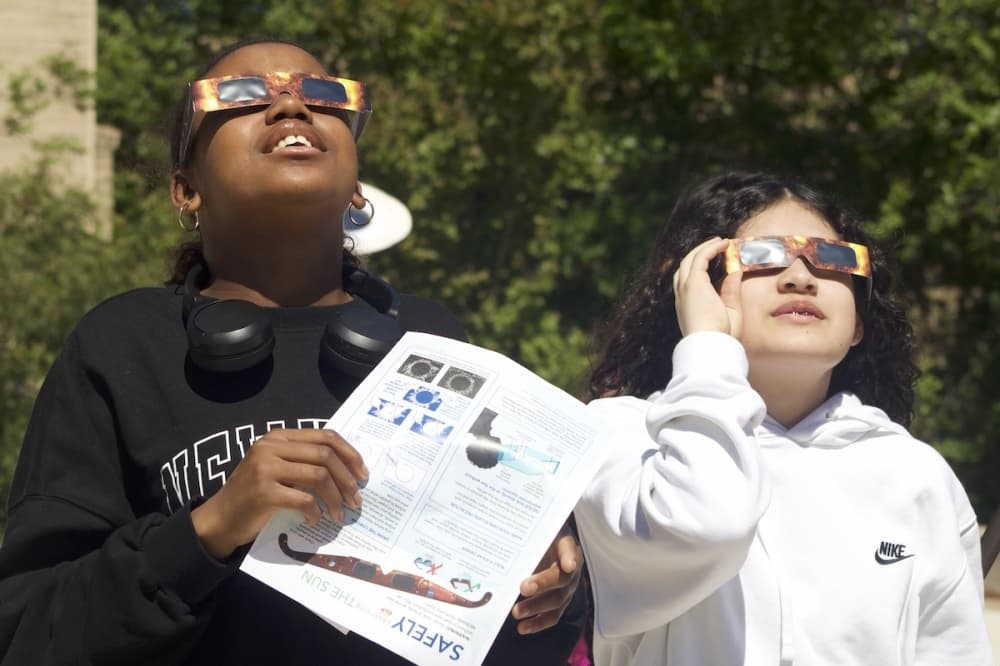
Bertha Sadler Means Young Women's Leadership Academy students practice use eclipse glasses, with solar filters, to look at the sun. (Elle Bent/Community Impact)
“This program is to really help inspire science, especially in underserved communities,” volunteer Christopher Bernhardt said.
What happened
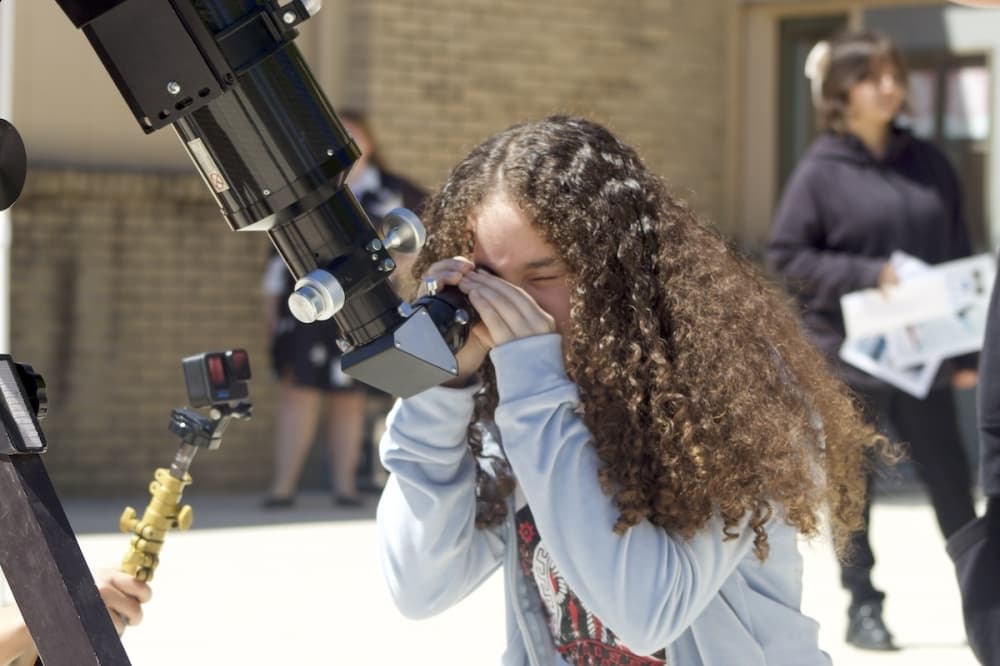
Bernhardt and Arizona State University student Savannah Goswick guided students at the all-girls middle school through a series of interactive activities, explaining the science behind the total solar eclipse. The demonstration ended with students looking at the sun through a telescope, and even found a sunspot—a part of the sun’s surface that is cooler and appears darker, Bernhardt said.
A Bertha Sadler Means Young Women's Leadership Academy student peers into a telescope to view the sun. (Elle Bent/Community Impact)
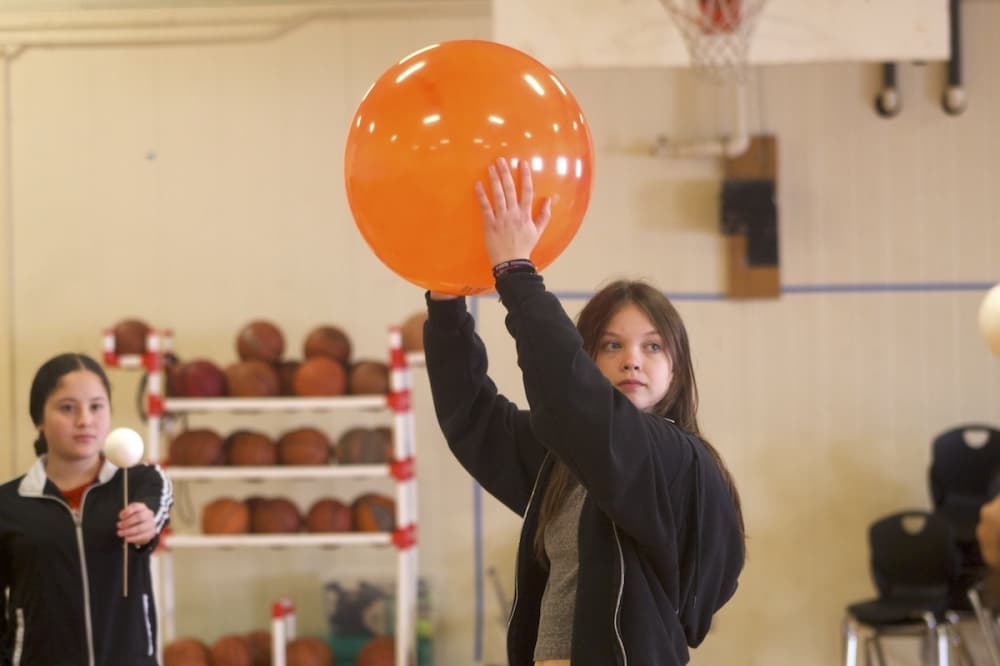
Students also physically demonstrated the path of the eclipse and the distance between the Earth and the sun. More creatively, students hole-punched shapes of their choosing onto cards, which will create shadows of half-moons on the ground if held outside during the eclipse.
Importantly, Bernhardt demonstrated how to use eclipse glasses, which have solar filters to safely view the sun. The students were told to look down and put the glasses on before looking up at the sky and look down again before removing them.
A Bertha Sadler Means Young Women's Leadership Academy student holds up a ball, representing the sun, in a demonstration about the total solar eclipse. (Elle Bent/Community Impact)