Residents across Hays County may face tighter water restrictions and higher costs in the coming months as drought conditions worsen.
The Barton Springs-Edwards Aquifer Conservation District, or BSEACD, is moving closer to declaring its first Stage 4 Emergency Response Period in the district’s nearly 40-year history.
Officials told Community Impact the declaration will be considered at a May 14 board meeting.
While recent rainfall has slowed the decline, it has not reversed the severity of the drought, said Shay Hlavaty, BSEACD communications and outreach manager. Justin Camp, a BSEACD hydrogeologist technician, said the water level at the Lovelady Monitor Well was just 5 inches above the Stage 4 threshold April 9.
Hays County domestic well owners may feel drought effects more sharply as groundwater levels drop.
The impact
The conservation district has been in a constant drought at various stages of severity since July 2022, over 45 consecutive months. The district previously faced an eight-month drought from November 2020 until June 2021.
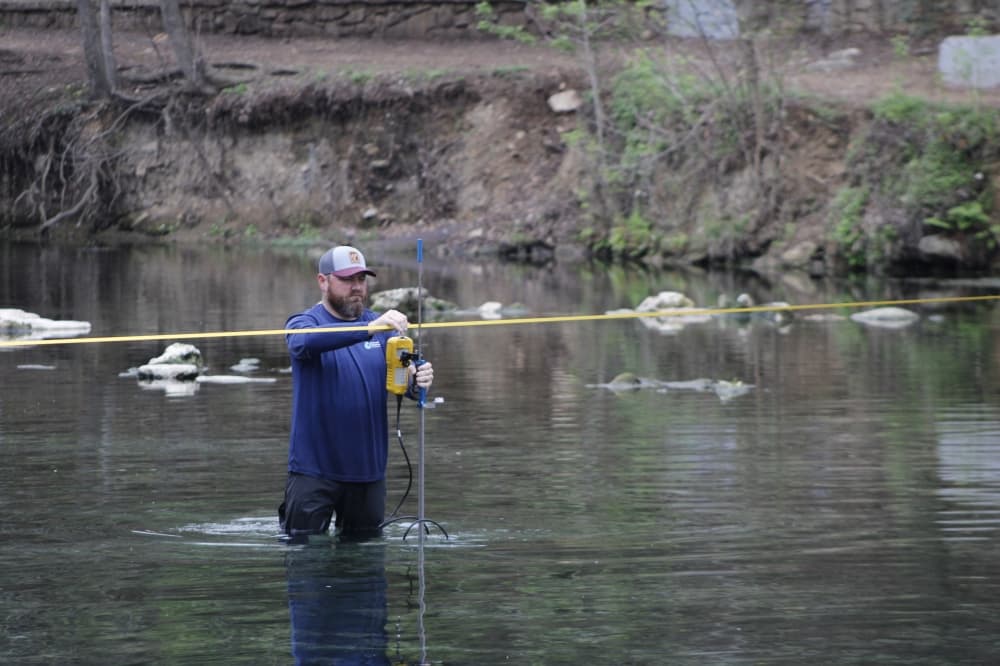
BSEACD determines the current drought stage by examining groundwater levels at the Lovelady Monitor Well in South Austin and flow rates at Barton Springs.
Groundwater levels at wells in the Edwards and Trinity aquifers throughout the district have declined similarly to those at the Lovelady Monitor Well and Barton Springs.
“About 50% of Texans rely on groundwater,” Hlavaty said. “Throughout the Hill Country, we’re seeing similar dramatic declines in groundwater. That’s tons of people whose water resources are being threatened.”
The district determines pumpage reductions by well permit type and the active drought stage, and may enforce penalties for repeated violations. It is strongly recommended that owners implement their own conservation measures to reduce the drought’s impact on them, Hlavaty said.
Due to the drought-driven drop in water levels, these privately owned wells may appear to have gone dry.
“What actually may be happening is that the water is just down below where their pump is, so it can be sputtering and water may not be coming out,” Hlavaty said.
Well owners may have to lower their pump to reach the groundwater—the process of which can be costly, time-intensive and inconvenient, Hlavaty said. Low water levels can also cause damage to well pumps.
If the water level has dropped too low for the pump to reach, it may begin pumping air, resulting in low pressure and potentially thousands of dollars in damage. Well owners would then need to lower their pump or reduce usage to combat the issue.
“We’re experiencing one of these long-term droughts, which is longer and more intense than what we’re used to on average, and we’re just waiting for rainfall,” Hlavaty said. “That drought-busting rainfall just hasn’t come.”
San Marcos
Water providers, including BSEACD, may implement increased water restrictions on the cities they supply, Hlavaty said. The city of San Marcos receives water from the Guadalupe-Blanco River Authority, Edwards Aquifer Authority and Alliance Water.
Alliance Water is a regional authority focused on addressing the water needs of its members that pumps from the Carrizo-Wilcox Aquifer. The cities of Buda and Kyle, and the Canyon Regional Water Authority, are also members.
San Marcos is currently under a Stage 3 drought—the city’s final stage before declaring an emergency.
The city’s current drought restrictions focus mostly on outdoor water and irrigation, said San Marcos Conservation Coordinator Jan De La Cruz. While water usage is currently stable, an expected increase in the need for irrigation is a city concern as summer months approach, she added.
San Marcos offers multiple programs to assist residents with water conservation, including free irrigation system evaluations. The city has a licensed irrigation inspector on staff to assist community members.
“We can look at your irrigation system and not only make sure that it’s working efficiently, but also make sure that it’s scheduled properly for the current drought status,” De La Cruz said.
The city offers a rebate to residents who convert some irrigation spray zones to drip zones or eliminate zones entirely.
While Stage 3 is the highest stage the city may issue under normal conditions, a Stage 4 drought can be declared as an emergency response.
Kyle
Kyle is under Stage 2 Amended Drought restrictions, so citizens using drip irrigation or soaker hoses are restricted to watering once a week. The city limits in-ground irrigation systems, spray systems and hose-end sprinklers to once every other week.
The city operates four wells regulated by the Edwards Aquifer Authority and one regulated by BSEACD. With advancing drought stages, pumping limits get stricter.
Kyle intends to expand its water supply through its regional partnership with Alliance Water, Mayor Yvonne Flores-Cale said.
The city currently receives 19% of its water from the provider. Flores-Cale expects the amount to grow to 56% by 2032, expanding the city’s long-term water security.
Buda
BSEACD is one of the main water providers in Buda, which is currently under Stage 3 drought restrictions. At this level, most forms of irrigation are limited to once per week on designated days. Residents receiving water from the city must comply with all restrictions.
“These restrictions are not arbitrary,” Buda Public Works Director Blair Murski said. “They are designed to help protect our shared water supply. ... Being good stewards of our water supply requires all of us to do our part. Every resident’s effort makes a difference.”
Looking back
Hays County
Hays County Judge Ruben Becerra, who also serves as the emergency management director, called for all water providers, municipalities and groundwater districts to issue Stage 4—or equivalent—water restrictions Feb. 4. His Stage 4 request would be defined by pumping reductions and the halt of nonessential outdoor water use.
Becerra proposed a moratorium on the issuance of new development permits to projects that require an immense amount of water, such as data centers, at a Feb. 24 Commissioners Court meeting. He tabled the proposition following court discussion.
On Mar. 23, District 45 state Rep. Erin Zwiener announced the creation of a Hays County working group that will address concerns with data centers, water use, and the authority of cities and counties to respond to related challenges.
The next steps
Becerra organized a Clear Water Summit on March 27. The event brought together representatives from water providers, groundwater districts, and local and state officials to discuss drought conditions and increasing water demand.
Attendees agreed to meet quarterly to continue discussions on water availability and industrial developments, Becerra said.
A second summit will be held in San Marcos this June.