Liberty Hill ISD is expecting surpluses of $8.5 million and $16,420 for the 2026-27 and 2027-28 years, respectively, according to district documents.
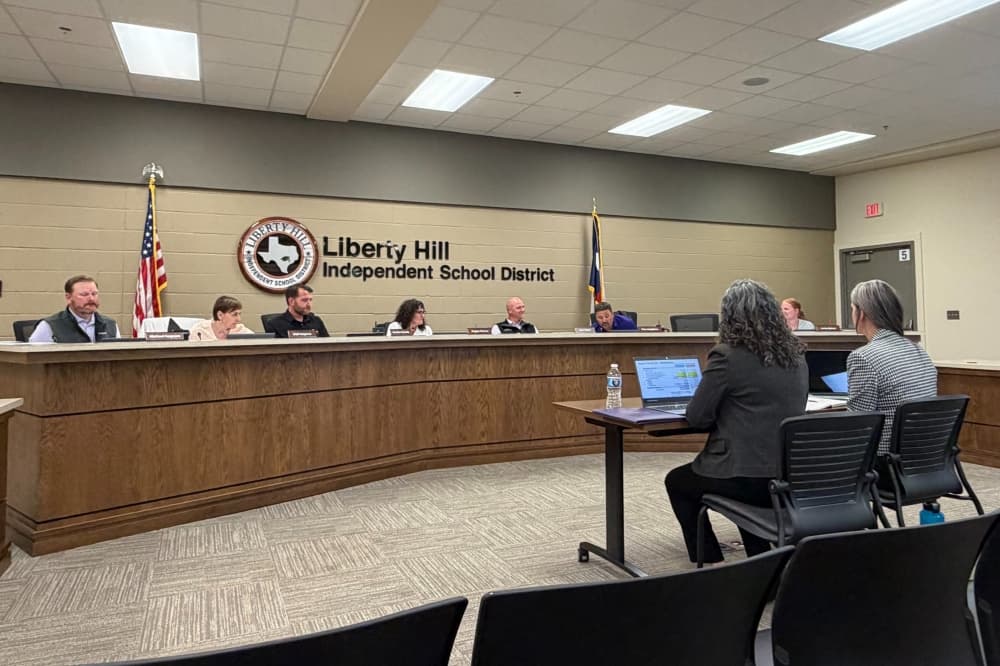
During its May 4 budget workshop, LHISD Chief Financial Officer Rosanna Guerrero and Executive Director of Human Resources Rebecca Owen highlighted expectations for state and local funding, district expenditures and changes that may affect the general fund’s budget.
“In March, when we had a meeting, we were projecting a deficit,” trustee Michael Ferguson said. “Here we are in May, and we’re not.”
The outlook
Currently, data from LHISD indicates that the 2025-26 budget is in the green with a projected $16.9 million surplus, an increase from the original estimate of roughly $10.8 million.
While the total estimated expenditures for 2025-2026 increased from slightly under $107 million to nearly $110.4 million, estimated revenues rose as well from nearly $117.7 million to a little below $127.4 million.
The district projects an increase in expenditures for the upcoming two years, largely due to expected increases in costs associated with increasing teacher compensation and staff growth. According to LHISD, expenditures are expected to increase to an estimated $126.7 million in the school year 2026-27 and to $145.6 million in the following year.
While previous information from the district indicated a deficit for 2027-28, Guerrero noted that increased property value growth and clarifying estimated expenses relating to salary benefits helped the district calculate these projections.
“We're really just trying to dial in on those numbers, but the biggest piece was that change in property value estimates and that tax collection increased revenue,” Guerrero said.
The funding sources
According to LHISD documents, 91.4% of the district’s general fund budget revenue comes from property tax collections and state revenues. The same data indicates that Liberty Hill’s residential properties—which make up 80.94%, or $10.6 billion, of LHISD’s property value—are valued at slightly above the average rate for Williamson County.
While the average residential mean value for all Williamson County hovers around $401,000 for 2026, Liberty Hill sits slightly below at $445,000.
Additionally, the passage of Proposition A in 2025 boosted the school district's revenue by $10.7 million for the 2025-26 school year, mainly dedicated to student programming, safety and teacher recruitment.
“Thanks to our community ... Prop A continues to generate additional revenue year after year,” Guerrero said during the workshop.
According to the district, the estimated $10.1 million additional revenue provided by Prop A for the 2026-27 school year will be allocated toward staff growth, increasing in compensation and reinstating budgets for campuses and departments.
“We're taking a really strategic look at the growth positions to ensure that we're adding back, but we're also doing it strategically while looking at the needs of our campuses,” Owen said.
Owen noted that some of the reinstated and growth budget may include positions that “may not be campus-focused, but may still support those campuses.”
The other side
In terms of expenditures, teacher salaries are projected to increase in the upcoming two school years, resulting in slightly higher estimated overall expenditures. The largest increase will come in 2026-27, with about $15.2 million expected to go toward staffing increases, pay grade adjustments and employee health insurance. The same costs will amount to an estimated $6.5 million for the following school year.
While property rates are expected to stay stable, the overall cost will increase due to new campuses opening up in LHISD.
“When you add square footage, that's also automatically giving an increase,” Guerrero said. “But overall, the rates are staying pretty stable.”
Next steps
Since the presentation relied on lowest enrollment projections for state funding, the final numbers may differ from projections.
Additionally, the Williamson Central Appraisal District will be releasing certified property values in July, which are used to estimate tax rates for the school district before the Texas Education Agency finalizes tax rate compressions in August. Furthermore, state funding is decided by property values released by the state comptroller in either January or February.
Guerrero also noted that there are expected changes for funding for bilingual education and special education. The district receives $14 million in state funding for special education, though overall it is spending more than it takes in from the state for the program. According to Guerrero, the current budgeted $16 million for special education in 2026-27 does not take into account any state changes to funding for special education.
“Changes are coming in terms of the tiers for special education, and that weighted funding is going to be adjusted,” Guerrero said. “A different way of reporting the data, a different way of calculating how that revenue is estimated. However, again, we know that the state is committed to not cutting from what the district is currently allocated.”