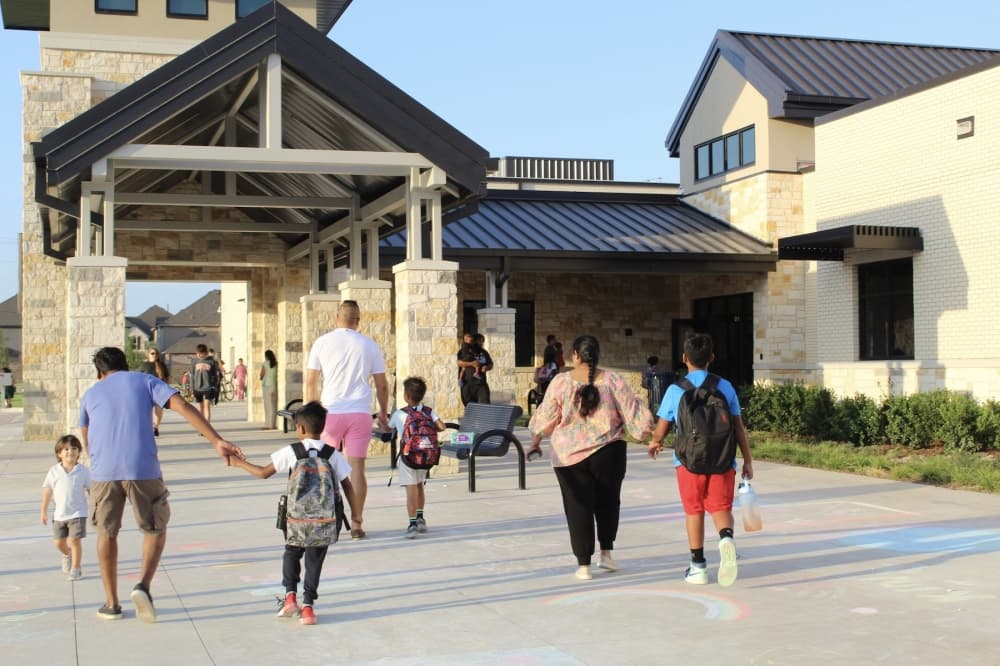
Children walk to their first day of school Aug. 12 at Block House Creek Elementary School in Leander ISD. A proposed tax rate election this November, if passed, would fund necessary campus improvements district-wide. (Haley McLeod/Community Impact)
To view this story as it appeared in Cedar Park's September print edition, click here.
As Leander ISD heads into the 2026-27 school year with a projected budget shortfall of $9.9 million, district leaders are looking at ways to generate additional revenue while still addressing district-wide campus and facility needs.
The big picture
Executive Director of Business Gina Mitschke said LISD continues to face funding pressures due to stagnant state funding, inflationary costs and flattening enrollment.
The board of trustees voted Aug. 17 to place a voter-approval tax rate election, or VATRE, on the Nov. 3 ballot, which would increase LISD’s current maintenance and operations tax rate of $1.0869 by three cents. This would garner about $6.7 million in additional local funding, Superintendent Chris Clark said.
“From a factual standpoint, we have to address a budget deficit [in] 2026-27 … but this is also about 2027-28 and 2028-29,” Clark said. “A VATRE passing reduces the amount of reductions that we have to make in the district. If the VATRE does not pass, that $6.7 million has to be made up somewhere.”
Separately, LISD’s Citizens’ Facility Advisory Committee developed a multimillion-dollar bond package to fund the interest and sinking fund (I&S) for capital projects addressing aging facilities, safety and security needs, and more.
A version of this bond package could be considered in 2027 or later, after the board of trustees opted not to place a bond on the November 2026 ballot.
The breakdown
While the district has already reduced upward of $26 million over the last two budget cycles, further reductions are likely, Clark said.
“About 85% or more of our budget is in people, so it would more than likely include reduction in positions,” Clark said.
Passing a $0.03 VATRE would generate an additional $12 million in local taxes. However, a portion of the additional revenue would be subject to state recapture. About $5.3 million of the VATRE-generated revenue would be recaptured.
Also of note
While the CFAC identified many district needs for a potential bond, the decision for the board to not place a package on the November ballot ultimately came down to timing, Clark said.
Projects included campus modernizations; fine arts and athletic improvements; cybersecurity upgrades; HVAC and school bus replacements; and the repurposing of police and emergency management services. A four-year bond cycle would cost $708.5 million, while a three-year bond cycle with a reduced project scope would cost $591.23 million.
Chief Operations Officer Jeremy Trimble said 47% of LISD’s 49 campuses will reach their 20- to 25-year lifecycle replacement or modernization window within the next decade. Deferring projects for six months could create yearlong construction delays, he said, but plans will be in place to mitigate risks associated with this.
Something to note
Clark said LISD is continuing to face enrollment challenges unique from other districts: fast growth in the northern parts, and stabilization or a decline in the central and southern parts, he said.
More charter school options in the area and the new education savings account program also continue to impact enrollment, Clark said.
“Choice for parents is not a bad thing,” Clark said. “It’s just another factor that we have to consider that is new to us, and it makes predicting enrollment even harder. … That relates to a bond and a VATRE as we’re planning from a budget standpoint and a facility standpoint.”
Prior to the board’s Aug. 17 vote, several trustees voiced concerns regarding community messaging for the VATRE.
At the July 23 board meeting, trustee Anna Smith said that while a VATRE felt “nonnegotiable,” the district needed to clearly communicate that.
"We have to tell them we’ve utilized everything we can. … To the flipside of that, my main concern is the messaging. … Everyone’s going to be like, ‘You’re just asking for money. More money.’ I need to be clear why we need that money.” Anna Smith, Leander ISD trustee
Trustee Trish Bode questioned whether a VATRE addressed LISD’s underlying budget issues, noting that 88% of LISD’s budget is devoted to payroll.
“Does a VATRE help us streamline and identify what’s going on, or does it just allow us to continue to have an issue and we’re going to be right back in this situation in another year?” Bode said. “If we’re going to go ask our taxpayers to help us, I also want to make sure we’ve done our due diligence to look under our rocks.”
What to expect
Early voting will take place between Oct. 19-30, and election day is Nov. 3.
The district will offer in-person and virtual community meetings, and a financial literacy website with frequently asked questions ahead of the VATRE.
District optimization efforts will have to continue whether the VATRE is successful or not, Mitschke said during the Aug. 6 board meeting. LISD would still need to generate $3.6 million to provide a 2% pay increase in FY 2027-28, even if a VATRE is approved, she said.
While there aren’t many opportunities to increase revenues as an ISD, Clark said the expansion of Career and Technical Education classes and a push to increase average daily attendance rates have helped these efforts.
Leander ISD discusses future of next 2 planned elementary schools