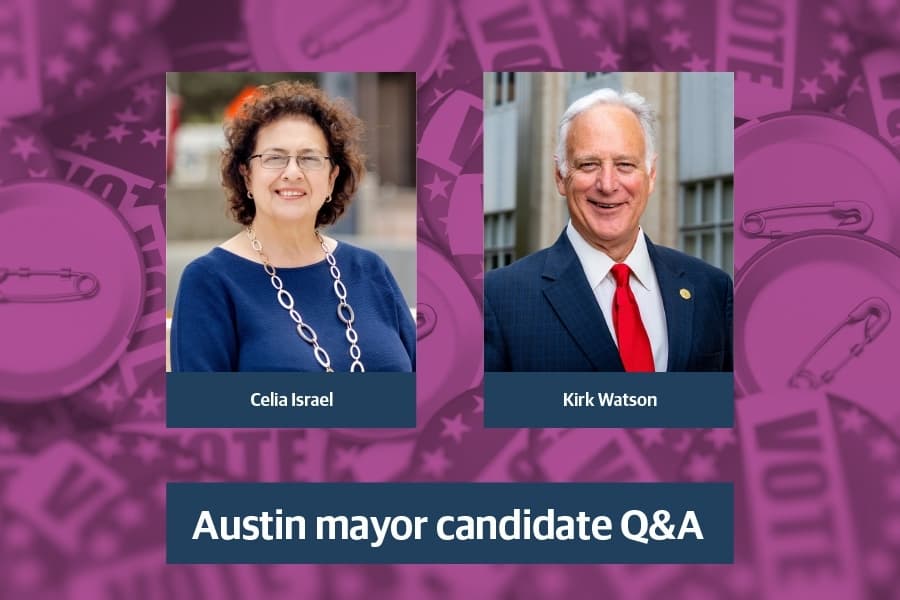
Why do you believe you are the best fit for this office? What kind of voice would you bring to the council dais?
I have a demonstrated history of bringing people together to get positive, progressive things done for our community. I don’t believe in “all or nothing” politics, where there are always winners and losers, and every policy choice must be binary. As a public servant, my goal has always been to bring diverse interests together to build consensus and take action to solve problems. That will remain my goal if elected in November.
How would you work to tackle the issue of housing affordability for both renters and homeowners in the city?
I’ve proposed many approaches to reduce housing costs in Austin, including scrubbing our development review process and reducing fees, reforming our land development code to allow more housing options in every part of the city while protecting the character of our existing neighborhoods, and building affordable housing on city-owned land. I also want to create and expand city partnerships with large employers and explore the use of incentives to facilitate the development of workforce housing.
How safe do you believe Austin is today? Do you think any funding, staffing or operational changes are needed in the city’s public safety departments?
I believe Austin police officers are working to provide the best possible service to our community, but our police department is seriously understaffed. I am an advocate for scaling our recruitment and training programs and bringing more officers onto the force as soon as possible. I also believe strongly in police oversight. We should strengthen public safety, but do so in a way that reflects Austin’s progressive values and ensures justice and accountability.
How do you believe city resources should be used to address homelessness? What do you see as the most effective policy options to get people services and housing?
I support creating more permanent supportive housing (PSH) units with support services, and accelerating the city’s efforts to get more unhoused people into PSH. We should also expand the city’s partnerships with community organizations like Caritas and Mobile Loaves & Fishes to deliver even more housing options. I also believe the city should further explore options, including city-sanctioned encampments, to protect unhoused people that cannot or may choose not to move into PSH.
What challenges or needs related to the overall city budget and property tax rate do you anticipate facing during your term? What fiscal strategies would you bring to the table to address those?
While Austin is experiencing an affordability emergency, the city should explore every option to minimize tax increases. I believe this should include starting each budget with the assumption of a no-new-revenue tax rate—the property tax rate that would allow the city to collect the same amount of revenue from the same taxpayers as it did the year before—and then having a public discussion about what expenditures, if any, may justify a rate increase.
What aspects of the city’s land development code, if any, would you propose to review? How do you believe council should handle Austin’s ongoing growth and its existing neighborhoods, from individual zoning cases to broader policy updates?
Among the reforms I support are creating designated hubs of density where the city requires development minimums as opposed to setting limits; reducing compatibility and parking requirements in targeted areas; and making it easier to subdivide and/or redevelop single-family lots with appropriate duplexes, ADUs, or more. More broadly, to respond to Austin’s ongoing growth, I believe the council must take every possible step to increase housing options while protecting the character of our existing neighborhoods.
How should council address the implementation of larger transportation initiatives including the I-35 expansion and Project Connect? What safety and mobility improvements would you propose for city roadways and bike/pedestrian routes?
With approximately $25 billion worth of major regional mobility infrastructure projects in the pipeline or already underway, our central challenge as a city is now to ensure that these massive projects are executed with maximum efficiency, speed, accountability, and equity. That’s why I’ve proposed to create a centralized Construction Command Center to streamline and optimize the planning, design, contracting, permitting, and construction of projects, including developing and executing strategies to mitigate impact.
Austin has weathered several disasters in recent years. How would you rate the city’s response to such incidents and what changes, if any, would you propose for civic emergency management operations?
I believe the city and its public and private partners have responded exceptionally well to emergencies. Emergency preparedness must continue to be a top priority, given especially anticipated changes in our climate that threaten more extreme weather events, including flooding and droughts that increase the potential for wildfires. If elected I will work to promote broader regional coordination and to ensure that the public is fully informed and prepared in the event of future emergencies.
What is your familiarity with Austin City Council meetings and city governance processes?
As a former Austin mayor I am very familiar with Austin City Council meetings and city governance processes. I believe my two decades of experience in public service, both at the municipal and state level, positions me uniquely to get things done at City Hall. If elected I will work to help build strong, positive working relationships between council members, city management and staff, the city’s public and private partners, and the public.
How would you promote accessibility, transparency, and trust between City Council and the public?
I am a strong advocate for open government and am proud to have played a leadership role in promoting transparency and accountability at both the local and state level. As mayor I would continue this work with an emphasis on ensuring that Austinites have easy access to policy makers and staff, and that the city is broadly and proactively sharing complete information about everything from budgeting to zoning to capital improvement projects.