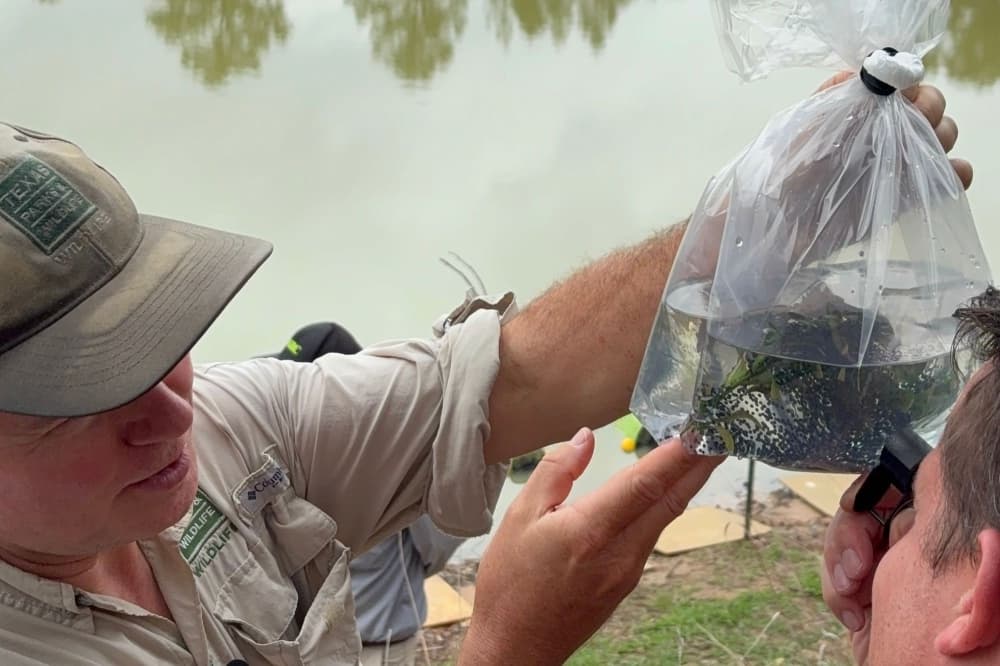
More than 1 million Houston toad eggs were released in Bastrop County this spring as part of a renewed effort to restore the endangered species.
“Bastrop State Park is in the established critical habitat areas for the toad and offers prime conditions that are ideal for the ongoing Houston Toad Recovery Program and population growth within the park,” said Paul Crump, Texas Parks and Wildlife Department herpetologist, in a news release. “It’s been about 10 years since we had a resident toad population within the park."
What's happening
In a news release, TPWD officials said they hope to reestablish Houston toads at Bastrop State Park after the species disappeared following the 2011 Bastrop County Complex Wildfire.
The toad eggs were released over a series of weeks in partnership with the Houston Zoo, the Amphibian and Reptile Conservancy, and the U.S. Fish and Wildlife Service.
What’s different
Previous reintroduction attempts in 2015 and 2019 were unsuccessful; however, this year was the largest number of eggs released at Bastrop State Park.
TPWD officials noted that more than a decade of habitat restoration efforts at Bastrop State Park have also helped to create suitable conditions for another reintroduction attempt.
Houston Toad Recovery Coordinator Matt Lammers said in the news release that the program is testing three sites—two in Bastrop County and one in Milam County—to track what environmental factors help populations succeed.
Why it matters
“Going forward, we can measure the varying success of these populations to determine what environmental factors are helping them along,” Lammers said. “Then we can try to replicate the most important of these factors in our other sites and across the state.”
Lend a hand
Officials said the Houston toad habitat historically spans parts of Austin, Bastrop, Burleson, Colorado, Lee, Leon, Lavaca, Milam and Robertson counties.
Landowners within the species’ native range are encouraged to support recovery through Bastrop County’s voluntary Lost Pines Habitat Conservation Plan, which preserves, restores and manages toad habitat across 124,000 acres.