Local governmental entities such as Montgomery County are beginning to adopt policies this year to address AI and how it’s used, considering security, transparency and other factors. (Courtesy Adobe Stock)
Artificial intelligence—technology that gives computers the ability to mimic human cognitive function—is being incorporated into many aspects of daily life, including for local governments and for business in The Woodlands area.
Rice University’s 43rd Kinder Houston Area Survey showed that in 2024, about six out of 10 area residents expected the rise of AI to have an impact on the Houston region’s workforce. At the same time, a 2024 survey by University of Houston Hobby School’s SPACE, or Survey on Public Attitudes and Community Engagement, City Panel shows a majority of businesses hope AI leads to more efficiency.
Local governmental entities such as Montgomery County are beginning to adopt policies this year to address AI and how it’s used, considering security, transparency and other factors. In April, Community Impact reported that Montgomery County commissioners adopted a new AI policy required in the state of Texas. Legislation passed in 2025 requires the Texas Department of Information Resources to establish an AI system code of ethics for use by state agencies and local governments and for DIR to establish minimum AI risk management standards, according to Senate Bill 1964.
Under DIR rules, counties must designate an AI risk management official. Officials said AI risks could include any use of county data, such as personal or budget information, by AI.
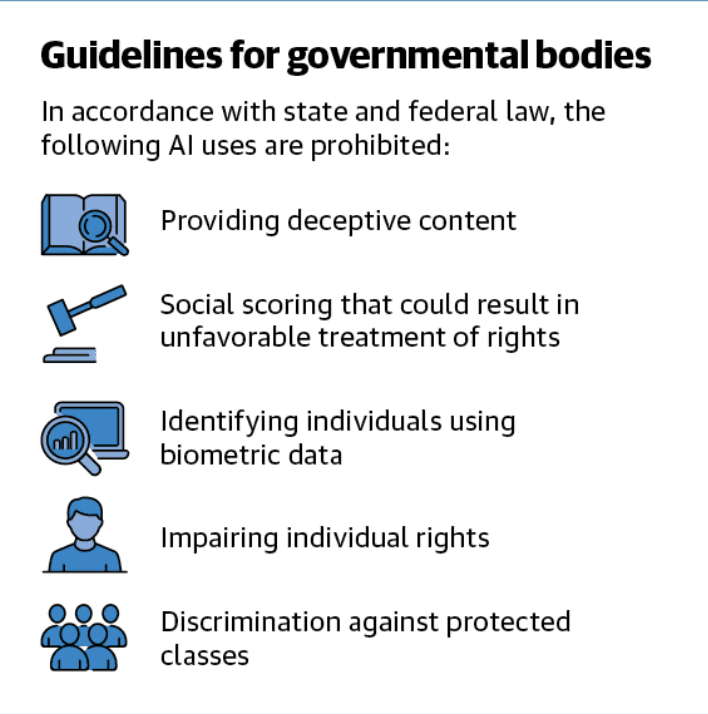
Per the state, the AI Systems Code of Ethics outlines what government entities and their employees should consider when using AI, but local officials are taking varying approaches to how to handle the new technology.
Source: Texas Government Code/Community Impact
Current situation
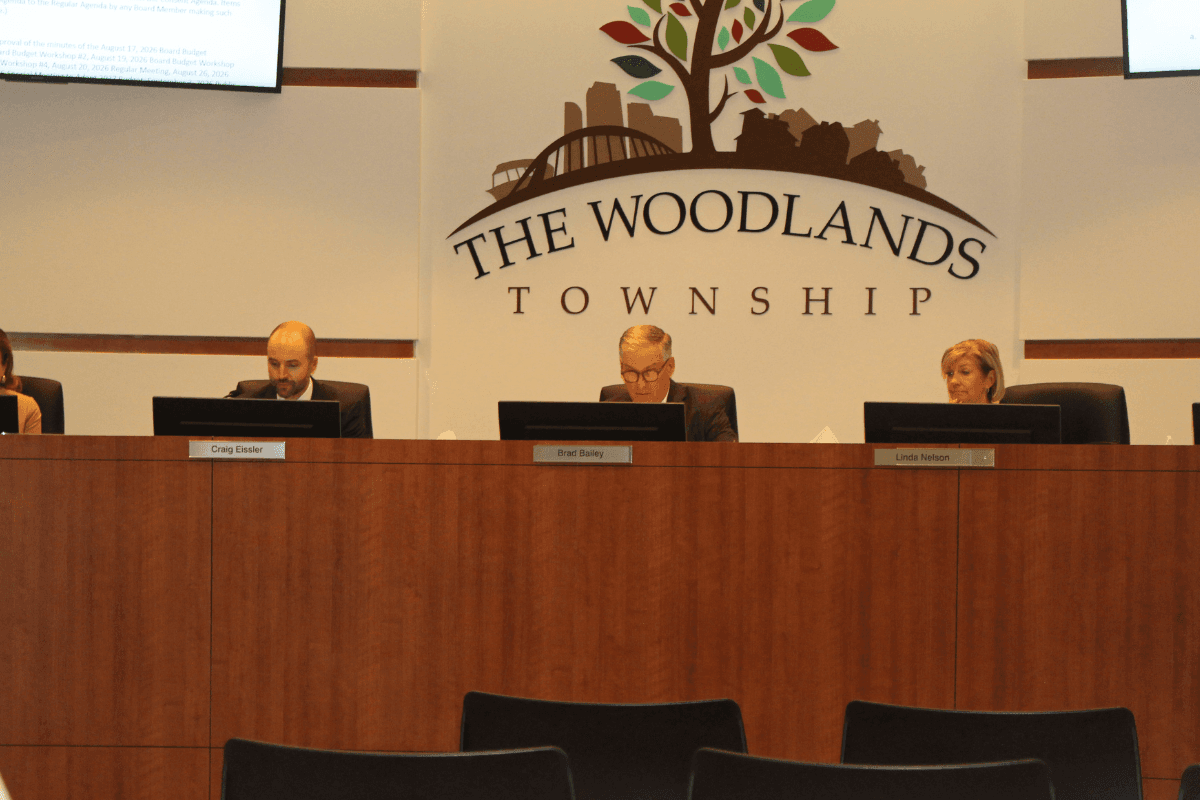
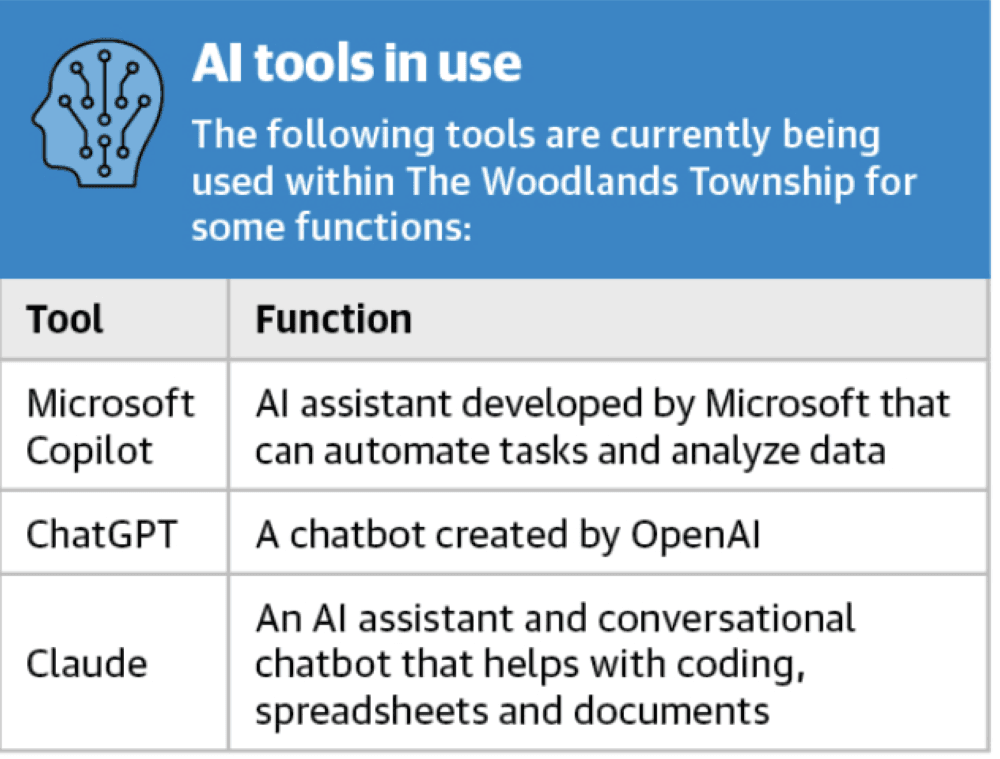
William Pham, IT director for The Woodlands Township, said The Woodlands is still in the early stages of using AI for tasks such as streamlining workflow, but its applications are limited because government platforms are restricted by the Department of Information Resources on which AI platforms they connect to.
“[In] the Covenant Administration Department, we are testing how we can use AI to speed up the application process,” Pham said. “Now, there’s still always a human interaction in everything we do, just for compliance and verification, but you’ve got to double-check everything,” Pham said.
Pham said when the township uses AI applications, it is mainly to work more efficiently and faster.
“As long as the guardrails are there that limits your risk [you can] ... use it responsibly and always have the human factor in there,” Pham said.
Craig Eissler, vice chair of The Woodlands board of directors, said use of AI is evolving at a rapid pace and requires a human touch.
“As [the IT department] explore[s] these opportunities, they’re committed to implementing the technology responsibly, with appropriate guardrails and human oversight to ensure it serves the best interests of our community,” Eissler said.
Countywide, AI is being used within the district attorney’s office in a controlled and limited capacity, Montgomery County District Attorney Michael Holley said. He said there are three primary concerns with AI in the prosecutor’s office, including security, accuracy and human capability, which means the DA’s office can’t fully use more publicly available AI products.
From a business perspective, however, Bryan Hill, a resident of The Woodlands and an ambassador for Cup of Joey—a regional networking group of business owners and creatives—said he believes AI can potentially help businesses and other entities work more efficiently.
“My son, who’s building a business, [is] 19 and building his business using a lot of videos [with] AI,” Hill said. “Those are areas that small businesses can accelerate faster, because back in the day ... it would take a lot of effort to figure out what you needed,” Hill said.
Hill is also working with a business partner on a startup company that will help other businesses better utilize and understand AI.
“Imagine you have a small business, and you can utilize the AI that is there or find the one that best fits because you've got chatGBT, Gemini and a lot of different ones, but finding the one that best fits [your business needs], you [can] use it to accelerate your business. As you grow, you're going to want training, so we can help them create [it] through AI, so that their businesses grow,” Hill said.
Hill believes AI can help business owners because it can help with sales to find new clients, in education to train new employees and help find new talent to fulfill roles within a business.
“I think for AI, those are three areas that are going to grow and are going to be huge as we move through with the AI movement,” Hill said.
Hill is also working with a business partner on a startup company that will help other businesses better utilize and understand AI.
Source: The Woodlands Township/Community Impact
The funding source
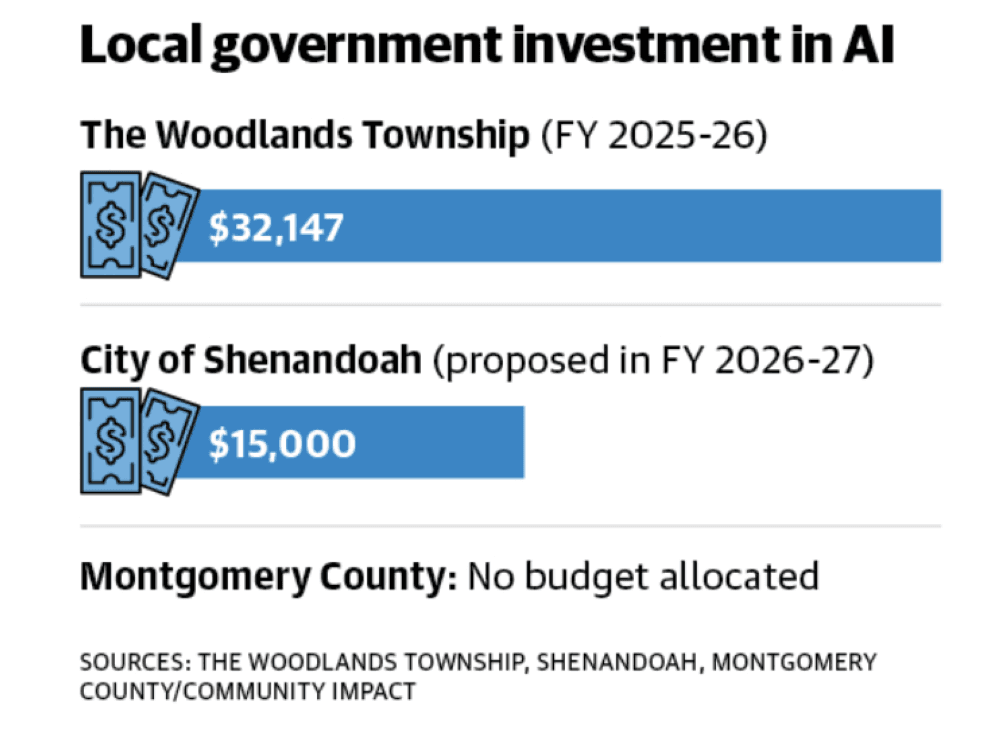
Pham said the township invested $32,147 in AI usage in fiscal year 2025-26. However, Montgomery County has no budget currently planned for AI, IT Director Bobby Powell said.
“[AI] can lead to incredible efficiencies, but it can also lead to incredible amounts of work being done ... without any type of compensation happening,” Powell said. “I’m trying to do as a county what’s best for the taxpayer, and I think right now that means we wait.”
In Shenandoah, the city included $15,000 for the CityBot AI communication platform in its proposed capital projects for
FY 2026-27. If approved, this would provide an AI-based chat solution to assist residents on a 24/7 basis, officials said. The initial cost would be followed by $10,500 annually.
Public input
Houston area residents surveyed by the Kinder Institute for Urban Research in 2024 said they believe AI will have the biggest impact in areas such as business, education and health services, which are among The Woodlands area’s top employers, according to The Woodlands Area Economic Development Partnership.
Anthony Krebs, vice president of digital technology for Baker Hughes, said AI will significantly impact its business systems.
“We need to move thoughtfully and quickly, or we could face any number of risks such as spending more time and money on training and external support, and minimizing the return we will see on AI-enabled programs,” Krebs said.
Something to know
Bridging the gap between government and business, AI can be more of a strategic enhancement tool rather than a replacement for marketing in the field of tourism, said Nick Wolda, president of Visit The Woodlands, the township’s convention and visitors bureau.
Wolda said AI can deliver personalized trip-planning experiences, improve operational efficiency and help officials gain deeper insights into visitor preferences and trends.
The agency also works to attract professional conferences to The Woodlands throughout the year. An AI conference held at The Woodlands Marriott in June focused on corporate applications of AI as well as robots and drones.
Looking ahead
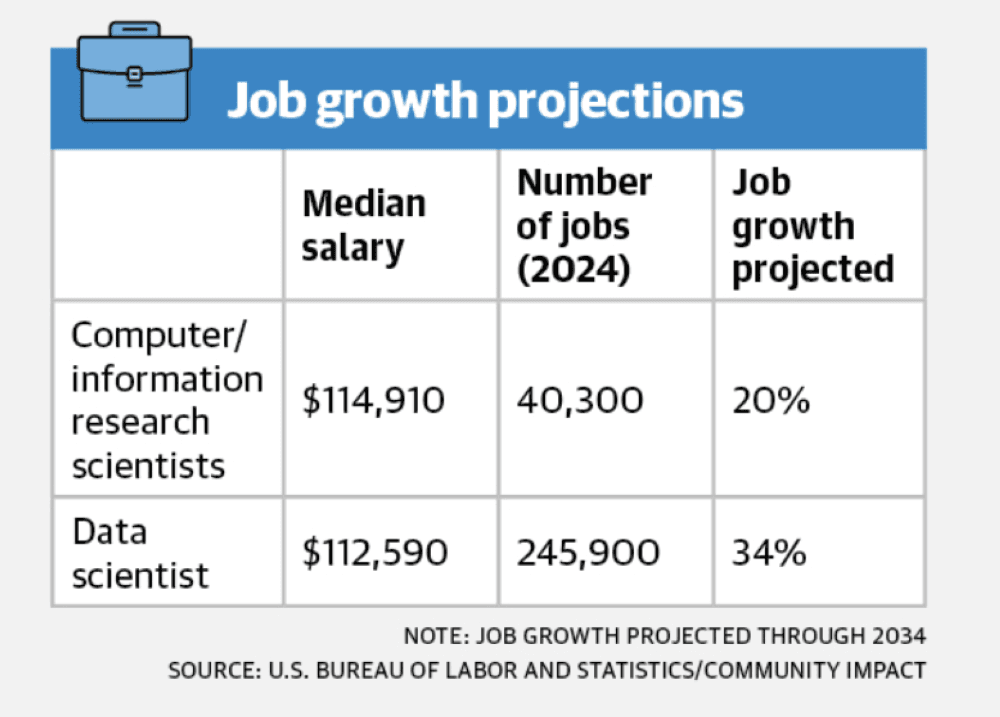
AI jobs in Texas are expected to grow by 27% by 2036, according to the Bureau of Labor Statistics. Jobs in areas such as computer and data science are already well-represented in The Woodlands area, but those fields will see increased demand through 2034, projections show.
Holley said it is also useful in the field of law, as his staff are evaluating ways that it can be used for time-consuming tasks to allow attorneys to focus on items that require human attention.
“AI is here, and it is a powerful tool,” Holley said. “Our challenge is not to stop it, but to govern it wisely. At the end of the day, we must protect our privacy rather than surrender it, preserve our abilities rather than outsource them and safeguard our humanity rather than lose it. If we can do those three things, AI can remain a tool that serves people.”