Harris County Precinct 3’s road and bridge department is giving old tires a second life with a new approach to street repairs that aims to cut maintenance costs and clean up landfills.
How it works
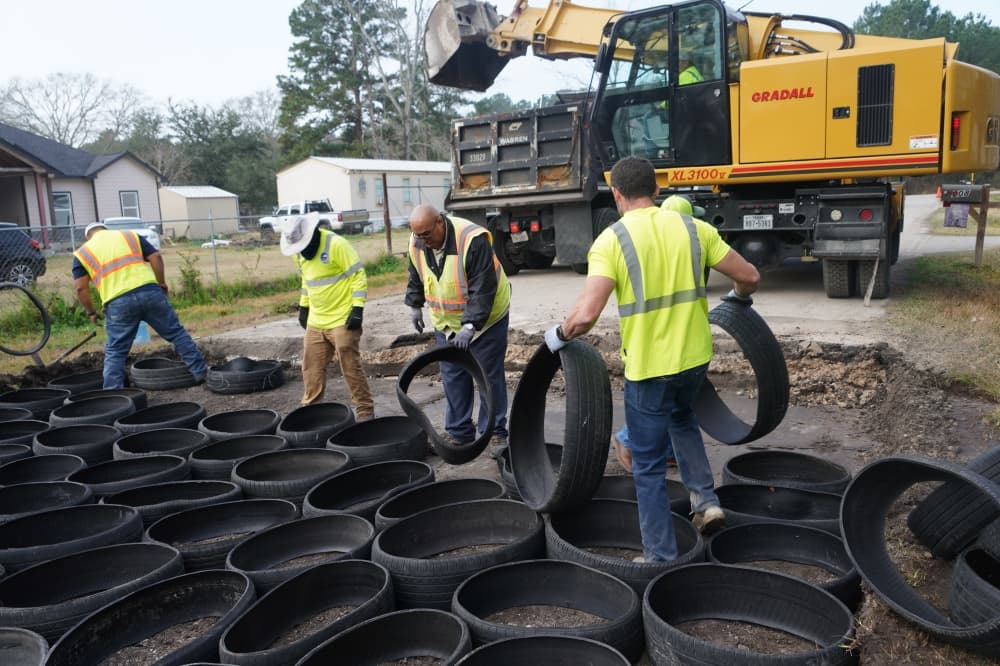
Road and bridge crews installed recycled tire rings beneath new asphalt to stabilize the foundation of the road, officials said. Precinct 3 staff performed repairs March 12 along a portion of Lindstrom Road in Crosby, but Road & Bridge Director Jennifer Almonte said the strategy could be replicated throughout unincorporated Harris County to fix potholes and cracks.
Almonte said Precinct 3 decided to pilot the solution after learning about the approach from 3rd Rock Renewables, a Houston-based sustainable construction firm that patented what they call “Mechanical Concrete” technology. Filling end-of-life tires with gravel stabilizes the road base and prevents erosion over long periods of time, according to the company’s website.
Almonte said maintenance that incorporates the tires could last decades compared to a six-month lifespan for a typical pothole repair. She said traditional repairs cost several thousand dollars per site in equipment, labor and materials, and reducing the frequency of maintenance could save an estimated $63,000 per taxpayer over the next 10 years.
“With this Mechanical Concrete concept of putting tires in the road, the projections that they’ve seen in other areas of the country are anywhere from 10 to 30 years of viability when fixing a pothole,” Almonte told Community Impact March 31.
Another detail
Almonte said staff collected the tires from illegal dumping sites and old Precinct 3 vehicles and gave them a new life in the roadway, which allows the county to qualify for credits from the Texas Commission on Environmental Quality for recycling waste.
Quote of note
“As a licensed professional engineer for over 40 years, my job is to solve problems in a practical way,” Precinct 3 Commissioner Tom Ramsey said in a statement. “If we can build roads that last longer, require fewer repairs and make use of recycled materials at the same time, that’s a win for taxpayers. I’m looking forward to seeing how this holds up and determine if it’s a viable long-term option for our area.”
Going forward
As part of the pilot test, Almonte said the crew filled the tires with different products and will monitor the quality of the roadway over the next one to two years to determine the best method for repairs going forward.
She said the road and bridge team will identify other sites in Precinct 3 with repeated potholes and street cracking as potential locations for the next round of maintenance.
“If it’s an area where we’re seeing a couple failures repeatedly in a heavy-traffic volume industrial area, then it’s definitely a good candidate for this type of maintenance application,” Almonte said.