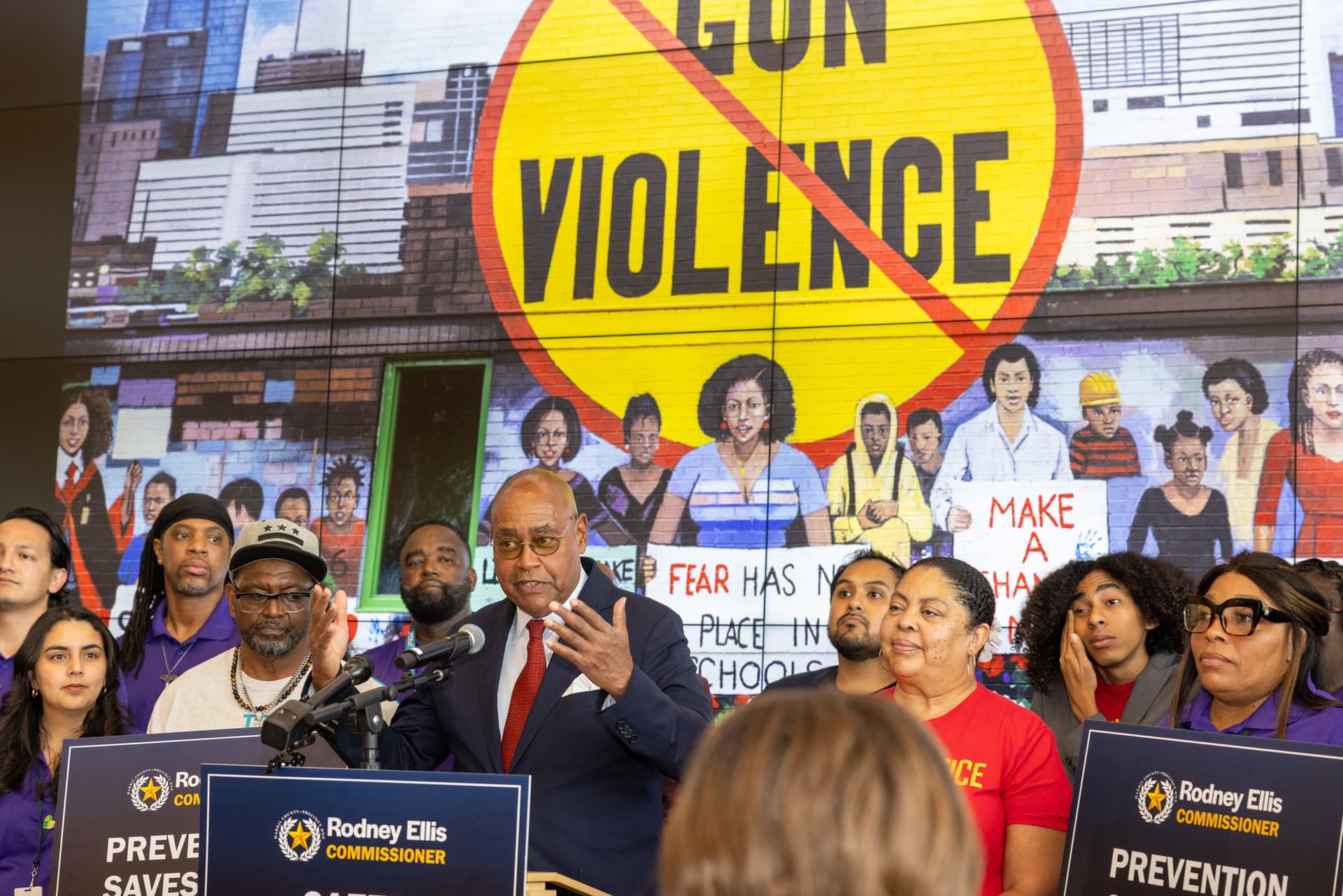
With Harris County commissioners set to make budget amendments next week, Commissioner Rodney Ellis is making an appeal for $4.5 million to go toward four community safety programs and strategies.
The big picture
The request is based on a report from Ellis’ office and Georgetown Law’s Center for Innovations in Community Safety. It evaluates results from three county programs, recommending investment to expand and sustain them, in addition to creating a community safety department.
The request would allocate:
- $1.4 million to the Holistic Assistance Response Team, or HART
- $600,000 to Relentless Interrupters Serving Everyone, or RISE
- $1 million to sustain domestic violence prevention and response
- $1.5 million to establish a community safety department
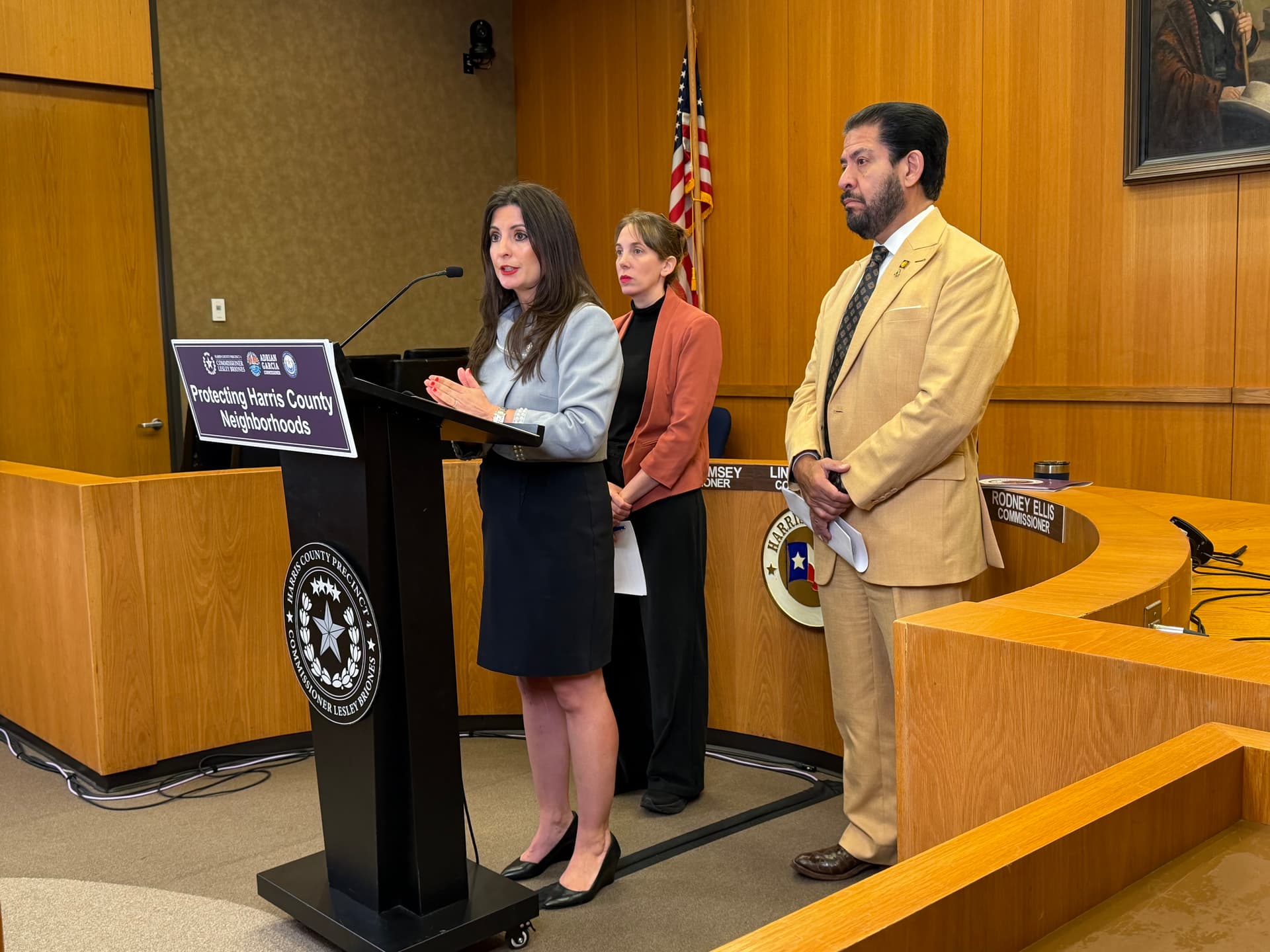
In a meeting with reporters Sept. 1, Ellis said $4.5 million is about 1.5% of what the county spends on law enforcement and jails.
“These programs deliver the right responses at the right time, and they are driven by fundamental truths,” Ellis said. “One being that people can’t be prosecuted out of poverty; mental health and substance use can’t be treated in a jail cell; and survivors deserve a path to safety.”
If the funding is approved, it would bring the county’s total investment in community safety strategies to $15.3 million, according to the report’s executive summary.
The county is estimated to save $5 million per year from reduced detention and case adjudication costs if the request is approved, according to a press release from Ellis’ office.
The background
The county launched HART, RISE and the domestic violence intervention and prevention programs four years ago, according to the executive summary.
HART is a crisis response program that sends trained responders to 911 calls that do not require a police or medical presence. The team responds to calls from community members “experiencing homelessness, behavioral health issues, or non-emergency health or social welfare concerns,” according to its website.
Mariela Ruiz-Angel, director of community safety initiatives at Georgetown Law, said the program dispatches a police officer, firefighter or EMT to a 911 call, in addition to a behavioral health responder.
“That not only complements the public safety system, it ultimately helps us get to calls faster,” she said.
Ruiz-Angel formerly served as the founding director of the Albuquerque Community Safety Department, one of the first alternative response programs in the country. Harris County’s programs are similar to those offered in Albuquerque and Durham, North Carolina.
Meanwhile, RISE aims to reduce gun violence through trusted community members who “interrupt violence and defuse immediate tensions,” according to the organization's website. As part of its work, RISE sends community members to hospitals to talk with victims of violent injuries to connect them with resources and mitigate retaliation.
The report outlines that the additional funding would allow RISE to expand its services beyond neighborhoods it currently serves, including Cypress Station and Sunnyside.
The context
The Harris County Commissioners Court is facing a $181 million shortfall, as Community Impact previously reported.
Sophie Elsner, senior policy adviser for Ellis’ office, said the county’s deficit will continue to grow if there is no change to how money is spent. About 60% of the budget goes toward the criminal justice system, which includes law enforcement, courts, prosecution and defense, she said.
“A lot of those costs come from reacting to a system,” Elsner said.
Ruiz-Angel, who has worked on alternative response programs since 2020, said other municipalities she has worked with also faced budget deficits while trying to implement these programs.
“The reality is that everything is going to cost,” Ruiz-Angel said. “And I think the question I come to every group is, ‘What is a life worth?’ when we’re talking about a situation that could actually save a person.”
Commissioners will have a chance to make amendments to the budget during its Sept. 8 special meeting. The final budget is expected to be adopted during the court’s Sept. 17 meeting.
The $4.5 million request is not reflected on the agenda for the Sept. 8 Commissioners Court meeting.