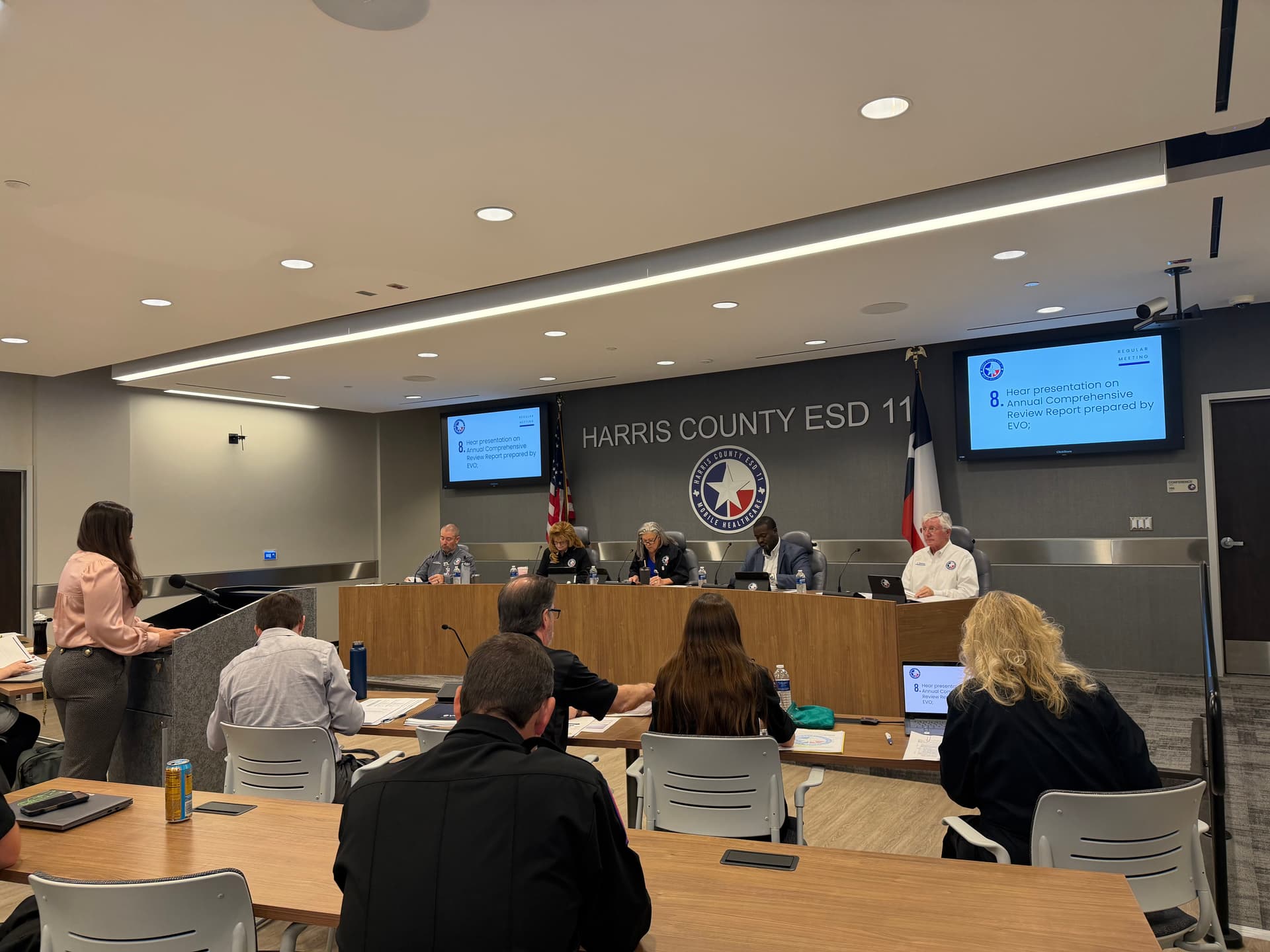
The Harris County Emergency Services District No. 11 Board of Commissioners approved a slight tax rate increase for the coming year during the Oct. 27 regular meeting.
At a glance
Commissioners unanimously approved a property tax rate of $0.039072 per $100 in home valuation, which Commissioner Dorothy Dalton said is “effectively a 3.69% increase” from the previous year. The board voted after no one spoke during the public hearing and after declining discussion.
For a median-valued homestead, the estimated property tax bill for the upcoming year is $124.05. That is calculated based on a median-valued homestead in the district valued at $317,484.
The board preliminarily approved the increase during its Sept. 22 meeting, when commissioners also voted without discussion.
Also of note
Commissioners also heard a presentation on the district’s annual comprehensive review report. The report is based on the 2025 tax roll and outlines development within the district and long-term growth. It was created by Evo, a data analysis company that works with emergency services districts and water districts.
The district spans about 177 square miles and has about 233,788 housing units and 634,771 residents, according to the report.
From 2024 to 2025, the district had a $2.745 billion increase in taxable value, according to the report. Next year, the district is estimated to have an increase of $2.058 billion in taxable value, bringing the total projected value to $81.33 billion. Per the report, it is also projected to bring in $30.18 million in revenue next year.
The statewide homestead cap, instituted in 1997, limits the amount a property can be taxed from year to year by 10%, according to the Harris Central Appraisal District. The report found that over the past two years, there has been a $5 billion decrease in the cap.
Cadence Dwyer, an economist with Evo, said the “recent cooling off” of market values over the past few years has allowed for large spikes in home value alongside the market cap.
Construction of new residential and commercial properties may slow in the coming years, per the report.
“This lack of physical growth combined with the continued limited growth in existing property value will limit the future growth of the taxable value of the district,” the report states.
The district is able to increase the tax rate up to the voter approval rate of $0.06 per $100 in taxable value, after which the increase would go to an election. It also has “some flexibility with patient billing to generate income to support operations,” the report notes.
Dwyer said the district has room to ensure it maintains the property tax revenues needed to function, but the district will need to continue monitoring them “as a lot of these prices stagnate but inflation continues to increase.”
“If all of your operation costs continue to increase significantly when your tax base isn’t, the gap has to come somewhere,” Dwyer said.