Austin released its first strategic plan for homelessness response in February. (Ben Thompson/Community Impact)
Austin Homeless Strategies and Operations unveiled its first-ever strategic plan in February, detailing how the city plans to invest and coordinate across the local homelessness response system in the coming year-plus.
“It’s how we will build on reporting, scale what’s proven, and stay accountable to measurable results. It will sharpen our focus, deepen our partnerships, and ensure that urgency and passion continue to guide every decision that we make," AHSO Director David Gray said Feb. 24.
The overview
The full plan is available to view online and was first released in a memo from Gray last week. It was developed last year and is meant to serve as a blueprint for AHSO from Austin's current fiscal year 2025-26 through FY 2026-27.
Gray said the city homelessness office spent months engaging with more than 30 local groups and polling its own team to build out the plan that addresses five high-level objectives:
Leadership of the area's homelessness system
Investments in the system
Crisis response management
Public communications
Support for AHSO staff and operations
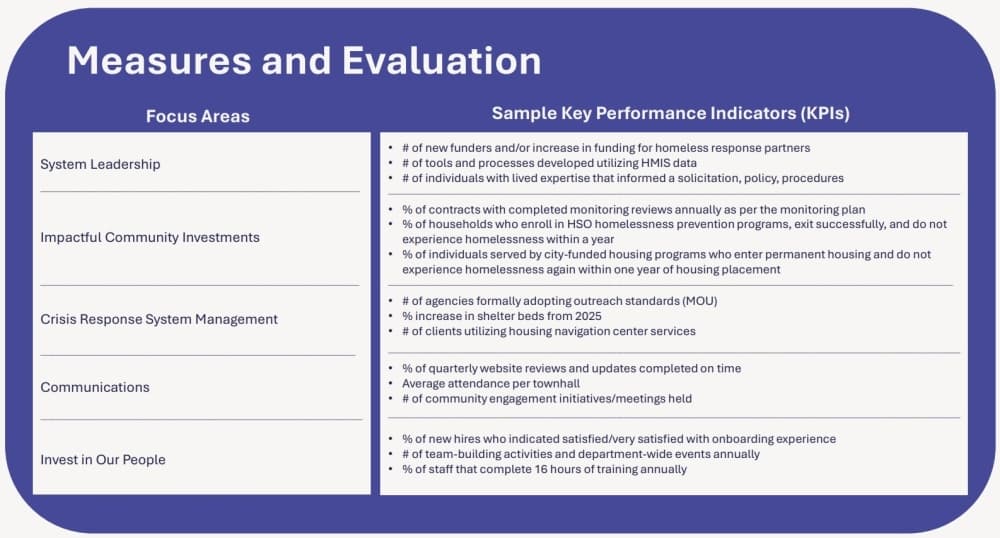
Dozens of strategies are laid out under those focus areas. Specific performance measures will be developed over the months ahead with the intent of improving how the city tracks items such as its spending and contracts, outcomes for homeless clients, resident and stakeholder engagement, and internal training.
The plan is meant to balance various priorities given constraints such as limited staffing and resources, Gray said, and updates are now underway. For example, programs such as street outreach have already seen recent additions, while transparency tools such as a new encampment dashboard are in development.
“A lot of this work’s already in progress, but our goal is to have really measurable outcomes on each of these goal areas by the end of FY ‘27," he said in an interview.
The new strategic plan is meant to improve tracking of the city's progress toward various goals for the local homelessness response system. (Courtesy city of Austin)
Put in perspective
During their first public briefing about the new plan, City Council members generally supported the outlook and questioned some pieces of the approach.
While the plan was crafted with dozens of local stakeholders, council member Vanessa Fuentes said its focus mainly on AHSO shouldn't mean the city is left as the only backer of new programs alongside other government and nonprofit entities.
“We cannot be the main entity funding and investing in homelessness," she said.
Council member Krista Laine, who has frequently remarked about less available outreach and offerings in her Northwest Austin district, also said Austin should look to work with more groups involved with homelessness outside of the central city area.
“I see a lot of signs that it is definitely critical to expand this list [of partners] if we are in fact going to meet the challenges of the increasing number of local children who do not have stable housing, the changes in where the homeless population is living in our city, and the challenges that they face both with connecting with services but also with transportation issues," she said.
AHSO's formal strategies were laid out after voters rejected a tax hike that would have provided millions of dollars for local efforts, and ahead of what Gray called "tectonic shifts" expected for federal homelessness funding. Still, he said the plan is based on commitments to housing assistance that can remain flexible regardless of past or anticipated budgeting impacts.
What else?
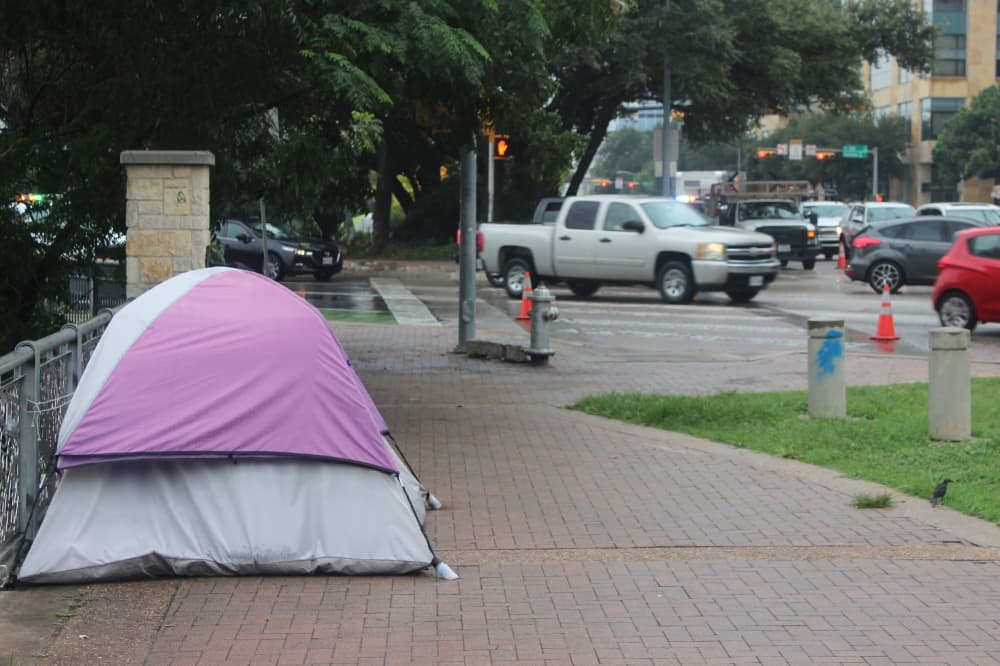
Among the plan's goals are better encampment management and related public engagement.
Gray said Austin currently does a "great job" balancing compassion and enforcement that is now required under local and state law, but that there's room for improvement with transparency, to be partially addressed via the forthcoming online dashboard with progress tracking for residents' service requests. He also said AHSO is looking to better maintain cleared areas once people are relocated.
“At our current staffing capacity, that’s been a big challenge for us. We are in the process of hiring more outreach staff and hiring more staff on our encampment management teams to help us do a better job of keeping areas clear after we’ve invested significant resources to get people into services and then to go and clean up a site," he said.
Two explicit targets for AHSO are the additions of 650 shelter beds and two new housing navigation centers—with one already slated to open.
City leaders have already been weighing Austin's shelter needs for years, and recent actions include the conversion of the Marshalling Yard warehouse to a 300-bed temporary shelter and the acquisition of downtown's Eighth Street shelter. On Feb. 26, council members will also take action to secure millions of state dollars for the expansion of The Other Ones Foundation's Esperanza Community on the east side.
Looking ahead, Gray said the city is "always searching for opportunities" to either buy new turnkey properties or land that would allow for more tailored shelter development. Depending on funding, future updates could include redeveloping the Northbridge shelter property off I-35 and shuttering temporary or aging facilities.
"One of the recommended bond projects is for a new shelter. And for us what that means is an opportunity to not only replace the Marshalling Yard, but also consider replacing [Austin Resource Center for the Homeless] and Eighth Street and closing those downtown shelters, and building a brand-new shelter that’s trauma-informed, that’s safe, but that’s also in a part of the city that’s not associated with or proximate to some all of the vices that we sometimes see being close to Sixth Street or in that downtown environment," Gray said.