Editor's note: This story has been updated to reflect that Kevin Webb is the Precinct 3 Commissioner for Comal County.
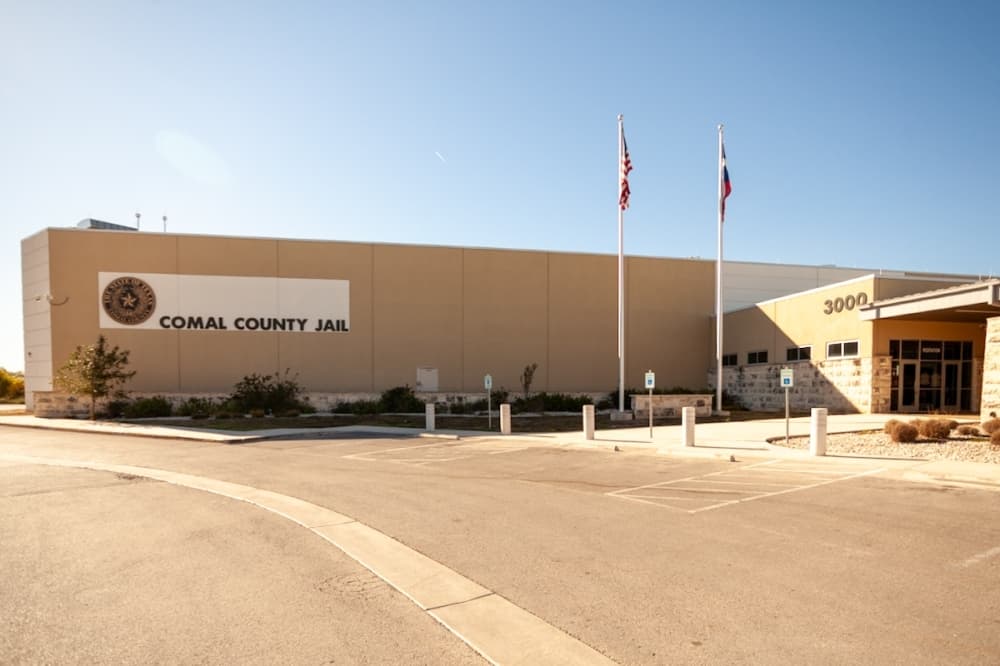
Another expansion to the Comal County Jail may be on the horizon.
Comal County Commissioners received an update from HDR, Inc., the firm tasked with gathering data on the potential expansion, on an ongoing feasibility study for the jail Nov. 20.
Commissioners showed support for “vertical” construction options designed to meet long-term growth, and an estimated upward trend in inmate capacity needs, according to a presentation from the firm.
The Comal County Jail, which completed its last expansion in 2020, has 582 beds and is operating at 88% capacity, according to the presentation.
The firm’s feasibility study shows the county growing at 23% annually, with an incarceration rate of 2.3% per 1,000 residents—slightly higher than the state average. Based on population trends, the county could require 810 beds by 2035 and 1,101 beds by 2045, according to the firm’s feasibility study.
Digging deeper
Several build-out scenarios were presented to commissioners, including repeating the existing single-story housing pods or constructing multi-story towers to maximize space. Only the tower options offer long-term capacity without exhausting the remaining land at the jail site, which commissioners saw as more practical.
Commissioners directed the firm to produce cost estimates for options 3A, 3B and 3C, all of which involve multi-story housing construction at the existing jail site off I-35.
Option 3A
- Two floors built out, third and fourth floors shelled
- Adds 274 beds
- Total capacity: 857 beds
- Meets projections until 2036
- Does not require immediate kitchen/laundry expansion
Option 3B
- Three floors built out, fourth floor shelled
- Adds 411 beds
- Total capacity: 994 beds
- Meets projections until 2041
- Does not require immediate kitchen/laundry expansion
Option 3C
- Full four-story tower build-out
- Adds 548 beds
- Total capacity: 1,131 beds
- Meets projections until 2046
- Requires kitchen and laundry expansion, including relocating warehouse storage
The three options would also create a footprint for a second future tower, extending potential capacity to the year 2055, according to the presentation.
Precinct 3 Commissioner Kevin Webb said the county wants to focus on future growth, rather than fulfilling short-term needs.
“The tower makes better use of space, and I think future us will thank us for planning ahead,” Webb said.
Martin Aguirre, project architect for HDR, Inc., said building vertically would require enhanced fire-protected construction, potentially increasing structural costs, but would preserve land and provide long-term flexibility.
Next steps
Once HDR delivers updated estimates, the court will determine design direction, financing and a construction timeline, according to the county.