Richardson residents are set to see water and wastewater rate increases this November as City Council considers new rate structures in light of rising costs for water and related services.
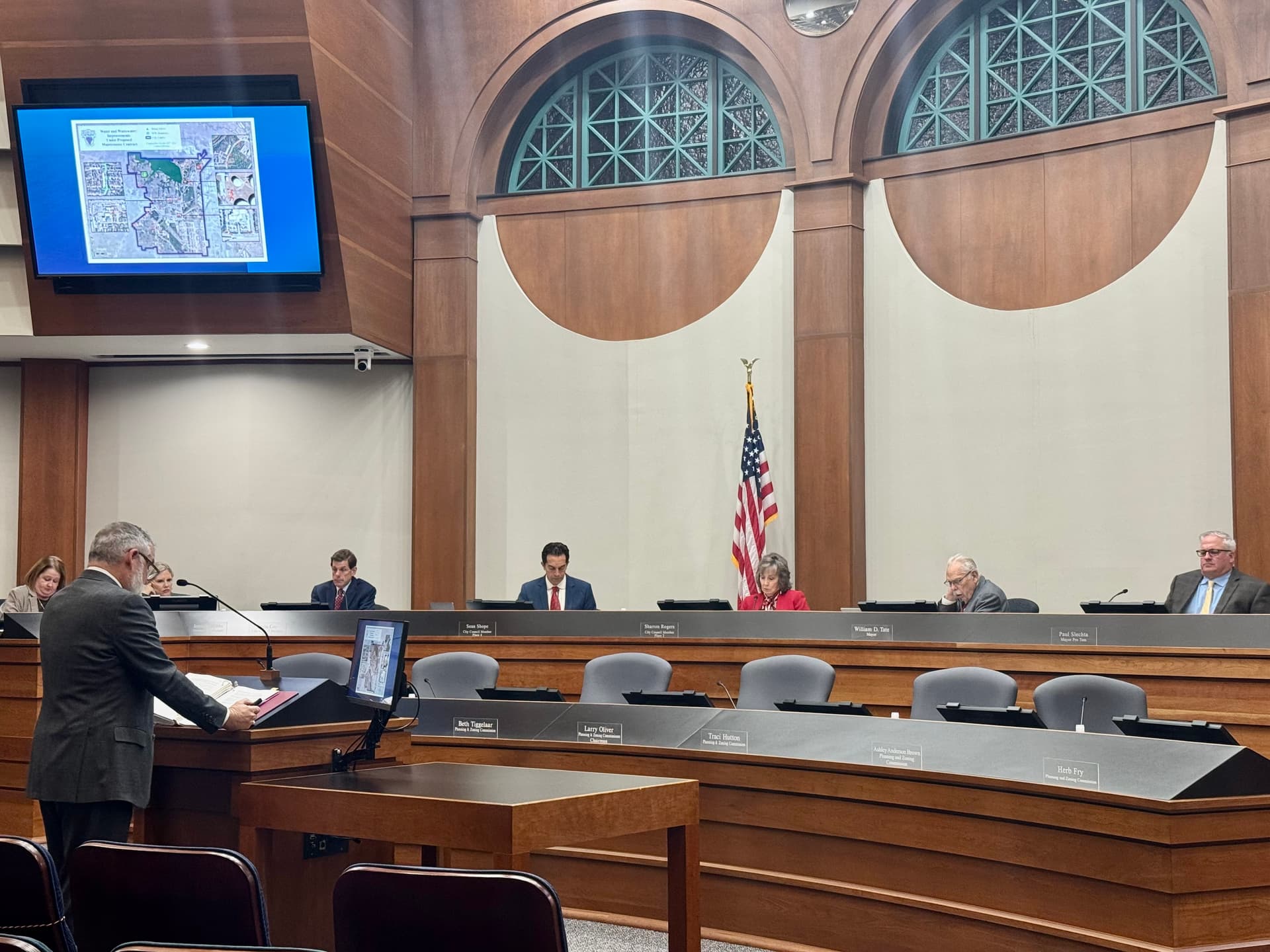
Consultant Dan Jackson, vice president at Willdan Financial Services, presented several options to increase the city’s water and sewer rates at the June 8 meeting.
“Water is a precious, valuable and diminishing natural resource,” Jackson said. “It is something that we literally cannot live without. However, water is becoming increasingly expensive, not only here in Richardson, but across Texas, across the United States and all across the world.”
What you need to know
The city currently charges an $8 monthly base charge as well as a volume rate that is calculated per 1,000 gallons of water used. Most utilities implement a higher monthly base charge for larger meters—the standard residential meter is a three-quarter inch, while a large manufacturing facility could have 8- or 10-inch meters.
Jackson proposed that Richardson not only increase its volume rate, but also implement higher charges for larger meters, which he called “meter equivalency.” This means water bills will increase the most for the highest water users, pushing more costs on commercial customers with lower increases for residential users who typically have smaller meters.
Jackson said the city could gradually phase in higher base charges over the next five years. The average residential user would see about an 8% increase in their monthly water bill each year, growing from $121.35 now to $152.91 in fiscal year 2028-29. The average commercial user would see a 10%-12% increase in their water bill each year.
“If [businesses] have a larger meter, then it takes more money to deliver the water into the business,” council member Arefin Shamsul said. “That model change is way overdue.”
The setup
The majority of Richardson’s water customers are residential accounts, but residential use only makes up about a third of the city’s water consumption. A smaller amount of commercial and special manufacturing accounts, which are likely to have larger meters, use the majority of Richardson’s water.
“[Richardson] charges the same $8 to every customer, whether they’re Walmart or a small family or a flower shop,” Jackson said. “That’s not how most utilities do it.”
Richardson’s $8 monthly base charge is also the lowest in the Dallas-Fort Worth area, with most cities charging between $20 and $30 a month.
The background
Richardson last adjusted its water and wastewater rates in November, but Jackson said the city’s standard rate increases will no longer be sufficient to cover costs.
The North Texas Municipal Water District, which the city buys its water from, has consistently raised its rates, while inflation continues to drive up utility operating and infrastructure costs.
It currently costs Richardson about $120.1 million to run its water and wastewater services. Jackson said that total will likely hit $196.7 million in 2035, due largely to cost increases from NTMWD.
“Water is a business,” Jackson said. “And like any other business, when costs go up, you’ve got no choice but to pass those costs over to your ultimate rate payer.”
Richardson’s existing water infrastructure also requires an estimated $83.89 million of investment over the next five years to replace and modernize the system.
“I don’t think anyone wants to see an increase in utility rates across the board, but it’s inevitable that we take care of our infrastructure,” council member Curtis Dorian said.
Another change
Jackson also proposed implementing a senior discount along with the rate restructuring, which would maintain the $8 base charge for senior residents. This discount would apply only to three-quarter meters, which are the standard residential meter size.
This would mean slightly higher increases for nonsenior residential customers, Jackson said.
“The majority of our population is aging in place,” council member Curtis Dorian said. “I do want to protect that asset to where it’s affordable for them to maintain their living environment.”
Also of note
Jackson also proposed an alternative plan to increase both the base and volume charges across the board, while maintaining the existing rate structure with an equal monthly base charge regardless of meter size. This would impact all customers equally, from residential to commercial users.
Under this proposal, the average residential user would see about a 10% increase in their monthly water bill each November over the next three years, increasing from $121.35 to $163.15 in FY 2028-29. The average commercial and special manufacturing user would see an increase of a little over 11% each year.
“These rate designs are all what we call revenue-neutral. They’re all designed to recover about the same amount of revenue,” Jackson said. “The decision you as a council have is, who do you get that revenue from?”
Several council members expressed preference for the meter equivalency plan, which would push more cost increases on commercial users than residential users, over the uniform charge increases.
Looking ahead
“I know it’s not easy to ask ratepayers to pay more, but it is necessary, not only to fund the water and sewer system, but also to continue to provide a superior level of service here at the city,” Jackson said.
City Manager Don Magner said city staff recommend the meter equivalency plan, increasing the base charge for larger meters, along with the senior discount, which several council members also voiced support for. Council is set to decide on the new rate plan at the June 22 meeting.