With a new section of the Dallas North Tollway set to open in late 2027, Celina officials are building a road map for future development.
At a Sept. 15 joint meeting, members of the Celina City Council and the board of the Celina Economic Development Corporation met with Kyle Talente, principal of consulting firm RKG Associates, to discuss officials’ long-term vision for land surrounding the future DNT.
“This is going to be our golden highway,” council member Andy Hopkins said.
The setup
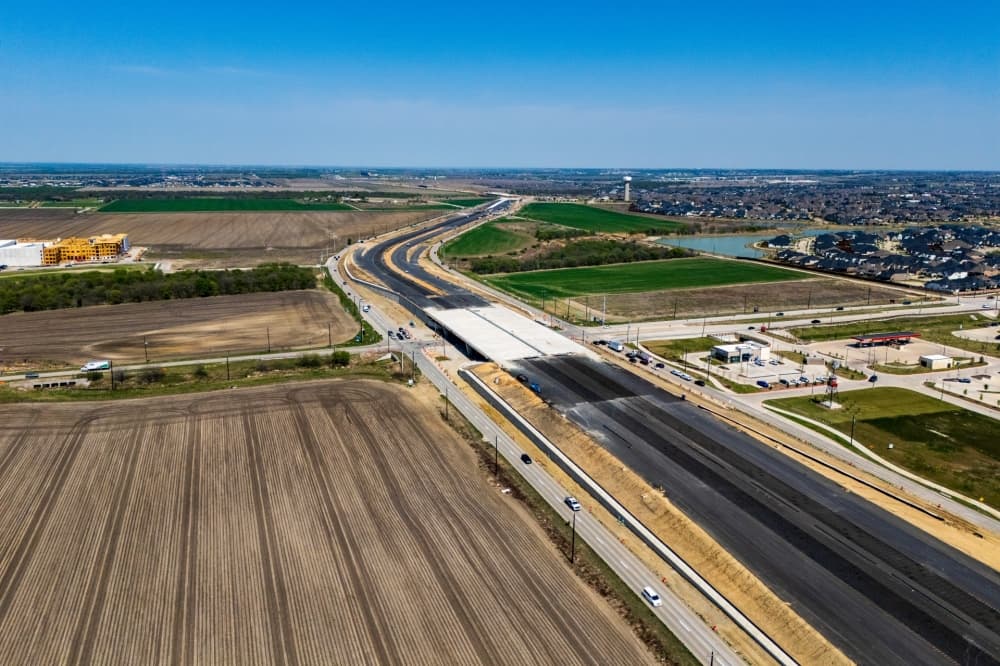
Construction is underway to extend DNT from US 380 to FM 428, according to the North Texas Tollway Authority, or NTTA.
Work on that section is set to wrap up in late 2027, and plans for the next section from FM 428 to CR 60 are under development, per the NTTA.
Officials expect DNT to drive economic growth in Celina the same way it did for other cities like Plano and Frisco, CEDC President Anthony Satarino said.
Major developments like Legacy West and Haggard Farms in Plano, as well as Hall Office Park, Stonebriar Mall and The Star in Frisco, all popped up near DNT, Satarino said.
The outlook
Celina officials are prioritizing employment centers as the anchor for development along the future DNT, according to RKG Associates' survey of the council and CEDC board.
Officials envision the tollway as a place for high-end mixed-use developments where corporate campuses are located alongside retail and entertainment destinations.
While the ideal mixed-use development may include a multifamily or condominium component to help support office and commercial users, the vision for Celina’s DNT frontage does not prioritize single-family homes, Talente said.
“You have plenty of land in this city to accommodate single-family development,” he said. “It's not to say that single family development is bad, but especially within the frontage areas of the tollway, that isn't really consistent with what our vision is.”
That vision applies to undeveloped land, not land that may already have single-family neighborhoods on it, Talente clarified.
“The goal here is not to change existing communities,” he said.
How it works
To facilitate their desired development, officials are working to revamp the city’s existing DNT overlay district, or DNTO, which sets guidelines for development decisions in the frontage area.
The DNTO is made up of a high-rise subzone that applies to 2,500 feet of frontage on each side from Punk Carter Parkway to Mobberly Road and a suburban subzone that covers 1,000 feet of frontage on each side everywhere else along the tollway, according to city ordinance.
As it stands, provisions in the DNTO, like requiring all nonresidential buildings in the high-rise subzone to be at least four stories, can be so narrow that they end up excluding attractive developments, officials said.
In the next iteration of the DNTO, officials plan to write guidelines that incentivize development by making it easier to build projects that align with the city’s goals instead of relying solely on strict prescriptions.
For example, officials could create a medical district around Methodist Celina Medical Center by allowing more leeway for developments that include a healthcare component, Talente said.
“It’s a starting point,” City Manager Robert Ranc said. “It’s leverage to negotiate the type of development that we want to see.”
Something to note
While light industrial uses like small-scale manufacturing, warehousing and logistics hubs were low on officials’ list of priorities, manufacturing was third on RKG Associates’s ranking of growth sectors in Collin County based on projected demand for square footage over the next decade.
“I recognize and realize that’s always going to be a touchy subject no matter where it is, but from RKG’s perspective … there is a role for [industrial] along the tollway,” Talente said.
Industrial development can help Celina maximize land along the DNT, he said. While companies in that sector prefer to be near distribution corridors, they don’t need to be seen from the highway.
Allotting space for light industrial development further back from the tollway within the DNTO would allow Celina to reap the economic benefits while maintaining the city’s aesthetic standards, council member Philip Ferguson said.
Even if officials allow light industrial uses, companies could still be priced out, Mayor Ryan Tubbs said.
“The biggest challenge you’re going to face is the barrier to entry just based off of land prices,” he said. “Industrial will pay $3 to $5 a foot, which is what our single-family prices are right now, and this is $15 to $20 a foot.”
Next steps
Based on officials’ feedback, RKG Associates will work on specific proposals to update Celina’s DNTO.
Council and the CEDC board will likely meet for one more joint meeting before a draft of the DNTO goes to council for final approval, Talente said.