Contending with lower than projected student attendance and property value growth, Hutto ISD staff are exploring new avenues for flexibility in the school district's budget.
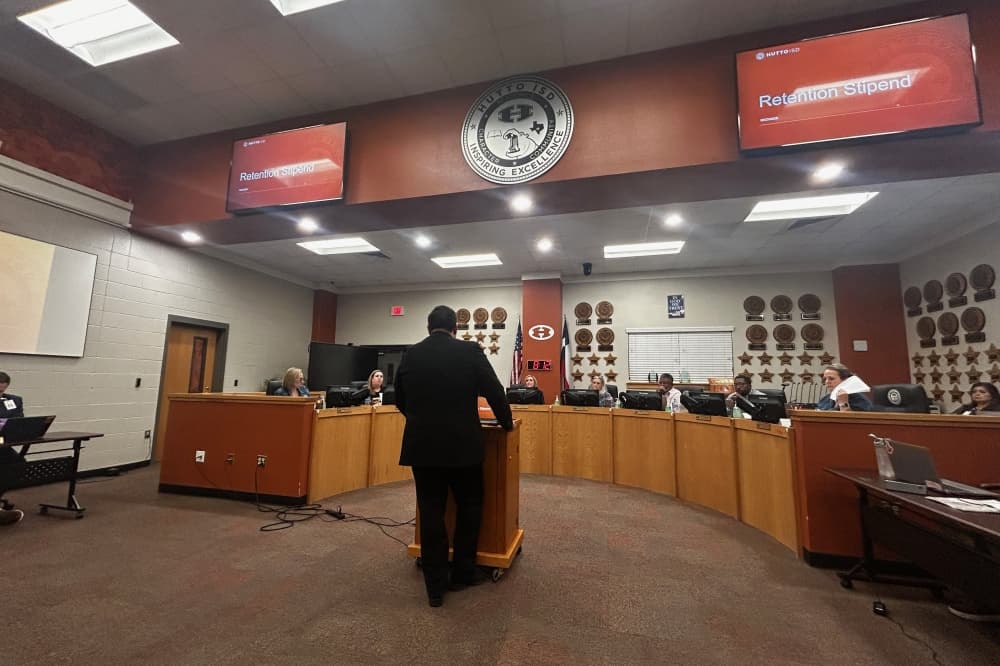
HISD Chief Financial Officer Caleb Steed provided a look at conditions impacting planning for the 2026-27 financial year, which begins July 1 in the district, in a Feb. 12 workshop.
In a nutshell
Campus leaders have been instructed to plan for all nonpayroll expenditures to remain flat, he said, as premiums for health and property insurance are expected to increase and enrollment growth to slow.
Steed said his staff have identified a few methods of containing costs further, including discontinuation of HISD's participation in the federal School Health and Related Services reimbursement program.
Leaving the program would not mean a discontinuation of services, as it only provides a reimbursement to school districts for services provided, he said.
How we got here
In recent years, the SHARS program has caused some volatility in budget planning for Texas school districts. After losing a yearslong appeal, the Texas Health and Human Services Commission notified districts in 2024 that their funding through this program would be reduced as a result.
In the 2021-22 financial year, Texas schools had an over $300 million retroactive reduction in funding for services provided to students. The audit and subsequent reduction in funds were due to a coding error for services provided, a representative of HHSC said at the time.
Given the decline in revenue received from the program in recent years, Steed suggested that the district might choose to leave it as time spent documenting services received is no longer a "no-brainer" for additional funds, but also takes time away from students.
"We would bring in upwards—at the very high end—$2 million to the district," Steed said. "The cost was nowhere near that because it's services that you're having to do anyway. So your additional cost is the third party software and then any additional like pieces of audit or any additional employee turnover that may happen."
In the coming school year, Steed said his department did not expect to reasonably turn a worthwhile profit on the cost of documenting services provided.
What else?
Steed said the district is assuming a 6% increase of total property value, lower than the usual 10% assumed increase, for planning. Preliminary numbers from the Williamson Central Appraisal District will be shared in April, he said. The lower projection is due to many homesteaded properties approaching full taxable value, he said, as the homestead exemption only allows taxable values to increase 10% per year.
The district is also only projecting enrollment growth of 240 students for the 2026-27 school year, he said, well below the 400-600 annual increase planned to generate revenue.
"I say 'only'—that's actually a lot," Steed said. "A lot of districts would love to have something like that. But for us, we're used to seeing between 400 and 600 growth in our [average daily attendance]. ... So that's where it's a little bit shift for us."
What's next?
Budget discussions will continue through the coming months, Steed said. Because the district has a July 1 start to its fiscal year, the budget for the coming year must be passed by the board of trustees on or before June 30.