North Austin will soon be home to a major expansion of The University of Texas’ medical, academic and research systems.
The big picture
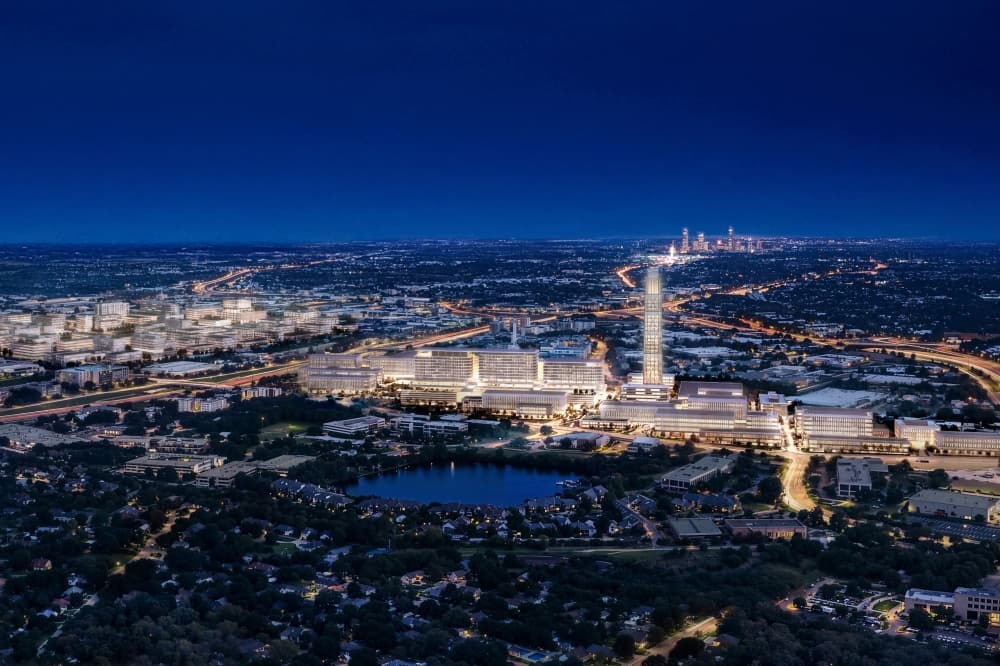
The 27-acre UT Dell Medical Center, a collaboration with the UT MD Anderson Cancer Center, will break ground this fall and is set to open in 2030 with a hospital tower, outpatient facilities and emergency department. New facilities will then be added in phases through 2032. The medical complex is one piece of the recently announced 300-acre UT Dell Campus for Advanced Research off MoPac.
The health care hub is aimed at filling local care and training gaps, as Austin remains the largest city in the nation without a comprehensive academic medical center.
“I don’t know anyone else who’s building an entire academic health system [from new] in the country, let alone the world. But I also can’t think of a better place to do it given this convergence and the last decade of what the medical school has delivered on,” Dell Medical School Dean Claudia Lucchinetti said in an interview.
A closer look
The university confirmed the medical center will feature 300-500 patient beds for specialized care, including potential cutting-edge clinical trials and therapies, to ensure patients won’t have to navigate multiple facilities or search outside Central Texas to address their needs.
“We hope to provide a much more integrated and seamless experience with less friction so that once they come in ... they can get all of that in a coordinated, seamless way,” Lucchinetti said.
Put in perspective
UT’s medical center represents the latest major medical addition in the North Austin area where institutions like Texas Children’s and Dell Children’s also widened their footprints. Ed Buchanan, Texas Children’s Austin chief medical officer, said the expansions significantly elevate the “rapidly maturing” health care landscape.
The complex is expected to provide new opportunities as Dell Medical School grows. It now has about 200 active students and almost 500 residents or fellows.
The new facility could increase annual enrollment, allow for new residency programs and support other health care professionals’ training.
“Creating a hospital for the 21st century with those capabilities built in provides an environment for not only our doctors and our nurses and our care team, but for our students and our residents to be actually learning in the environment they are practicing in,” Lucchinetti said.
Zooming out
The new campus ties into broader efforts to encourage health and science initiatives.
The facility was initially expected to rise downtown near Dell Seton Medical Center, and state lawmakers removed building restrictions on a university-owned property for the UT-MD Anderson project. However, the project’s scope led officials to select Northwest Austin instead.
UT’s entire advanced research campus off MoPac went through a rezoning process ahead of the medical center announcement. That update placed hundreds of acres under Austin’s Research and Sciences Mixed Use label. The change included the medical center site, undeveloped land next door, and a shopping center and JJ Pickle Research Campus across MoPac.
UT’s announcement showed possible future development on those other sites, and said the broader campus will result in economic growth tied to medicine, health and life science, and tech initiatives.
The bottom line
Lucchinetti noted many patients still see rising costs, access and outcome gaps while providers face workforce shortages and complex disease treatment.
With those challenges in mind, officials are looking to ensure new investments end up improving the health of Central Texans for years to come. The campus also ties into UT’s established research, engineering and computing capabilities; the university said the new medical center will be “[Artificial intelligence]-native” with advanced technologies embedded in care.
What’s been referred to as a “once-in-a-generation” project won’t replace existing services around Austin, Lucchinetti said, but instead will bring new offerings for patients in the city, throughout the region and statewide.
“We are committed to ... changing the model of care delivery, and hope to become a model of health for the nation,” she said.