Doctors at Resolute Baptist Hospital in New Braunfels have begun using a new piece of technology to help treat cardiac issues, like atrial fibrillation.
Atrial fibrillation is a rhythm disorder where the upper chamber of the heart is beating rapidly and not contracting, which increases an individual’s risk of stroke. Symptoms of atrial fibrillation include feeling tired, fatigued, short of breath or having palpitations, Dr. Shane Bailey said.
Bailey is a board certified physician at Resolute Baptist Hospital who specializes in cardiac electrophysiology, cardiology and internal medicine.
Key information
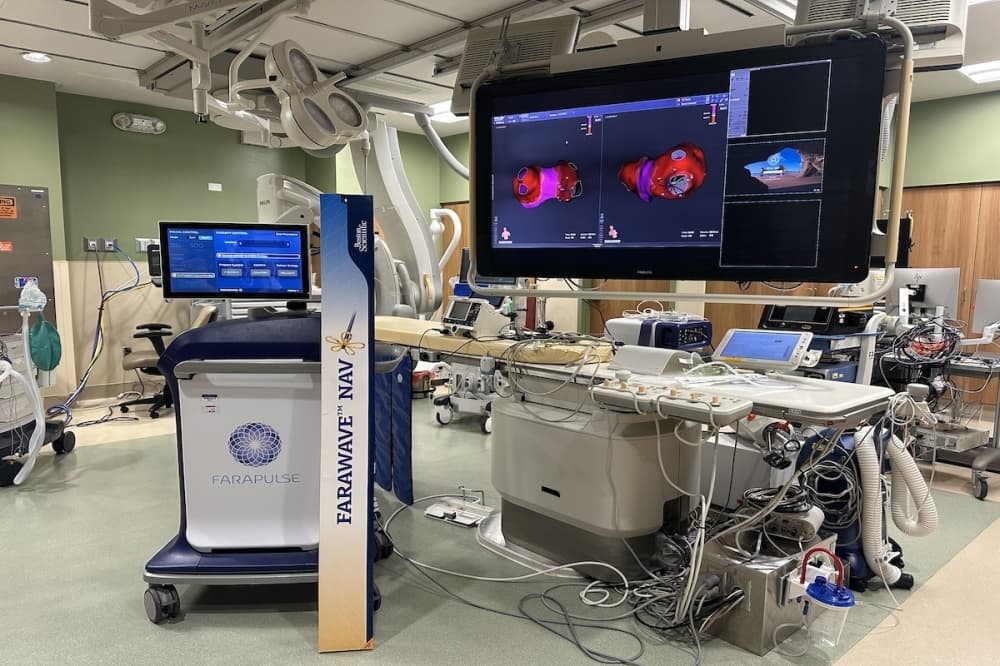
Created by Boston Scientific, the OPAL HDx Mapping System is an advanced 3D mapping system used to help physicians understand where catheters are inside a patient who decides to get treated for atrial fibrillation. When someone with atrial fibrillation decides to get treated, doctors have to put catheters up into the patient’s leg to their heart, Bailey said.
The OPAL HDx Mapping System works with the FARAPULSE Pulsed Field Ablation System and the FARAWAVE NAV Ablation Catheter to streamline the procedures by combining mapping and ablation.
The FARAPULSE Pulsed Field Ablation System and the FARAWAVE NAV Ablation Catheter technology creates nonthermal heat when delivering energy, which does not create thermal damage, unlike radiofrequency ablation or cryoablation procedures—which could collaterally damage nerves or the esophagus due to thin walls in the heart. Radiofrequency ablation is a procedure that burns parts of the heart, and cryoablation is a procedure that freezes parts of the heart, Bailey said.
“For decades we’ve always been worried about, ‘Are we [going to] damage the nerves?’ ‘Are we [going to] damage the esophagus?’ Now with this technology we don’t have to worry about that,” he said.
Aside from atrial fibrillation, the mapping system will also be able to help treat atrial flutter and supraventricular tachycardia, Bailey said.