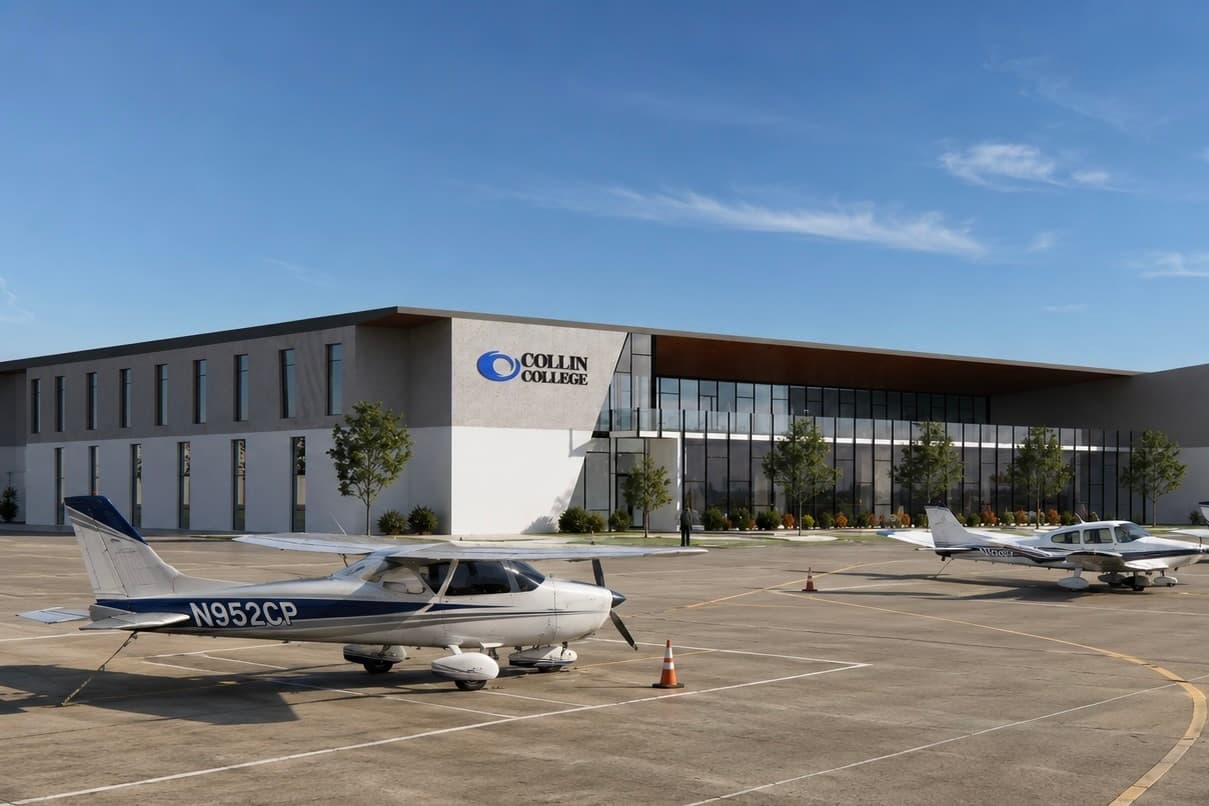
If approved by voters, the Collin College bond proposition would fund a new Aviation Academy at McKinney National Airport, officials said. The new facility, as well as other planned expansions and new campuses, are part of the college's Destination 2030 plan to expand the organization's footprint across the country. (Rendering courtesy Collin College)
This November, Collin County voters will consider a $600 million Collin College bond proposition that could expand eight campuses and build new ones in Anna and Royse City, plus an aviation academy in McKinney.
The overview
The proposed expansions include new buildings that would be used for workforce education and other program-based needs. If approved by voters, the single bond proposition would fund projects to meet countywide growth while also meeting workforce needs identified by college officials, per the college's website.
“If [the pathways] come to fruition, it’s a real feather in the cap,” Collin College District President Neil Matkin said.
The McKinney campus expansion would add space for programs like construction management, electrical, HVAC, welding, auto technology, healthcare professions and information technology. Plano’s Courtyard Center expansion would focus on renovations for its web development, cybersecurity and healthcare programs, per the college website.
Allen campus renovations would add more classroom and lab space, and more space for automotive technology, diesel technology and automotive specialty programs, per the website. Celina campus renovations would include a new Career and Technical Education center for health professions, welding, construction management and HVAC.
Frisco campus expansions would include a new space for doctoral and graduate-level pathways with a regional university partner, as well as expanded space for healthcare programs in endoscopy and occupational therapy, per the college’s website.
The need
The proposed construction projects are part of Collin College’s Destination 2030, a long-range master plan created to address projected enrollment growth, workforce needs and aging facilities. While some expansions would add to campuses that opened in 2020 and 2021, the average age of Collin College’s campuses is roughly 20 years. The college’s enrollment has also grown by 11.92% from 2017 to 2024.
When Collin College adopted its Destination 2030 master plan in 2023, projects from the 2017 bond were incorporated into the plan as Phase 1. The proposed $600 million bond would fund the second and third phases of Destination 2030. Frisco Chamber of Commerce President Christal Howard said the college’s expansion fosters a stronger workforce pipeline and further talent development.
“Workforce availability is one of the biggest factors that affects a business’s ability to succeed and grow," Howard said. "When students can receive the right relevant education and training and have it be affordable and close to home, it helps create a stronger pipeline of people who can build their careers here and stay long term, which helps our businesses scale and grow."
McKinney National Airport generates nearly $300 million in economic output annually, Airport Director Ken Carley said, and aviation partners “are always interested in workforce development and a pipeline of aviation professionals.”
“[The Aviation Academy will] be wildly successful here,” Carley said. “It’s definitely going to have a positive impact on the economic activity and output of the airport and what it gives back to the community.”
Numbers to Know
1986: Collin College opens its first campus in McKinney
1988: Second campus opens in Plano
+56%: Allen's Technical Campus enrollment growth over the last five years
+198%: Celina's campus enrollment growth over the last five years
+78%: Wylie's campus enrollment growth since fall 2021
1/3: Students coming from out of district into the Wylie campus
11: Collin College campuses now open
4: Collin College campuses that have opened since the first bond in 2017
The cost
Matkin said the college’s property tax rate is expected to stay the same if the 2026 bond is approved. However, voters will see the bond proposition listed as a tax rate increase on the Nov. 3 ballot, he said.
Josh Sanderson, the executive director at Equity Center, said schools are expected to build bond repayment into their annual tax rates. Equity Center is an Austin-based nonprofit that represents school districts seeking funding. He said state law requires schools to list bond election items as a tax rate increase even if homeowners would be paying the same as the previous year.
“You’re supposed to set a tax rate that generates enough revenue for the year for you to pay your bonded debt back,” Sanderson said.
Most projects from the college's previous bond have been completed under budget, Matkin said, noting that college officials aren’t going to sell more bonds unless the college can afford to repay them without raising the tax rate.
“We’re going to continue to sell bonds when the financial circumstances surrounding it allow us to keep our word and do the right thing,” Matkin said.
What voters need to know
Matkin said with the addition and expansion of the college’s five bachelor’s degree programs, as well as dual credit programs and more career and technical education opportunities, “the demand doesn’t seem to be slowing down for us.”
As the region’s growth continues, Collin College has become “a destination college” that will continue operating at its current capacity if voters do not approve the bond, he said.
If voters don’t approve the bond proposition, Matkin said the district would look to alternative financing options.
“With the kind of growth we’ve experienced, we’d figure out alternative financing or we’d slow the projects down until we could figure out a way to afford them,” Matkin said. "Nothing slows down."
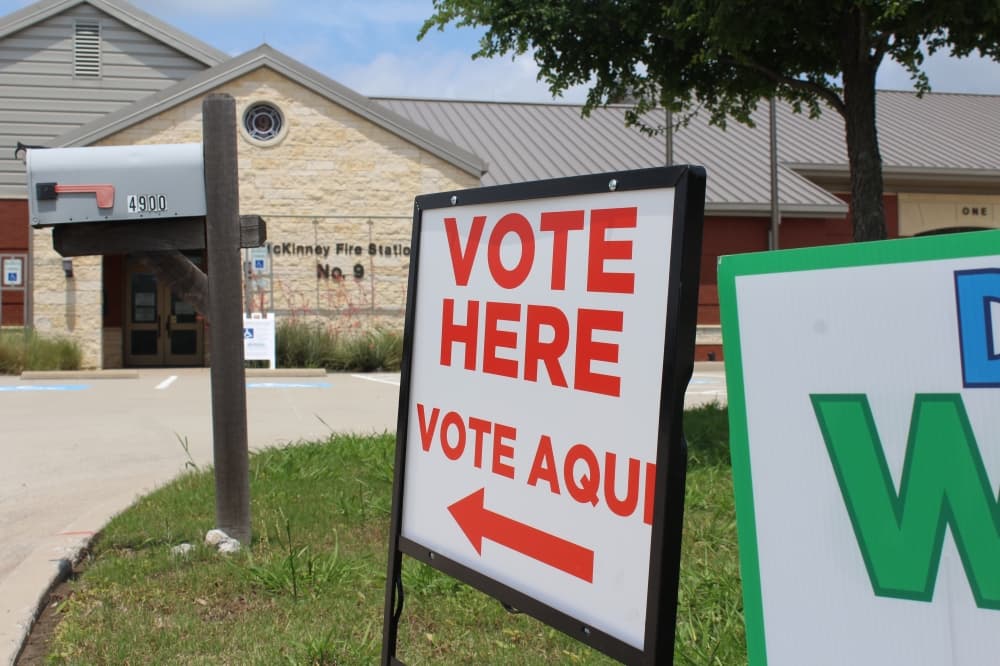
Early voting begins Oct. 19: Here is what Collin County residents need to know