Editor's note: To view this story as it appeared in Community Impact's Cedar Park edition, click here.
When Jennifer Bittner moved to the Austin area in June 2023, she feared her family would need to make frequent, hours-long trips to Houston to access specialized care for her children.
Bittner, who has three medically complex children, said specialty services were still expanding when her family first settled into the area.
“When we first moved here ... [Texas Children’s] wasn’t finished yet, so we were really concerned that we’d be traveling back and forth to Houston every couple of months,” she said.
Today, Bittner’s family makes just two trips to Houston each year for care related to her sons’ rare disease. Both boys receive regular care at Austin’s Texas Children’s Hospital, located along US 183 heading toward Cedar Park, while her daughter receives care at Dell Children’s Medical Center in Central Austin.
For families like the Bittners, the opening of new hospitals in the Austin metro has expanded access to specialized programs much closer to home.
By the numbers
Between 2017 and 2024, Williamson County’s child population increased by 19.2%, or 26,034, according to data from the U.S. Census Bureau’s American Community Survey 5-Year Estimates. The same data indicates that the overall populations of Williamson and Travis counties grew by 17.9% and 6.3%, from 2020 to 2024, respectively.
As one of the fastest-growing metro areas in the country, Austin and its northern suburbs have seen a rapid increase in the need for pediatric specialties. In 2020, then-President of Dell Children’s Medical Center Christopher Born said that more than 5,500 children in Central Texas had traveled outside the region for complex care since 2009.
To respond to the area’s rapid growth, Dell Children’s opened a new four-story North Campus in 2023, which treated more than 15,500 emergency patients in its first year of operation. The following year, Texas Children’s Hospital opened its five-story North Austin Campus.
Beyond introducing new pediatric specialties to the area, these facilities have also expanded access to existing services.
“I prefer to have our appointments at the main hospital, Texas Children’s Hospital [North Austin Campus], mainly because you have radiology there already, or if you take a blood draw, it’s all there. That’s way easier,” Bittner said. “If you’re going to the outside clinics, they don’t have that.”
While Texas Children’s serves as a catchment area for Lubbock, Midland, Odessa and parts of the Rio Grande Valley, patients also regularly come from San Antonio, Cara Buskmiller, a fetal surgeon at Texas Children’s, said. Families have even come from neighboring states.
“Most of the families that we serve would have had to travel to Houston, and the doctors they see who recognize the problem historically had been referred to Houston, either to Texas Children’s Houston or elsewhere,” Buskmiller said. “It’s wonderful to save those families the trip and the travel.”
At a glance
Buskmiller treats expectant mothers after their fetuses are diagnosed with spina bida, a condition where the spine doesn’t form properly in utero. Spina bida affects 1 in 2,857 births annually nationwide, per Centers for Disease Control and Prevention.
Between its Houston and Austin locations, Texas Children’s treats one case every two to three weeks, Buskmiller said.
Spina bida is typically detected by ultrasound. At Texas Children’s, mothers whose babies carry the condition can now receive surgery to treat it in utero. While spina bida can be treated after birth, new studies demonstrate that treating the most severe form, myelomeningocele, improves outcomes for fetuses.
Patients who undergo the procedure can typically return home after about four days in the hospital, even if they live outside Central Texas and lack access to a local fetal center, Buskmiller said. By November 2025, Texas Children's completed the most fetoscopic surgeries — a less invasive, in utero surgery — of any fetal center in the nation.
Texas Children’s fetal center stays in touch with the mother after the surgery to monitor outcomes.
“Sometimes that means the mom continues her care at Texas Children’s,” Buskmiller said. “Sometimes that means the mom goes back to her health care team and has something closer to the idea of what she envisioned for her delivery before discovering that her baby had spina bifida.”
Earlier this year, Texas Children’s also became the first pediatric hospital with its own helicopter in Austin, expanding the facility’s ability to provide faster critical care in Central Texas.
Check this out
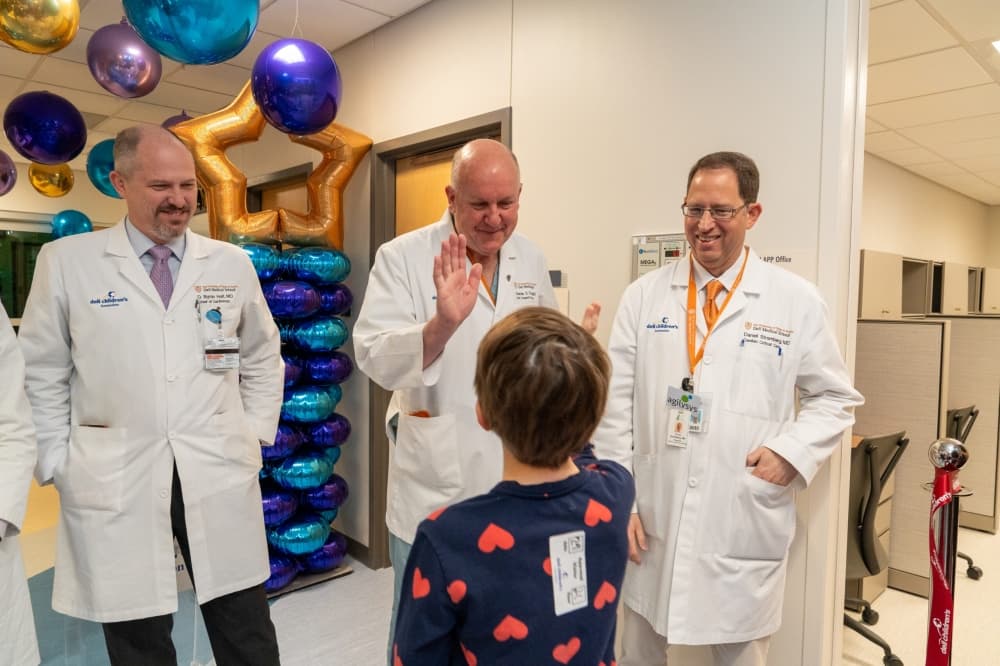
In 2025, Dell Children’s North Campus became the first pediatric hospital in the world to perform spinal surgeries using an advanced active robotic-assisted navigation platform. This technology supports surgeons in operating with precision on especially complex spinal deformity cases.
The same year, Dell Children’s Austin campus performed Central Texas’ first successful pediatric bone marrow transplant. According to previous Community Impact reporting, families receiving this care had to travel to San Antonio, Houston or Dallas for this treatment, which could mean leaving their jobs and support networks for months at a time.
“Those families did have to go to Houston, so that is wrapping right into [our] decade vision ... to keep families closer at home,” Heckenlively said.
The program, which treats pediatric cancer, partners with We Are Blood, the sole supplier of blood products to facilities that perform blood transfusions in Central Texas.
The collaboration began after Dell Children's Medical Center approached We Are Blood to help collect stem cells, Nick Canedo, We Are Blood's vice president of community engagement, said.
“We were thrilled to have this opportunity to be able to participate and make happen this revolutionary treatment now available for pediatric patients in Central Texas,” Canedo said.
Although We Are Blood has collected stem cells for adult patients for more than 15 years, its pediatric stem cell program marked a first for the organization, which more commonly supports children through blood, platelet and plasma donations for transfusions, he said.
We Are Blood assists hospitals in finding donors for pediatric patients with specialized needs. However, only 3% of eligible donors in Central Texas support the blood needs of more than 2.5 million residents, Canedo said, adding that the blood center needs to develop both its infrastructure and donor base.
“Many of the amazing new pediatric health care developments in our community over the past 15 years, especially like new revolutionary transplant programs, are really only possible when there is a transfusion available in blood products that the patient can have during the surgery and transplant,” Canedo said. “We've been proud to be able to support those new programs as they've grown in our community.”
The cost
Cathy Heckenlively, chief administrative officer of Dell Children’s Medical Center North Campus, said data suggests that the “population explosion” of the younger population in recent years will “plateau just a little bit” as children continue to grow. However, Heckenlively doesn’t expect medical innovation to stop.
Bittner still must travel to Houston twice a year for her sons, who have a rare mitochondrial disease. Bittner noted the cost of traveling, both across Austin and to Houston, has been difficult for her family.
“I don’t think people realize when you have a medically complex child, or if you yourself are medically complex, the money that goes into spending not only on health care,” Bittner said.
The future
Looking forward, hospitals in the region are planning for growth. Dell Children’s North Campus is working to further expand its orthopedics program, Heckenlively said.
Establishing cutting-edge procedures and specialties not only expands patient offerings but also attracts new recruits, Heckenlively said. The orthopedics team attracted a new sports surgery doctor following the debut of the robotic surgery.
The north campus is also seeking to develop an organ transplant program. Dell Children’s has also relocated its urologists to its north campus in order to grow its urology department.
The plastic surgery department is also expanding its footprint on the north campus. Currently, the Dell Children’s Craniofacial and Reconstructive Plastic Surgery North team treats patients with burns, cleft palate and other conditions.
Meanwhile, Texas Children’s is integrating the resources of Austin to develop and expand its offerings. The fetal center in Austin conducts more research and innovation on medical devices to improve the safety of fetal surgery than the Houston location, Buskmiller said.
Texas Children’s is blending its Houston foundation with Austin’s “spirit of innovation,” she said.