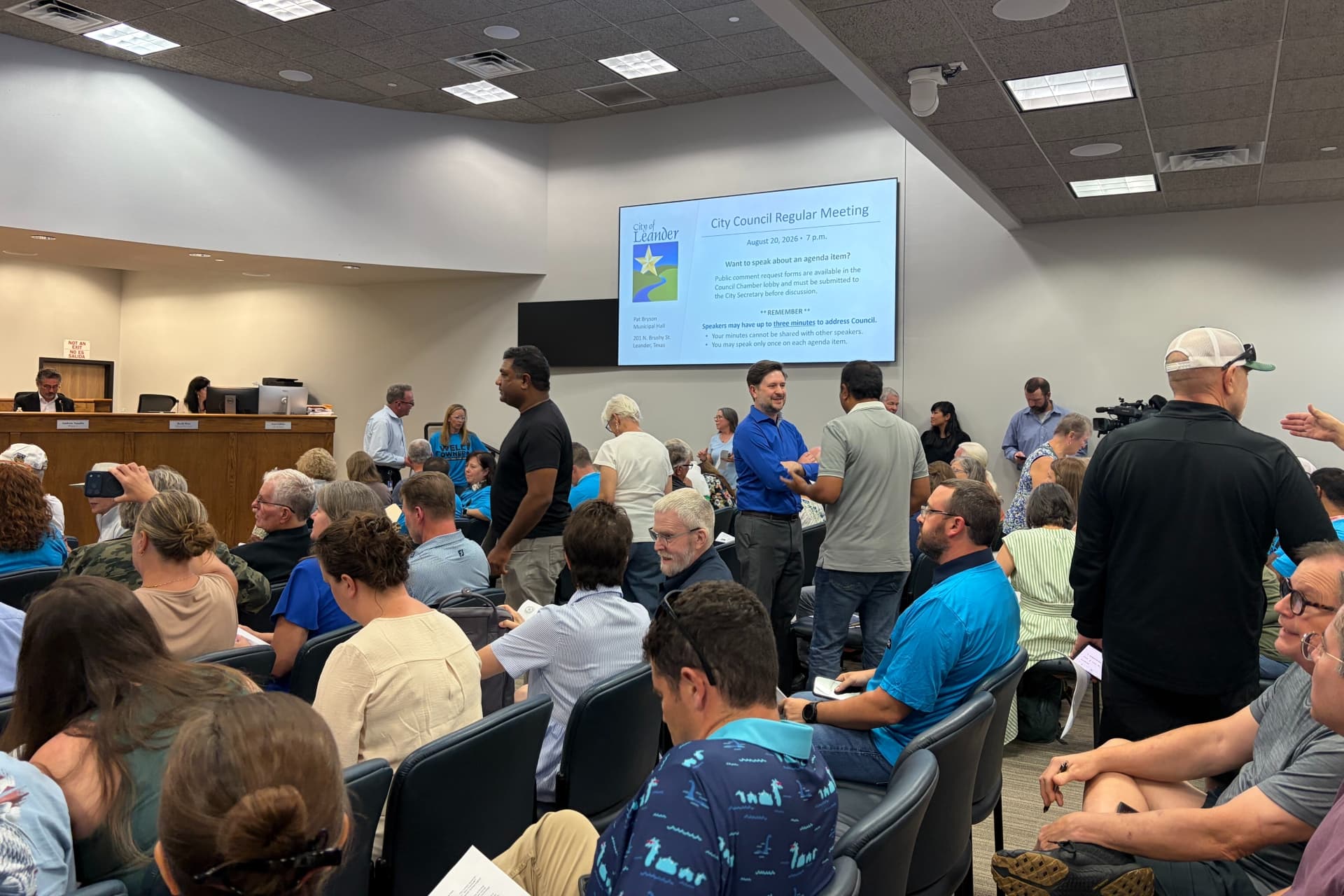
Dozens of residents expressed their opinions during the Aug. 20 Leander City Council meeting. The fire marshal permitted viewers to come in only as others left due to capacity concerns. (Hamera Shabbir/Community Impact)
The Leander City Council unanimously voted Aug. 20 to reject a zoning change for the lagoon-anchored Leander Springs development.
Residents raised numerous concerns, ranging from the proposed 4-acre lagoon’s impact on groundwater to traffic in neighboring communities, during a public hearing that lasted over two hours.
“Timing is everything," Mayor Na'Cole Thompson said. "When this project probably came to council nine or 10 years ago, it was probably the right move at that time, but the city has grown and developed and changed."
The gist
The Leander Springs project received an initial approval from the city’s planning and zoning commission June 25, allowing developers to pitch plans to city council for a 4-acre lagoon surrounded by 1,200 apartments, over a million square feet of commercial space, a 275-room hotel, a 20,000-square-foot conference center and 21 acres of parkland. The development was proposed for a tract of land along 183A Toll and RM 2243, south of the Northline development.
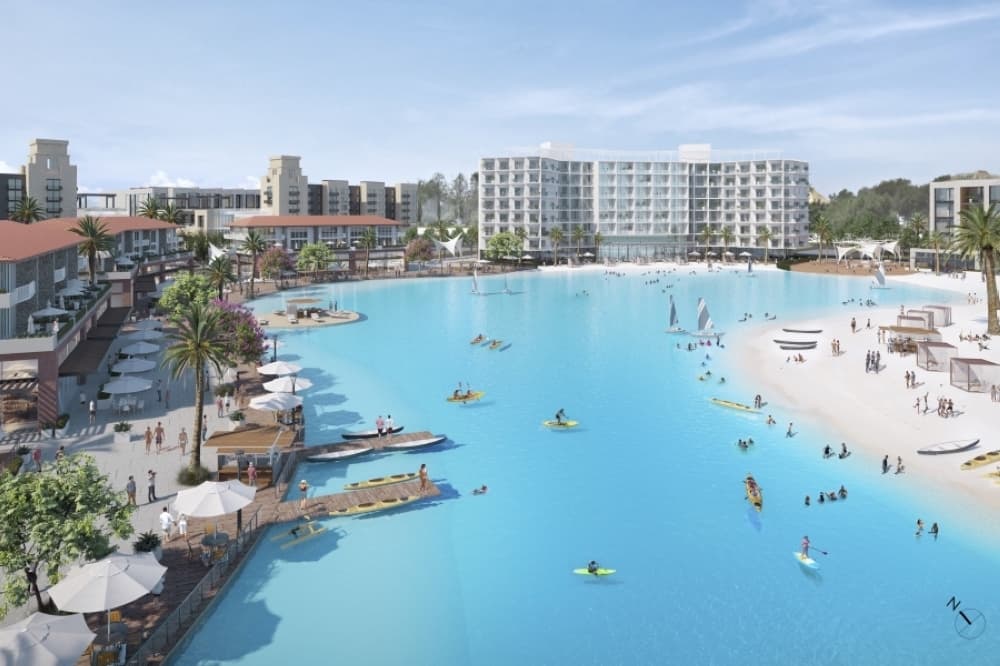
Leander Springs has undergone several revisions since it was first brought to city officials in 2018. This previous rendering for a previous iteration of the plan highlights the crystal lagoon that was the centerpiece of the previous development. (Courtesy iLand Development Group)
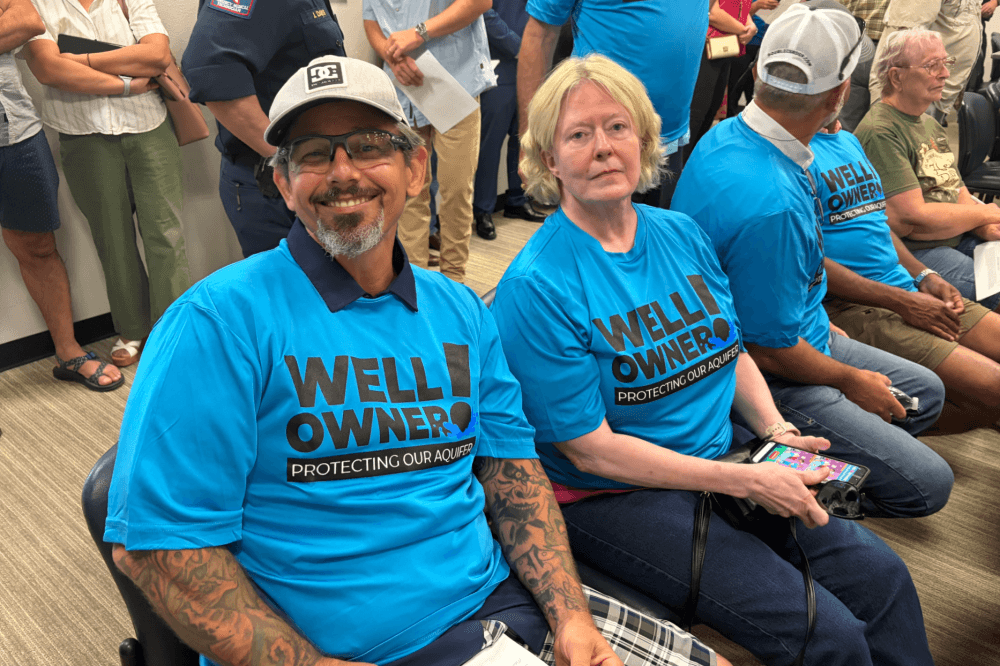
While many residents voiced concerns about different features of the project during the June 25 meeting, water for the lagoon emerged as a major topic of discussion. Over a dozen residents sported blue T-shirts with text stating “Well owner! Protecting our aquifer” during the Aug. 20 city council meeting.
“My concern is not simply the lagoon itself,” Leander resident Mohan Marchetti said. “It's the cumulative demand this entire development could place on water, wastewater, roads and city infrastructure.”
Although the developer, Ravi Katta, said the lagoon would draw water from the Lower Trinity Aquifer, many neighboring residents who rely on residential wells expressed concerns that their water supply could be impacted by the development.
After hearing dozens of residents voice their opinions, the Leander City Council unanimously rejected the zoning change.
"I really don't think people are going to get on a train to come up to Leander and go swimming," council member Natomi Blair said. "... We want to have something that reflects economic value, but also reflects us as a city."
By rejecting the proposed zoning change, the project remains zoned for commercial use, meaning that mixed-use elements of the development—like the apartments—cannot be built. A city official confirmed to Community Impact that the lagoon also cannot be built under current zoning without a future zoning amendment approved by council members.
Public input
Over the summer, Leander residents expressed concerns about the water required for the project with public scrutiny centering around the lagoon in particular.
"There won't be one drop of water that comes from the city system into the lagoon," project supporter and former mayor Troy Hill said during a June 25 planning and zoning meeting. "But for optics, the developer has agreed that in case of a severe drought, it could be deemed non-essential, and then there wouldn't be any water taken from even the well to fill the lagoon, if the city so desires."
Katta said the lagoon would source water from the Lower Trinity Aquifer through an on-site well about 800 feet deep, prompting concerns from Leander residents who rely on residential wells for their water needs.
“The aquifer does not stop at the city limit,” Robert King said during the Aug. 20 meeting. “Families outside the city depend on that water. We don't get a vote. I don't get a vote because I live just outside the city limits.”
Multiple residents have spent thousands of dollars to repair their wells, which can reach over 600 feet deep, according to resident testimony during the city hearing and comments made to Community Impact.
Robert Harden expressed concerns about the proposed lagoon's reliance on the Trinity Aquifer and noted that drought is always a concern in Central Texas. (Hamera Shabbir/Community Impact)
Elizabeth Ferry, a hydrogeologist hired by Leander Springs, said the “majority of the impact is going to be right at the [Leander Springs] well itself” since it is in a cone of depression within the aquifer. Katta said this analysis factored in 140 verifiable wells within a 3-mile radius, a statistic that does not factor in residential wells.
Ferry said that the development team doesn’t “know for sure” of the exact number of wells within a 3-mile radius of the site. She noted that there may be more wells than the 140 factored into the hydrology study since state agencies maintain different databases of plotted wells.
Those in favor
Supporters of the project noted the economic impact the development could bring. Some residents highlighted the project’s potential to raise sales tax revenue while offering a destination for locals to enjoy dining and entertainment.
“These kinds of projects do really change the trajectory or direction of cities if they work, if they embrace it,” Katta said. “In this scenario, water is the biggest issue, I understand and it can be mitigated.”
Katta and Hill have repeatedly compared the proposed Leander Springs project to other successful developments in the Austin area and beyond, including The Domain, the Round Rock Kalahari location and Barton Creek Square.
“I like a lot of the development aspects of this, the economic aspects are good,” council member Andrew Naudin said. “But I do feel that we've been stuck on the same conversation for a while. While it was very aspirational in its original intent and original concept, I think the market has moved.”
How we got here
The project has appeared before city council as far back as 2018, with the city terminating a development agreement with the project in March 2024.
The current conversation around Leander Springs centers around the zoning change, which advanced to city council after the Leander Planning and Zoning Commission voted on the development twice earlier this year.
Although the commission approved the project May 14, the neighboring Overlook Estates Homeowners Association was not notified, forcing the item to return to the commission June 25.
Going forward
Katta said many other notable developments such as The Domain and Barton Creek Square have experienced development delays and challenges, noting that the pandemic had an impact on the Leander Springs project.
“I'm now trying to drive it to completion," Katta said prior to the vote. "That's the kind of challenges everything goes through, but again, we [have] not given up in the last four or five years.”
City leaders said that if the developers behind Leander Springs were to propose a new project, the development could begin the procedural process by going before the planning and zoning commission again. However, if the Leander Springs project does not make any changes, it will need to wait six months before appearing before the city again.