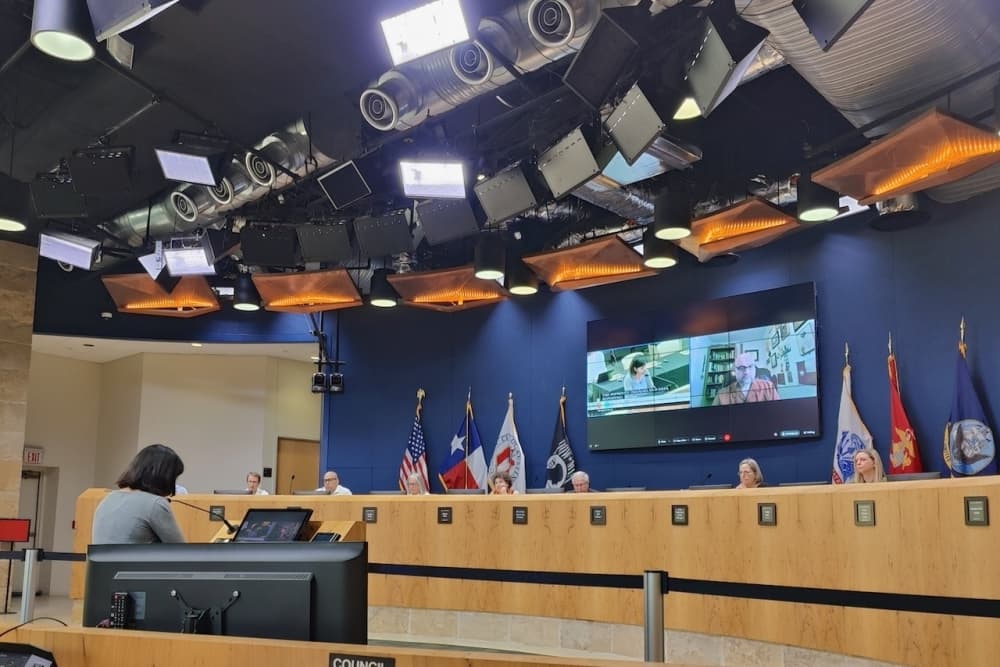



Lakeway Wildlife Advisory Committee members on Thursday agreed to shore up an evolving information-gathering campaign regarding the city’s deer population. During a presentation by newly-contracted wildlife biologist Warren Bluntzer, the WAC voted 5-1 to conduct an additional spotlight survey that would combine with a December 2017 survey and a planned September 2019 survey to help more accurately tally the number of deer in the area. “I think I owe it to you all to ask for another survey,” Bluntzer said. “I think it’s going to strengthen whatever we do. It will strengthen our ability in how we move forward, and I think it will be money well spent for us.” Bluntzer’s request reflects ongoing calls from city residents and officials for more information on the exact scope of both the number of deer and how deer-human interactions are impacting the overarching Lakeway ecosystem.
Deer in Lakeway through the years
Pat Henneberry, a Lakeway resident for the last 28 years, said she was inspired to attend Thursday’s WAC meeting due to a flyer placed on her door from local resident group Citizen Advocates for Animals. Henneberry said following the meeting that she’s always been passionate about the deer in Lakeway, and that when she first moved to the city, sentiment surrounding the animals was different. “The signs, we had them all over Lakeway, used to say: ‘Deer and golf carts have the right of way,’” she said. “Thirty years ago, we knew that you would plant lantana and Salvia gregii and oleanders so that the deer wouldn’t eat those things.” The local tone surrounding deer has become more divisive compared with Henneberry’s recollection of life in Lakeway almost three decades ago. As one example, public outcry for more information contributed to City Council placing a one-year moratorium on the city’s controversial Trap, Transport and Process program. The TTP has resulted in the trapping and killing of thousands of deer since being implemented in 1999, according to data provided by the City of Lakeway. Shortly after the issuance of the moratorium on Aug. 20, Lakeway City Council authorized the hiring of Bluntzer on Sept. 18 based on a recommendation from WAC. Since being officially contracted by the City of Lakeway in October, Bluntzer has set in motion strategies seeking to gather more accurate field data on the deer population. This way officials and residents can use the data to better address problems resulting from the city’s deer co-mingling with its growing human population, he said.
Community viewpoints converge
Several members of CAFA, a group that also hired its own wildlife biologist to conduct a deer population survey at the end of 2017, attended the WAC meeting. One major issue brought up by WAC and CAFA members Thursday was the increasing number of incidents resulting in unnecessary deer fatalities.
To that end, WAC member Ted Windecker told Bluntzer that while population surveys could prove beneficial, it is most important to concentrate on problems generated by deer-human interaction. “We know that 20 years ago we had 10 times as many deer here, and that was a problem because of the drought and starvation,” Windecker said. “But, I think that one of the most important things we need to do as a community is figure out what are the problems and how do we address those problems. Just the number of deer-per-acre isn’t the problem, it’s the interaction of the deer with the people.” If the community could develop a methodology for living with four deer-per-acre while eliminating the problems associated with that ratio, then it wouldn’t be necessary to harvest deer, Windecker said. Bluntzer said he didn’t totally agree with Windecker, and that he would never want to have deer living in a habitat that didn’t provide an ideal biological setting for the animals. “Any biologist that works with dynamics in populations knows there has to be some type of normal level you try to see, like water in a fishbowl,” Bluntzer said. “You don’t want the water [level too low] because then the fish don’t do well. So, you want it at an intermediate situation.”