Commissioners unanimously approved the county’s final Fiscal Year 2026-27 budget Sept. 29. (Jessica McLaren/Community Impact)
Editor's note: Travis County commissioners unanimously approved the $2.3 billion FY 2026-27 budget Sept. 29, with Commissioner George Morales III voting separately on items related to The SAFE Alliance. Commissioners adopted a tax rate of 38.6210 cents per $100 valuation Sept. 15. Individual Axon contracts have not yet come back to the court.
Travis County commissioners approved an estimated $2.3 billion Fiscal Year 2026-27 budget Sept. 29, boosting funding for public defense, housing and diversion programs after voting Sept. 10 to consolidate the county's contracts with public safety tech company Axon Enterprise.
The consolidation following weeks of pressure from the Coalition for Budget Accountability, composed of legal aid, harm reduction and civil rights groups, who rallied outside the markup urging commissioners to reject the Axon increase and fund the Public Defender's Office instead.
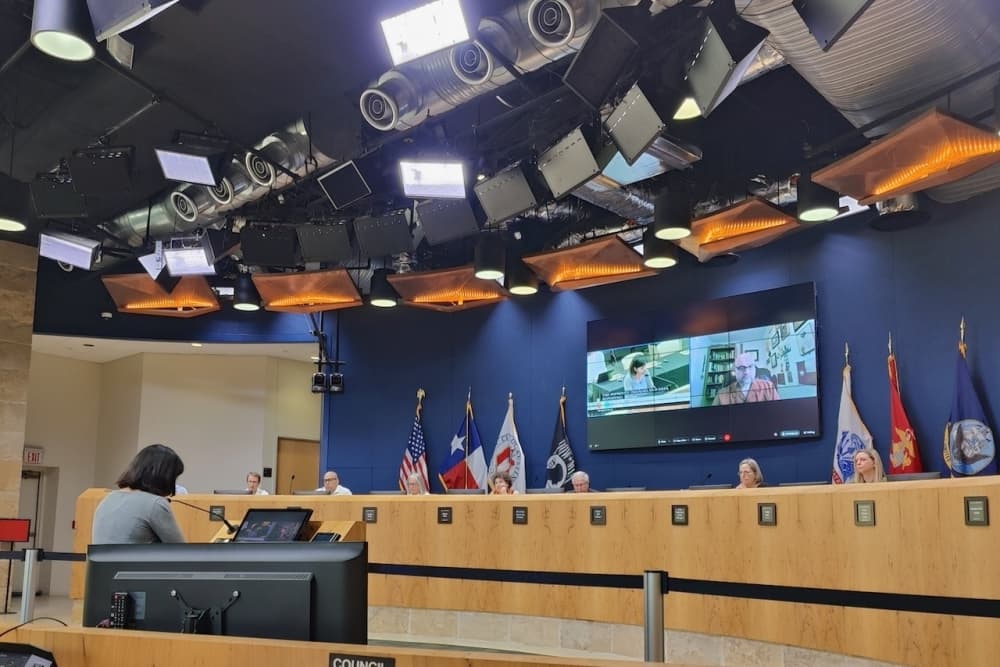
Travis County commissioners at the Sept. 10 budget markup session.(Jessica McLaren/Community Impact)
By the numbers
Both the safety tech and public defender requests drew from the same pool of funds, setting up a direct trade-off between public safety technology and indigent defense spending.
Indigent defense funding—reserved for those who can't afford representation—rose across multiple lines, per county data:
Reserve earmark for outside indigent-defense counsel doubled to $3 million
$1.5 million added directly to the department for increased attorney pay
$1.6 million earmark added to improve felony case representation
The Travis County Transformation Project, the juvenile restorative-justice initiative CFBA pushed for, received $1 million a year for two years.
The county also added $2 million in new ongoing funding for its Supportive Housing Initiative Pipeline, pulling roughly $931,000 from its diversion and deflection reserve to help fund it, leaving that reserve near $15 million.
The budget also sets a new minimum pay for county employees of $23.71 an hour, or $49,316.90 annually, plus a 3% across-the-board raise and matching step increase for the Peace Officer Pay Scale.
By contrast, the newly centralized Axon budget totals $6,832,000, including $376,592 in existing Taser costs across the Sheriff's Office, Constables and Transportation and Natural Resources, more than $1.3 million shifted from an earmark, said Assistant Budget Director Alex Braden. The funding covers Taser upgrades, drones, licensing and jail camera monitoring.
No new money was approved Sept. 10 beyond what had already been set aside. Commissioners freed up $777,876 in one-time equipment funds by folding it into the new subscription model and moved $57,478 into a separate earmark for law enforcement licensing costs.
What officials are saying
Maurice McCreary Jr., the county's executive for technology and operations, defended the Axon contract at the markup.
"It is body cameras, it is a way for us to be transparent in the kind of law enforcement activities we take care of, but it's also our Justice Department,” he said. “So we're sharing information with the county attorney, with the district attorney, and with the public defenders and with defense attorneys."
On the Taser upgrade, McCreary said the county would "continue to get the state-of-the-art equipment" through the proposed Axon contract.
Commissioner Brigid Shea called cameras "essential parts of accountability, around law enforcement interactions," adding, "we need body cam footage. We need vehicle footage."
“I just want to reiterate again, this is moving money in from the departments. We’re not today signing any contracts,” Judge Brown said. “This is centralizing the funding for you to have a discussion at a later time, but the resources are there if you want to move forward,”
In the county's press release, he said the county has "to be disciplined about every dollar we spend and focused on the investments that will make the biggest difference."
What advocates asked for
At the press conference before the markup, Yasmine Smith, attorney and vice president of advocacy justice with the Austin Area Urban League, said new Axon spending should be matched dollar-for-dollar with public defense and family stability funding.
"If the county can locate additional discretionary funding by the millions for [Axon] contract expansion, those dollars must be matched by funding community stabilization, public defense and family preservation," she said. "[The county] cannot justify a massive tech expansion while leaving foundational human care underfunded."
Yasmine Smith led the Sept. 10 press conference urging commissioners to reject the Axon Enterprise contract expansion.(Jessica McLaren/Community Impact)
Organizers with CFBA said their campaign has included more than 8,000 messages to commissioners and a 20-page budget-priorities proposal.
Chief Public Defender Adeola Ogunkeyede said this is the third straight year the office has requested the same funding without a firm answer.
Leticia Juarez, a District 2 resident whose husband was detained and deported after 23 years in Travis County, asked commissioners to fund Padilla attorneys, who advise noncitizens on the immigration risks of a plea, instead of expanding Axon's contract.
Leticia Juarez asked commissioners to fund immigration legal counsel instead of expanding Axon's contract. (Jessica McLaren/Community Impact)
Texas places the funding burden for public defense on counties, not the state, compounded by property tax caps, Burkhart said; statewide, local and state governments spend $400 million yearly on public defense, with the state providing only 10%.
Travis County is one of only seven Texas counties guaranteeing counsel during bail hearings, Burkhart noted in 2025, per earlier Community Impact reporting.
What’s next
Travis County released the preliminary budget July 28. Commissioners approved the final budget unanimously Sept. 29.
Individual Axon contracts will return for separate consideration once the consolidated tech department sets guidelines.