The corporation was formed following a conversation at a Sept. 15 commissioners court meeting about refinancing the authority's debt. Commissioners were presented with three options—the first involving a simple debt refinance without any changes to how the toll road authority operates; and another that would have allowed the county to issue mobility bonds to use toll road revenue to fund more non-toll projects.
The third option—which was recommended by the toll road authority and the budget office and which commissioners ultimately supported in a 3-2 vote—involved creating the corporation to contract with the county over the operation of the toll road authority.
As a key part of the corporation's inception, the authority will pay the county a $300 million one-time franchise fee, as well as roughly $90 million in annual franchise fees moving forward, money that is effectively removed from the authority's budget and given to the county. The court's five commissioners will initially assume the rolls on the board of directors of the new corporation.
The three Democratic members of the court who supported the motion—Harris County Judge Lina Hidalgo, and Precinct 1 and 2 commissioners Rodney Ellis and Adrian Garcia—said they saw value in the added flexibility in how that money can now be spent. While money collected by the toll road authority can only be spent on debt and transportation infrastructure, money in the LGC can be spent on a wider variety of projects, including flood control projects and health care needs.
"I favor some flexibility on the issues that we deal with in this county," Ellis said. "I think in the midst of the worst health challenge in 100 years and probably the worst economic challenges since the Great Depression, we can’t solve all our problems, but I think we should not handcuff ourselves."
Meanwhile, Garcia called on commissioners to begin the process of determining what infrastructure needs exist within the county to determine how the money should be allocated.
The motion was opposed by the two Republican members of the court, Precinct 3 Commissioner Steve Radack and Precinct 4 Commissioner Jack Cagle. Cagle said he did not see a need to rush the decision on what officials believe is the largest financial transaction in the history of the county, instead calling for a second opinion and for more public input.
Radack said the move lacked transparency. He argued that money collected from toll road drivers should not be used to fund projects that otherwise would have to be funded by an increase in property taxes.
"There is nothing transparent about this," Radack said. "This is a money grab, and it is a way to try to basically, as far as I'm concerned ... use money to pay for things that are normally paid for by ad valorem [property] taxes."
Garcia said he was sensitive to concerns about transparency. He said keeping the conversations within commissioners court would demonstrate a commitment to transparency as funds are allocated.
"This is not a workaround, but rather this is just working to give the public more for what they have already given us other than just holding it all in a safe deposit box without it working for the public," Garcia said.
Any funds not sent over to the county in franchise fees would remain with the authority. The portion of toll road revenue that goes to each county precinct for mobility projects each year will also not be decreased, Berry said.
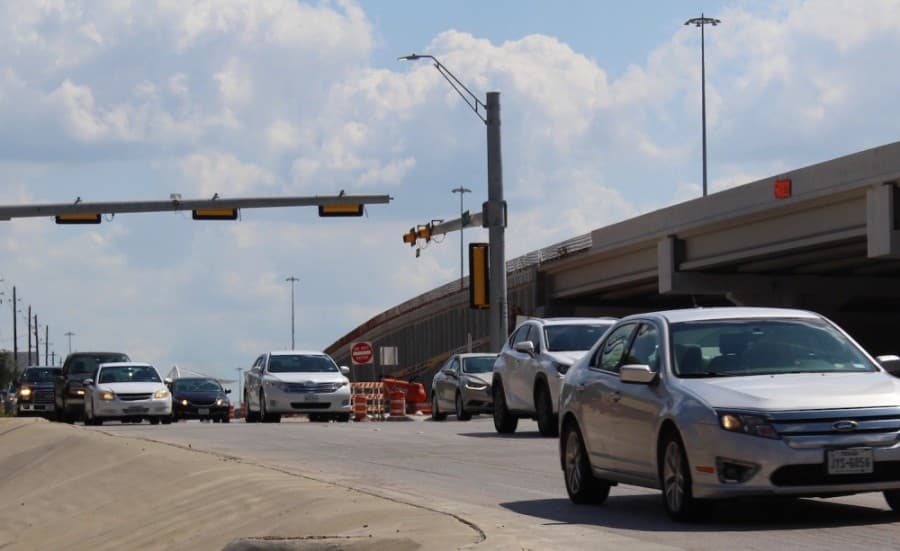
The county will refinance between $2.7 billion-$2.8 billion in toll road debt, Berry said. He said the move to establish the LGC will not likely trigger a downgrade in the toll road authority's bond rating, though he cautioned that a downgrade still could eventually come as a result of fewer people using toll roads during the pandemic.
"All toll roads right now are under some negative pressure," Berry said at the Sept. 15 meeting. "If commissioners court goes down that path, it is unlikely that would trigger a downgrade, but I can’t promise no downgrade because we’re in middle of pandemic where folks are driving less."
Hidalgo, who cast the deciding vote on the measure, said she thought the move would help the county "maximize every dollar" while also taking advantage of the low interest rates.
"We have time to develop priorities," she said. "Right now, the proposal is that we bring this additional resource to the community. As far as I am concerned, if there is an additional resource that we're not maximizing ... then we should do it."