Editor's note: Professor Kellen Zale's definition of eminent domain has been clarified to note that eminent domain authority can only be granted to state or private entities that have been authorized to do so through the Legislature
As ground broke on the master-planned community Dunham Pointe in Cypress, future residents gathered on an unofficial community Facebook group in February to meet new neighbors. While most discussed their home closing dates, several future residents posted about mentions of Texas Central’s high-speed rail project cutting through their homes, with some noting their developers did not offer an opinion on the project’s status.
Michael Fang, who moderates the Facebook group, told Community Impact Newspaper in an email that while the railroad was a big “what if” during his family’s buying process, ultimately the railroad’s procedural hurdles convinced him it was unlikely to succeed.
“A high-speed rail will affect not just Dunham Pointe; it will also affect neighboring communities such as Fairfield, Bridgeland and [Towne Lake]. We decided that [we’ve] already [built] our lives in the area, and we will handle whatever obstacles when the time comes,” Fang said.
The high-speed rail project connecting Dallas to Houston, which was announced in 2014, was set to begin construction in 2021, according to previous estimates from Texas Central from 2015. It will use a system modeled after Japanese Shinkansen bullet trains to transport passengers between the two cities in 90 minutes, according to Texas Central’s website.
However, a lawsuit from a Leon County landowner made its way to the Texas Supreme Court, questioning Texas Central’s right to the power of eminent domain to condemn properties. Texas Central has also faced questions about its ability to fund the $20 billion project.
Christie Parker, a Harris County landowner and board member for the nonprofit Texans Against High-Speed Rail, said her personal experiences with Texas Central and its eminent domain authority made the project a non-starter for her.
“We’ve worked with legitimate eminent domain from pipelines, gas transmission, you name it. We’ve never had an issue with one of them,” Parker said. “It’s only been with Texas Central.”
Texas Central officials did not respond to questions or requests for interviews from Community Impact Newspaper by press time. Dunham Pointe developer NPH Development declined to comment.
Property acquisition and process
Fang said he had to sign a disclosure agreement during the homebuying process, acknowledging if the railroad comes to fruition, there would be nothing Dunham Pointe’s builders and developers could do.
“When we were going through the sales process, we asked the question to our builder, and the response was our guesses were as good as theirs,” Fang said.
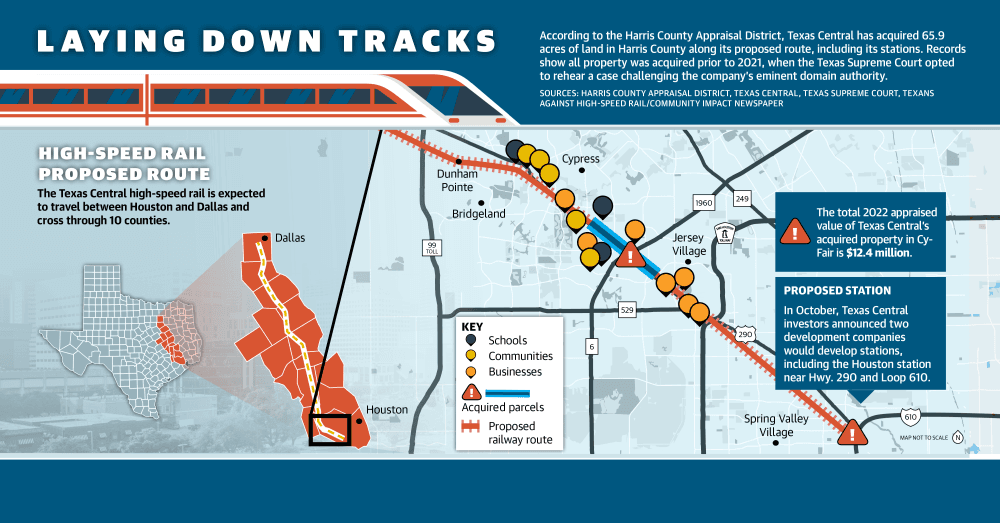
Texas Central has not yet acquired any property in the Dunham Pointe subdivision, according to the Harris County Appraisal District’s parcel viewer. Forty-two county parcels are registered to “Texas Central Railroad and Infrastructure,” according to the HCAD, with the majority of them located within the White Oak Falls subdivision near Hwy. 290 and Hwy. 6. These parcels were all acquired prior to 2021.
Additionally, the Northwest Mall, which Texas Central previously announced as the site of its Houston station, is registered under Cadiz Development LLC. In October, Cadiz Development was announced as one of the companies merging to form a separate company called Texas High-Speed Rail Station Development Corp. to build the railroad’s stations.
The railroad’s planned route, according to its website, would pass through several Cy-Fair businesses and residential communities—including the Stone Gate community and Camden Cypress Creek apartments. Additionally, The Connection School of Houston, a private school on House & Hahl Road, is located within the route, and several Cy-Fair ISD campuses are nearby. The property management companies responsible for the communities and officials with The Connection School and CFISD did not respond to requests for comment.
The future 43-acre mixed-use Village Center development in Jersey Village also lies within the route. Mayor Bobby Warren said at a February town hall meeting the train is being considered throughout the development of the property off Jones Road and Hwy. 290, but with the Texas Supreme Court decision up in the air and state legislators expressing their intent to file bills to protect rural landowners, Warren said he was uncertain of the train’s future.
“If either the court finds that they do not have eminent domain power or if the Legislature takes it away, I suspect that that would probably spell the end of the high-speed rail,” he said.
According to the federal government’s Permitting Dashboard, which tracks infrastructure projects throughout the country, the high-speed rail project had passed its initial permitting checks as of September 2020. However, the project has not yet received a construction permit from the Surface Transportation Board. The STB rejected a Texas Central petition for an exemption from construction approval requirements in July 2020.
Peter LeCody, president of the Dallas-based nonprofit Texas Rail Advocates, suggested the company was waiting until the resolution of the Texas Supreme Court case before proceeding with acquiring a permit.
“If I was an investor with Texas Central, I would want to wait to see what the Supreme Court of Texas has to say,” LeCody said. “Once that’s solidified, Texas Central can present what they’ve got to the STB.”
Funding issues
Several critics of Texas Central have raised issues regarding Texas Central’s ability to raise funds for its project with the company’s own estimations fluctuating over time.
A 2018 drafted memorandum of understanding between Texas Central and the metropolitan planning organization Harris-Galveston Area Council stated Texas Central “will not seek federal or state funding for the deployment of their project.”
H-GAC transportation officials confirmed the project is on the organization’s 2023-26 Transportation Improvement Plans, where its current entry lists it receiving $3.3 billion in local funds.
Texas Central has made one announcement of its capital fundraising to date in 2015, announcing an initial $75 million in private investment. The announcement was removed from the company’s website but can be accessed through archived versions.
In May 2021, Texas Central CEO Carlos Aguilar testified before the U.S. House of Representatives Transportation Committee and its subcommittee on railroads. Aguilar thanked the committee’s 1998 effort to pass House Resolution 2, a bill that includes a program that guarantees federal loans of up to $3.5 billion for projects.
Texas Central did not respond when asked about its plans on using state or federal funding. In filings to the Texas Supreme Court, the company’s attorney Marie Yeates reported the company had spent $125 million since 2019 on acquiring railroad cars and other “procurements.”
In a separate filing March 30, six counties in the railroad’s proposed path argued the company was delinquent on its property taxes in all eight counties it covers. The taxes owed come to a total of $622,975 with Harris County making up $216,359 of the money, according to the brief.
Eminent domain
The Texas Supreme Court heard oral arguments from Yeates and attorney Jerey Levinger, representing Leon County landowner Jim Miles, on Jan. 11 as part of its rehearing.
Miles led the suit in 2016, arguing Texas Central is not by definition an “interurban electric railroad company” and therefore cannot use the power of eminent domain to survey and condemn property. According to Kellen Zale, a property law professor at the University of Houston, eminent domain can be used by state agencies or private companies that demonstrate a significant public use, provided that entity's activities—such as railroad or pipeline construction—have been designated to do so by law.
Companies using eminent domain to survey or condemn property must provide landowners with a “landowners bill of rights,” according to the Texas Attorney General’s office. This bill of rights outlines requirements for entities using the power, including that they provide a written appraisal.
Parker said in an interview that Texas Central did not provide her with any record of their title to eminent domain nor with the landowner’s bill of rights when they attempted to survey the property, which also serves as her family’s wedding venue business.
“They tried several times, and towards the end they sued us for not letting them on,” Parker said. “We won an injunction, but [in 2019], we received word that Texas Central had trespassed anyway to perform a survey for the Texas Historical Commission.”
During oral arguments Jan. 11, Levinger argued because Texas Central is not operating railroads, it cannot be defined as a railroad company.
Matthew Festa, a professor at the South Texas College of Law, said the plaintiffs were adhering to “dictionary definitions” of a railroad company.
“What I find very interesting about this case is that it seems like both sides of the argument are relying on general common sense rather than the legal technicalities because it seems like the plaintiffs are saying operating a railroad means you have to be operating a railroad,” Festa said. “[The defendants’] common-sense argument is, ‘We need to use eminent domain to become a company that operates a railroad and [we cannot] do it until we have your land.’”
Although Texas Central has not publicly provided its future steps for construction nor an updated timeline, the company has signed with partners for construction and operation, including Spanish railway operators Renfe in 2021, Community Impact Newspaper previously reported.
The Texas Supreme Court is likely to rule on the case before June, according to Festa.