The next Bryan ISD school board meeting will be April 20. (Karley Cross/Community Impact) (Karley Cross/ Community Impact)
As Texas prepares to phase out the State of Texas Assessments of Academic Readiness exam and potentially standardize how GPAs are calculated, Bryan ISD officials said these changes could significantly reshape how students are evaluated in the coming years.
What's happening?
Associate Superintendent Barbara Ybarra briefed the district’s board of trustees at its April 6 meeting on upcoming shifts to the state’s accountability and assessment systems, including a new testing model expected to replace STAAR beginning in the 2027-28 school year.
The new system, referred to as the Student Success Tool, is still under development by the Texas Education Agency.
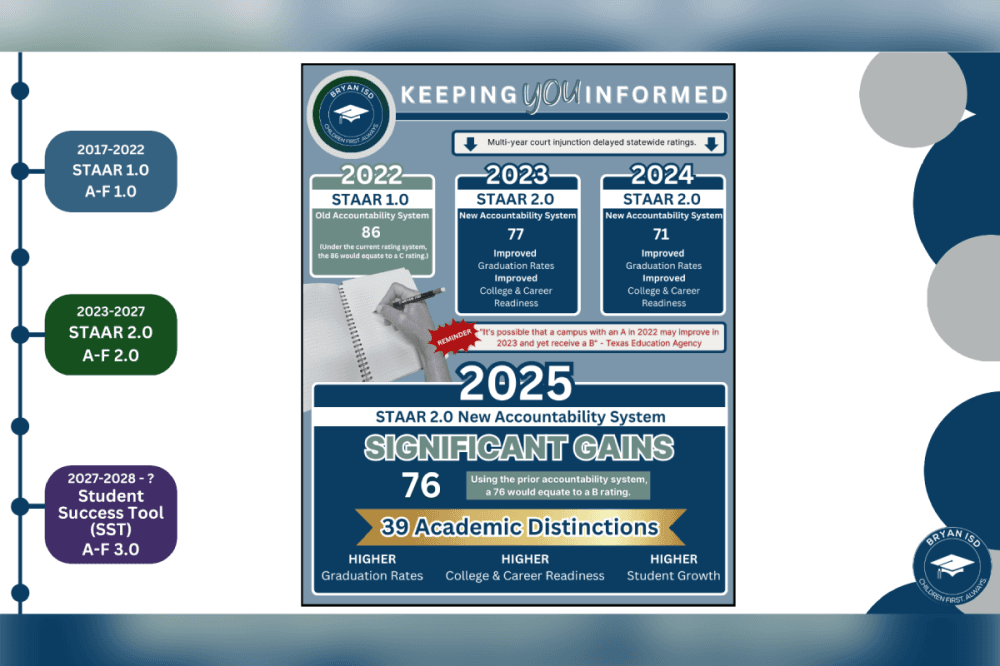
Instead of a single exam at the end of the school year, students would take shorter assessments multiple times throughout the year—at the beginning, middle and end—designed to measure academic growth rather than performance on one test day.
Bryan ISD's end-of-year exams will soon be changing from STAAR to shorter form SST exams. (Courtesy Bryan ISD)
Ybarra said the change aims to give teachers faster feedback to allow for earlier intervention for struggling students.
Under the proposed structure of the SST, the final end-of-year assessment would still factor into state accountability ratings, but earlier testing windows would be used as instructional tools.
The new assessments are expected to be shorter than STAAR exams, Ybarra explained, with quicker score turnaround times. The English II end-of-course exam is also expected to be removed under the SST model.
“Students in the graduating classes of 2026 and 2027 must still meet the current English II requirement,” agenda materials clarify.
Trustees raised concerns about continued changes to state testing requirements and uncertainty surrounding the details. They also questioned how districts can plan long-term when state accountability systems change frequently.
Ybarra addressed the concerns, saying many questions will remain unanswered as the state finalizes rules and timelines. She said the district will continue to monitor guidance from TEA and will adjust within the district as more information becomes available.
Under this new standard, Advanced Placement, International Baccalaureate and dual-credit courses would get equal GPA weight statewide, while career and technical education dual-credit courses could get slightly less weighting.
Districts would maintain some flexibility for honors coursework.
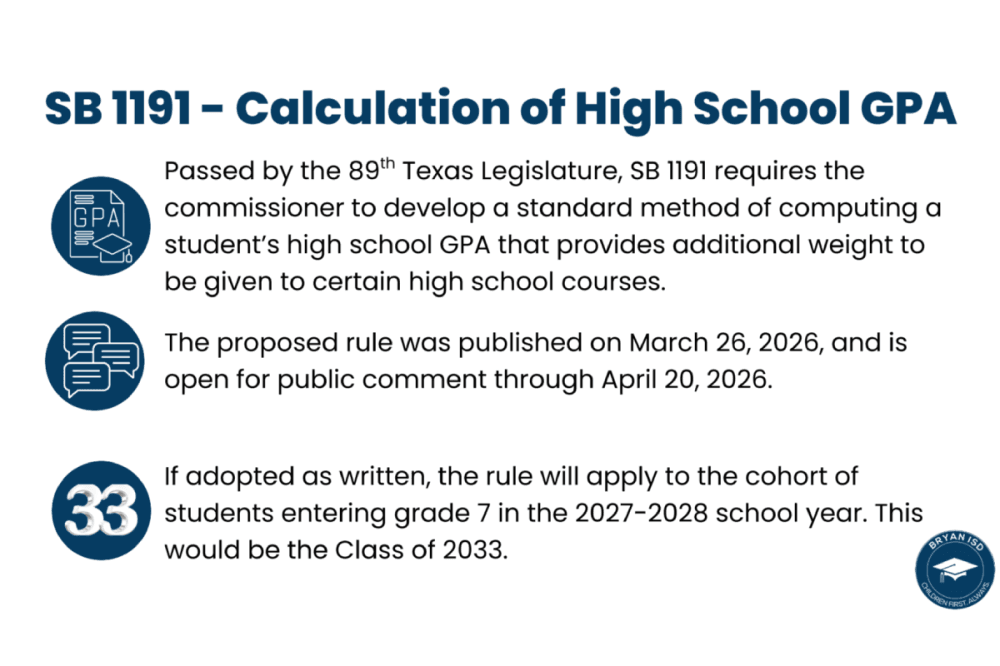
Bryan ISD's GPA weighting system may become standardized statewide. (Courtesy Bryan ISD)
If approved, the changes would not immediately impact current high school students. The proposal is expected to apply beginning with incoming seventh-graders in the 2027-28 school year.
Superintendent Ginger Carrabine emphasized that GPA policies influence class rank, scholarship eligibility and automatic college admission decisions.
Bryan ISD has not adopted any of these policy changes, but said it is tracking developments at the state level and questioning professional education organizations.
Ybarra said the district’s focus remains on ensuring students are prepared regardless of how state accountability measures evolve. Specifically, she said the district is requesting a “hold harmless” year to adjust to the new systems if they are adopted.