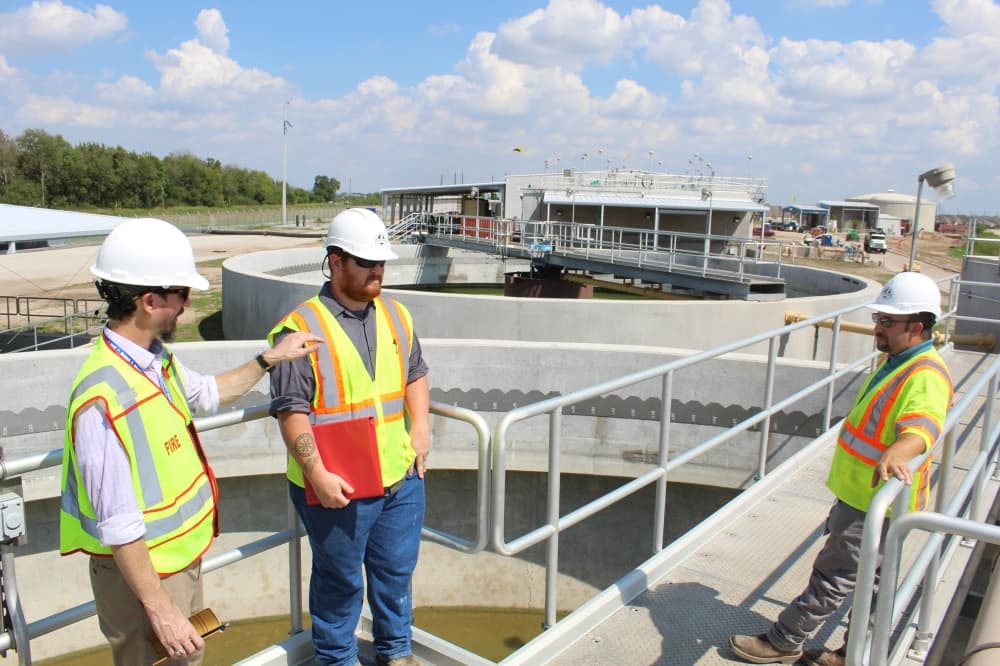
[caption id="attachment_67894" align="aligncenter" width="700"] From left: Mike Turco and Al Rendl discuss existing and future issues with groundwater and surface water throughout the Greater Houston area, including Harris and Fort Bend counties.[/caption]
Population growth in the Greater Houston area continues to put a strain on groundwater resources throughout the region. Several groundwater conservation and subsidence organizations have begun in recent years and are implementing a number of programs with the purpose of reducing the dependency their communities have on groundwater.
The Harris/Galveston and Fort Bend subsidence districts were created by the Texas Legislature in 1975 and 1989, respectively, with the goal of preventing subsidence, which can lead to flooding. Mike Turco has served as the general manager of the subsidence districts since 2013 and is responsible for the management of the district operations.
Created in January 2000, the North Harris County Regional Water Authority works to secure long-term, reliable water sources for neighborhoods, municipalities and municipal utility district in north Harris County. NHCRWA President Al Rendl served as Harris County Water Control District No. 91 as a director for 16 years and was the chairman for the North Harris County Water Issues and Annexation Reform Group.
From left: Mike Turco and Al Rendl discuss existing and future issues with groundwater and surface water throughout the Greater Houston area, including Harris and Fort Bend counties.[/caption]
Population growth in the Greater Houston area continues to put a strain on groundwater resources throughout the region. Several groundwater conservation and subsidence organizations have begun in recent years and are implementing a number of programs with the purpose of reducing the dependency their communities have on groundwater.
The Harris/Galveston and Fort Bend subsidence districts were created by the Texas Legislature in 1975 and 1989, respectively, with the goal of preventing subsidence, which can lead to flooding. Mike Turco has served as the general manager of the subsidence districts since 2013 and is responsible for the management of the district operations.
Created in January 2000, the North Harris County Regional Water Authority works to secure long-term, reliable water sources for neighborhoods, municipalities and municipal utility district in north Harris County. NHCRWA President Al Rendl served as Harris County Water Control District No. 91 as a director for 16 years and was the chairman for the North Harris County Water Issues and Annexation Reform Group.
Where does most of the water come from within your region?
Rendl: We have water basically coming from two places. In the ground, where we have been [using water], there have been three aquifers. There was a Chicot Aquifer, which is very shallow, and that's about dry. And there was an Evangeline Aquifer that most of the subdivisions in the north part of the county had been drilling into, and that is depleting very rapidly. And there is the third aquifer, the Jasper Aquifer, that goes down much deeper, but it has a problem of, when you get that deep you get water that starts to be too salty to drink. Surface water today comes from San Jacinto River or Lake Houston and Lake Conroe also, because it flows from Lake Conroe into the San Jacinto River down to Lake Houston.
Turco: There's the North Harris County Regional Water Authority area and if you zoom out a bit and look at Harris and Galveston and Fort Bend counties, a lot of the same sources of water are there, [such as] the Gulf Coast Aquifer System, which includes the Chicot, the Evangeline and the Jasper aquifers, [and] the San Jacinto River Basin, which includes Lake Houston and Lake Conroe. Trinity River does supply water to the south parts of Harris County through the Coastal Water Authority canal, which moves water from the Trinity River to the east plant in the city of Houston. The Brazos River provides most of the alternative sources of water to Fort Bend and Galveston [counties], and that's an important thing, because in the 2011 drought, the Brazos River really was exposed as maybe not being as reliable as we had hoped.
Why is the Luce Bayou project so important and what effect will it have on the Houston area?
Rendl: The Luce Bayou Project is an absolute must in terms of our being able to meet the needs of the growing population. There's simply not enough water in the San Jacinto River Basin—which is [lakes] Houston and Conroe—so we're bringing it from the Trinity River through the Luce Bayou. That project will be bringing about 450 million gallons a day at its peak. The North Harris County Regional Water Authority will be getting 36 percent of the capacity ultimately, which will be about 150 million gallons that we will have at our disposal after this is completed. That's at a cost of about $469–$470 million that our water users are going to have to pay as we go through. But if we don't do it, what is the alternative? You won't have water. So water is going to become very expensive.
What conservation programs have your districts implemented?
Turco: We have a program where we incentivize folks who sponsor children in a water conservation program in the schools. In return, they get some groundwater credits that offsets their conversion. I know the North Harris County Regional Water Authority has a great program where they do a lot of conservation efforts. So that's part of the equation and something that these two guys could probably spend a whole hour just talking about that. We had 70,000 students in our program last year throughout Fort Bend, Harris and Galveston counties.
Rendl: The North Harris County Regional Water Authority has a program that we take to all of the fifth-grade and seventh-grade students at all the ISDs that are in our authority. We have a couple of trailers with all kinds of water-related items. We give teachers a curriculum with books, [and] they spend a week to 10 days with the students. Then our folks come in and do a program for the students, usually in the cafeteria. It's getting the kids to be aware of water conservation, where the water comes from [and] the importance of water. The municipal utility districts and many of our contractors and other folks that deal with this authority pay for this program. They buy the materials that go into the classrooms for the schools that are within their areas.
The Houston-Galveston Area Council estimates the Greater Houston area's population will increase from 5.8 million in 2010 to about 9.5 million in 2040. What kind of stress will that population increase have on water as a resource?
Turco: Everybody drinks water. Everybody uses water. So certainly you bring in more bodies, you're going to have an increased water use. In 2010, the district along with its partners, we went down a road to update our regulatory plan. We worked with a wide variety of consultants and even the [U.S. Geological Survey] to upgrade our models, to upgrade our predictions of how populations are going to not only increase, but where they're going to be. We factored that into our regulatory plan, and we used that information to help develop our timeline for how much conversion should occur and when it should occur. Houston is a great place to live. In that equation is water conservation. Water conservation is something that is hard to quantify. You can't really put a real metric on it, but it's something that everybody can contribute to, and at the end of the day, everybody can have that impact.
What is the city of Houston doing to help provide water resources to the Greater Houston area?
Rendl: I've got my fingers crossed that Houston City Council is going to pass the resolution that will allow for the building of the [expansion] of the water treatment plant. This is something that's monumental. I think you have to look at it in terms of people who've sat in the mayor's chair going back to 1940 and 1950 when they were thinking about, 'Where are we going to get our water?' And they said, 'Well, we've got to build some reservoirs,' because there are no natural lakes in Houston. So they built Lake Livingston, and they're using probably 450 million–500 million gallons or more out of Lake Livingston today in the two water treatment plants that they have outside of Lake Houston. What we are seeing today is a project of almost that magnitude. We're looking at probably in the range of $1.2 billion to $1.5 billion that is being invested by the people in Harris County [and] the city of Houston.
Although there has been a lot of growth in the region in recent years, there is still plenty of undeveloped land in the Greater Houston area. How important is water is a resource to the development of that land?
Turco: No water, no development. They've got to go hand in hand. Those areas where you move farther out into Harris County in particular in our district and in western parts of Fort Bend County, they're likely going to be developed on some form of groundwater use because there is no infrastructure in those areas to get the alternative supply that's there. As we've seen happen in the past with development, infrastructure will reach those areas and we'll be working with them
to get them converted to surface water and alternative sources of water as that development occurs. But we fully expect in those developing areas [to see] additional groundwater use until infrastructure is in place to provide them alternate sources of water. It's important to recognize that in our regulatory plan in moving folks from groundwater to surface water over the last 40 years, there has been a great commitment by the regional water providers, the city of Houston, the North Harris County Regional Water Authority, the West Harris County Regional Water Authority, all the Municipalities in the area, have committed effort and dollars to infrastructure to support this regulatory plan."



 From left: Mike Turco and Al Rendl discuss existing and future issues with groundwater and surface water throughout the Greater Houston area, including Harris and Fort Bend counties.[/caption]
Population growth in the Greater Houston area continues to put a strain on groundwater resources throughout the region. Several groundwater conservation and subsidence organizations have begun in recent years and are implementing a number of programs with the purpose of reducing the dependency their communities have on groundwater.
The Harris/Galveston and Fort Bend subsidence districts were created by the Texas Legislature in 1975 and 1989, respectively, with the goal of preventing subsidence, which can lead to flooding. Mike Turco has served as the general manager of the subsidence districts since 2013 and is responsible for the management of the district operations.
Created in January 2000, the North Harris County Regional Water Authority works to secure long-term, reliable water sources for neighborhoods, municipalities and municipal utility district in north Harris County. NHCRWA President Al Rendl served as Harris County Water Control District No. 91 as a director for 16 years and was the chairman for the North Harris County Water Issues and Annexation Reform Group.
From left: Mike Turco and Al Rendl discuss existing and future issues with groundwater and surface water throughout the Greater Houston area, including Harris and Fort Bend counties.[/caption]
Population growth in the Greater Houston area continues to put a strain on groundwater resources throughout the region. Several groundwater conservation and subsidence organizations have begun in recent years and are implementing a number of programs with the purpose of reducing the dependency their communities have on groundwater.
The Harris/Galveston and Fort Bend subsidence districts were created by the Texas Legislature in 1975 and 1989, respectively, with the goal of preventing subsidence, which can lead to flooding. Mike Turco has served as the general manager of the subsidence districts since 2013 and is responsible for the management of the district operations.
Created in January 2000, the North Harris County Regional Water Authority works to secure long-term, reliable water sources for neighborhoods, municipalities and municipal utility district in north Harris County. NHCRWA President Al Rendl served as Harris County Water Control District No. 91 as a director for 16 years and was the chairman for the North Harris County Water Issues and Annexation Reform Group.