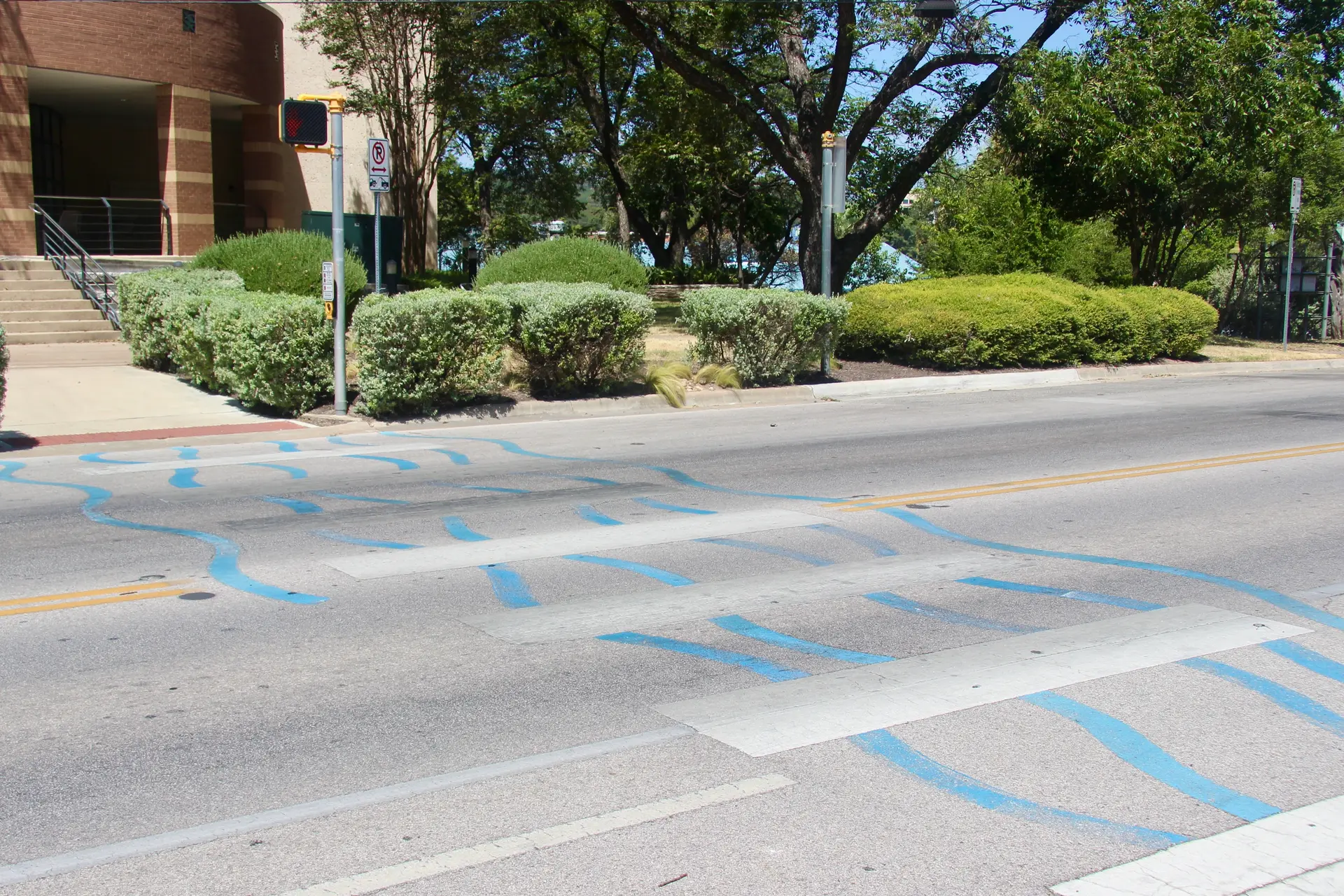
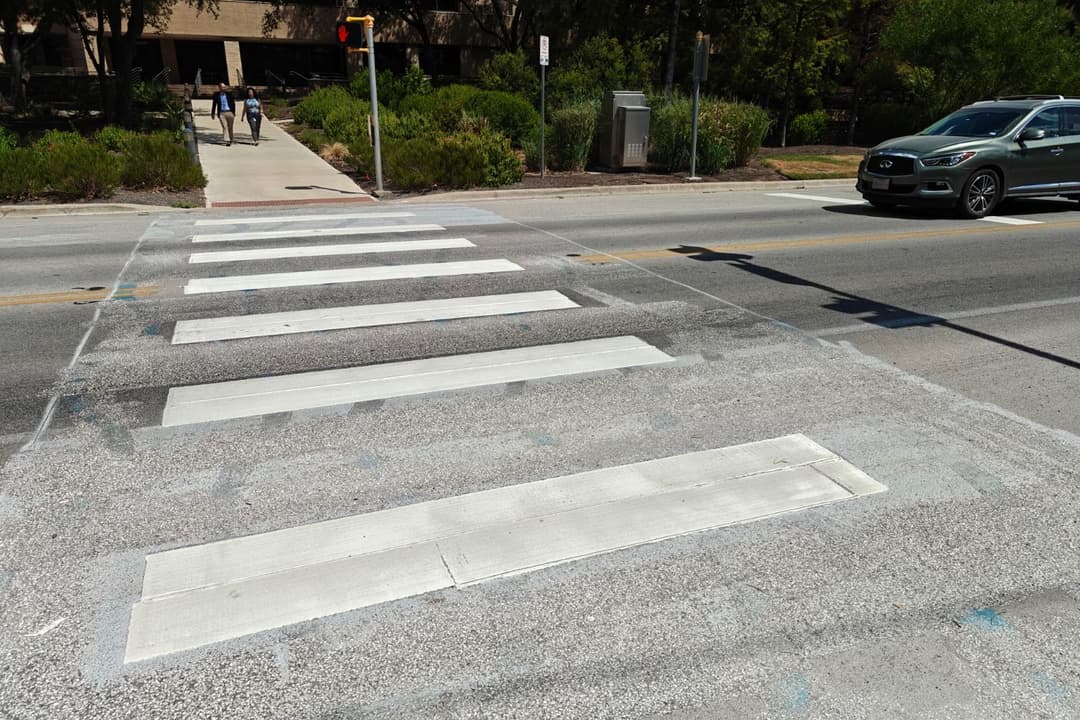
City Council approved the deaccession of "Crosswalk on the Lake," part of Austin's public art portfolio, in response to a state mandate for the removal of pavement markings. (Ben Thompson/Community Impact)
The removal of a public art installation on Lake Austin Boulevard was formally approved this summer, representing the final pavement marking to be cleared by the city under a state mandate this year.
The overview
At the direction of Gov. Greg Abbott, the Texas Department of Transportation imposed a new standard for the removal of any roadway markings that don't "directly support traffic control or safety." Cities that didn't comply risked losing significant state or federal funding, leading Austin to develop a plan for the removal of more than a dozen art installations citywide.
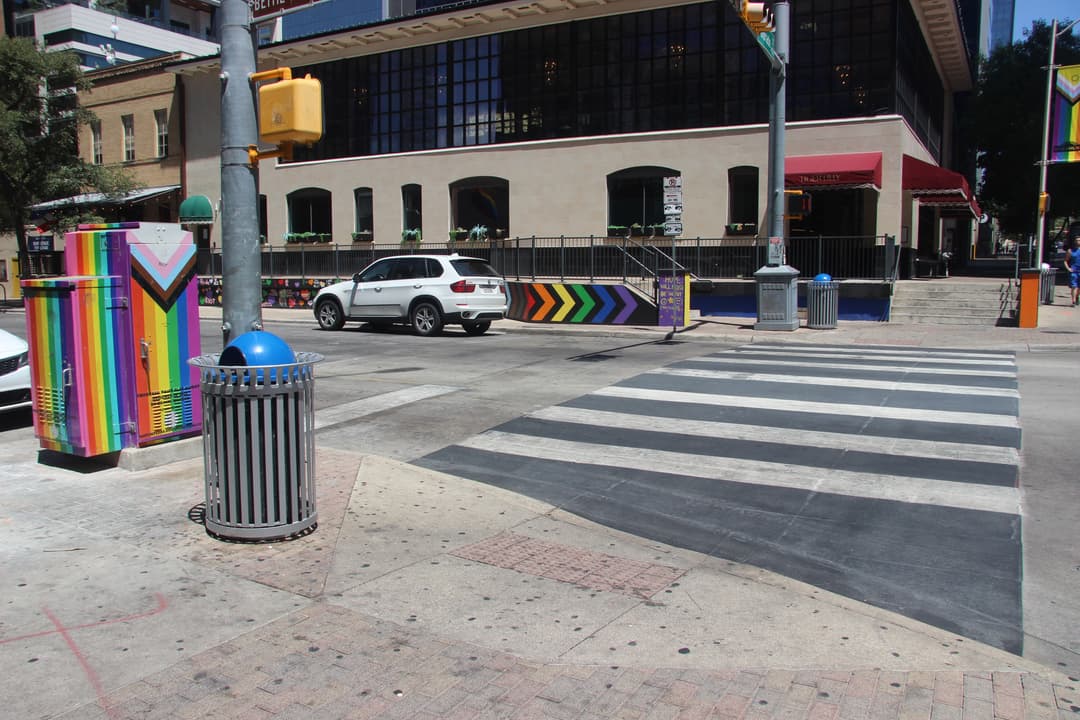
Affected markings included a painted "Texas" on Guadalupe Street near The University of Texas at Austin campus, the "Black Artists Matter" mural along East 11th Street, neighborhood roundabout and alleyway art, and painted crosswalks including rainbow crossings at Fourth and Colorado streets downtown.
Austin attempted to secure exceptions from the state standard and compiled local mobility data showing no apparent impact on safety after street markings were added. But TxDOT's traffic safety division denied that request in May, prompting Austin Transportation and Public Works crews to address all but one of the identified markings at a total cost of around $43,000.
A city task force created in response to the state mandate also supported alternative commemorations at some affected locations, like a new historic marker near the downtown crosswalks.
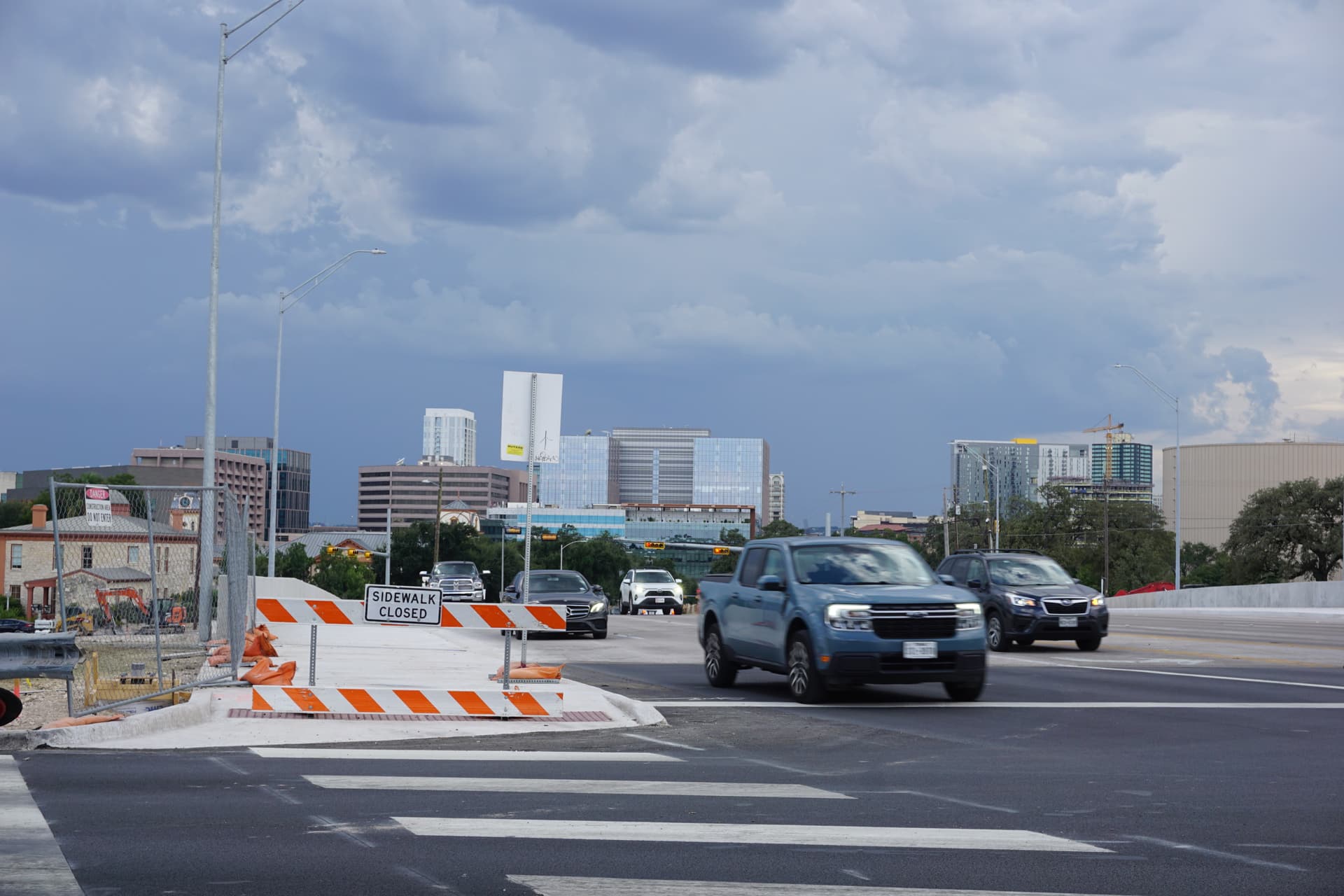
Roadway markings in Austin that were identified for removal under a state mandate have been painted over, including former rainbow crosswalks at Fourth and Colorado streets downtown. (Ben Thompson/Community Impact)
Zooming in
The final targeted pavement marking—"Crosswalk on the Lake” by Mery Godigna Collet and Luis R. Gutierrez—was part of Austin's public art collection, meaning City Council approval was needed before its official removal.
The river-themed painted crosswalk was installed outside the Lower Colorado River Authority headquarters at 3700 Lake Austin Blvd., Austin in 2016. The piece was donated to the city as part of Austin's Art in Public Places, or AIPP, program.
That program has detailed policies for the deaccessioning, or removal, of pieces of Austin's public art collection. Public artworks can typically only be deaccessioned due to issues like damage, age or relocation after a series of evaluations including consideration by the resident-led Arts Commission. However, with no other options to handle "Crosswalk on the Lake" the city advanced its deaccessioning after TxDOT's May denial.
Put in perspective
The Arts Commission's AIPP panel, and eventually the full commission, each voted against the removal this summer. Their recommendations against stripping the pavement art didn't affect the final outcome; council voted 9-2 for deaccessioning, budgeted at a cost of $1,500, on Aug. 27.
While acknowledging they couldn't impact the required removal, commission members said they were taking a stand for responsible art stewardship and rejecting Texas' approach.
“I think there’s some power in saying, “This is our artwork, and you’re making us destroy it.’ Not, ‘We’re relinquishing our art so that it can be destroyed,'" commission Chair Gina Houston said.
City staff reported the crosswalk was the only street mural formally included in Austin's AIPP collection, and that its original artist had hoped to preserve it in some form. Although removal was imminent, commissioners' unanimous votes against deaccessioning were based on the action not aligning with AIPP processes.
Quote of note
“We all understand that the city’s under significant duress and that the murals are going to go no matter what. But in our discussion, the committee found that what we perceive to be politically motivated pressure from the state does not meet AIPP’s criteria surrounding deaccession," commissioner Heidi Schmalbach said in July. "It’s not a matter of artistic merit, condition or public value of the artwork, and we felt that the integrity of the AIPP panel’s decision-making process would be jeopardized by supporting a deaccession when the work itself doesn’t meet our understanding of the criteria.”
Austin removed 'Crosswalk on the Lake' after City Council approved the public art installation's deaccession this summer. (Ben Thompson/Community Impact)