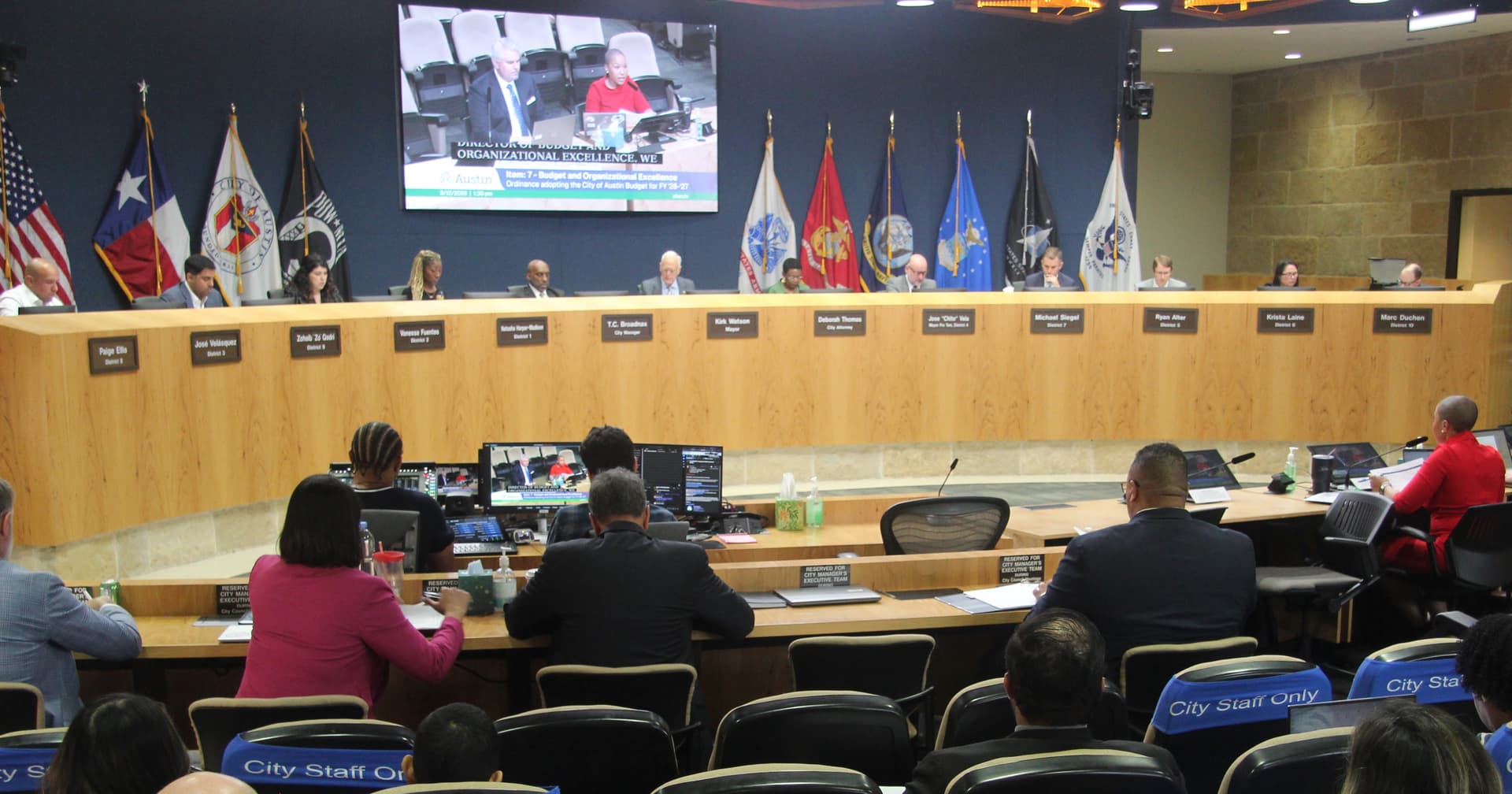
City Council adopted Austin's $6.6 billion budget for fiscal year 2026-27 on Aug. 12 alongside a property tax increase and other adjustments to city rates and fees. During and after their deliberations, officials weighed in on their support or opposition to the final spending plan that passed 9-2.
Those in favor
Most council members who voted for the FY 2026-27 budget highlighted the month-long review process that led up to their final decision, and the millions of dollars in funding that were maintained for the city's extensive social service programs.
“What I think is really uplifting of this budget process is that we very quickly came together and set out that social safety was a No. 1 priority for us, and we coalesced around that as a priority this budget cycle," said council member Vanessa Fuentes. "When you’re in an economic downturn, that’s not the time to be reducing your social safety net. That’s when people need you the most, and I view government as a way of helping people."
Council member Ryan Alter agreed, saying officials passed a responsible budget that reflects local values.
“We were down to the very last discretionary spending to try to make this budget work, and we chose to strengthen our social safety net because that was the must-have for a lot of people," he said.
After what he called a difficult and challenging budget cycle, council member Zo Qadri said his focus was on ensuring residents who rely most on city services wouldn't be negatively impacted by financial decisions from City Hall.
"I’ve knocked on thousands of doors the past few months, and the one thing that I constantly hear from folks are about protecting critical social services and making sure that Austinites aren’t being left behind. And I think that’s something that this budget does," he said.
While calling the budget a "generally positive" plan that commits funds to city employee raises, housing assistance programs and other social services, council member Mike Siegel also noted it reflects Austin remaining in a "defensive" financial position.
"We have to endure reductions and cuts, we have to raise fees and fines more than we’d like to. Things might improve if leadership changes at the state or federal governments, or if our local economy takes off again. But until that time, we’ll have to work increasingly hard to keep what we have," he said.
While voting to adopt the budget, council member Natasha Harper-Madison said the approach wasn't the most practical and may not have considered enough service cuts given Austin's finances.
“Sometimes always being there, being that social safety net, is not the best position for a municipality to be in. That’s not how we should be conducting business, in my honest opinion," she said.
Council member Paige Ellis said she hopes to see improved 911 response times and safety in city parks, which had been noted as a priority among her constituents. She also shared "conflicting feelings" about the budget, particularly given council's narrow vote to begin reorganizing some of Austin's 911 call-taking system, which she didn't support.
"I have seen some of the ideas that we propose go well, or go not so well. We still don’t have parks police back, we don’t have a motors unit yet, and I really want to make sure that these charts about response times increasing continue to go down," she said. "That is the largest investment in our general fund, is to make sure that we’re supporting public safety and that people have the attention that they need from our officials.”
Those opposed
On the other hand, Mayor Kirk Watson and council member Marc Duchen criticized the decision to advance a budget without deeper cuts and more focus on the expenses being passed on to residents. Both voted against adopting the final FY 2026-27 budget and tax rate.
While noting some positive investments included in the plan, Watson said he was discouraged about the final result after leading multiple city efficiency reforms since last year's failed tax increase election. He said the approach led to his first vote against a city budget over his multiple terms as Austin's mayor.
"This budget bothers me. This budget goes back some of on the actions we’ve taken over the past year to strengthen city government and put affordability first. This budget adds debt—and it increases the average Austinite’s property tax bill by over $400—that’s just the City’s portion," he said in a statement.
Duchen said other officials didn't fully scrutinize the budget outline, and refused to seriously consider his strategy to limit the annual tax increase and cut millions of dollars in spending
"The City Council let Austin down tonight. Utility rates, county taxes, and the cost of living are all on the rise, and the last thing residents can afford right now is a big property tax hike. Sadly, that’s what they got," he said in a statement. "I fought against today’s proposal in an effort to preserve affordability, protect Austinites at risk of displacement, and address our structural deficit. If we fail to fix these problems, we’ll threaten Austin’s financial stability and make this community even less affordable for struggling families and small businesses."
Residents will be able to view the completed spending plan in October, when Austin's next fiscal year begins.