Early voting runs Oct. 19-30 for the upcoming Nov. 3 election. Cedar Park-area voters will be able to cast ballots in a number of national, statewide and local races.
Continue reading for information on when and where to vote, as well as what will be on the ballot.
Dates to know
Oct. 19: first day of early voting
Oct. 23: last day to apply for a ballot by mail (received, not postmarked)
Oct. 30: last day of early voting
Nov. 3: Election Day and the last day to receive a ballot by mail (or Nov. 4 if the carrier envelope is postmarked by 7 p.m. at the location of the election)
Where to vote
Residents in both Travis and Williamson counties can vote at any polling location in their respective county during early voting and on Election Day.
For some Cedar Park residents, the closest polling location may be outside the city limits.
Visit www.votetravis.gov or www.wilcotx.gov/elections for more polling locations in the surrounding area.
What’s on the ballot?
Cedar Park voters will help decide races for the U.S. Senate and House of Representatives, as well as state-level races including governor, lieutenant governor, attorney general, agriculture commissioner and railroad commissioner.
At the local level, Williamson County residents will vote on county-level positions including county judge and tax assessor-collector. Residents of Leander ISD and Round Rock ISD will also vote on school board trustee positions. Leander ISD residents will also vote on a proposed tax rate increase.
More information on specific races, including Q&As with candidates, can be found in Community Impact’s Voter Guide.
What to bring to the polls
Voters must bring one of seven forms of identification to the polls:
A Texas driver's license (issued by the Texas Department of Public Safety)
A Texas personal ID card (issued by the DPS)
A Texas handgun license (issued by the DPS)
A Texas election ID certificate (issued by the DPS)
A U.S. military ID card with the voter’s photograph
A U.S. citizenship certificate with the voter’s photograph
A U.S. passport
Texans without an approved ID can sign a “reasonable impediment declaration” at the polls and present an alternative form of identification, such as a birth certificate, a current utility bill or a paycheck. More information about voter ID requirements is available here.
Voters may bring written materials, such as notes and sample ballots, to the polls to help them cast their votes, according to the secretary of state.
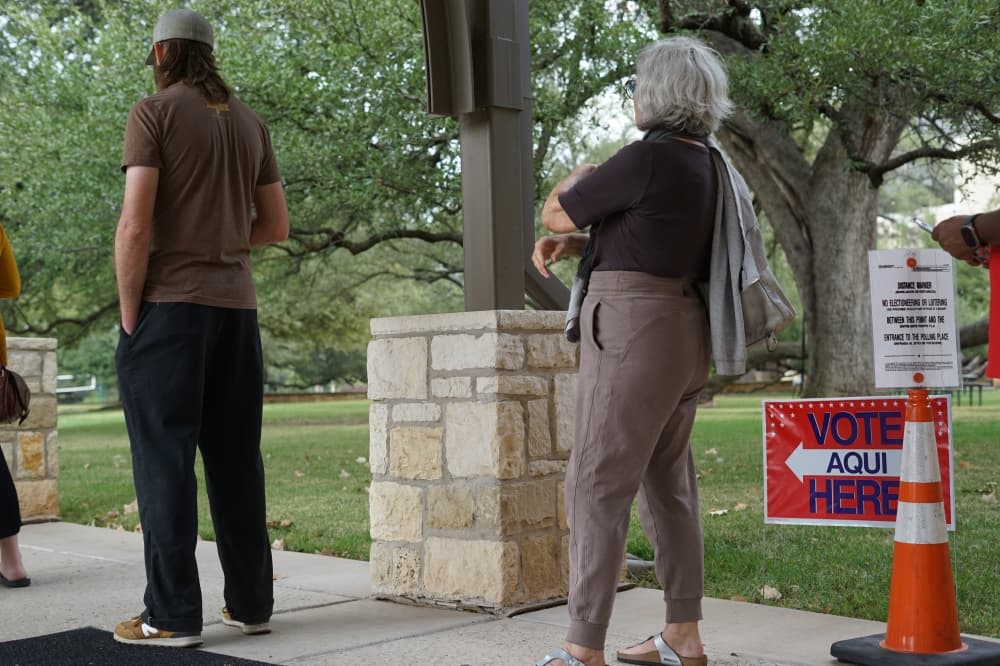
Texans cannot post or distribute written materials within 100 feet of an entrance to a polling place, as this is considered campaigning or electioneering under state law. Guns and wireless devices such as cellphones, tablets and smartwatches are not allowed at polling places.