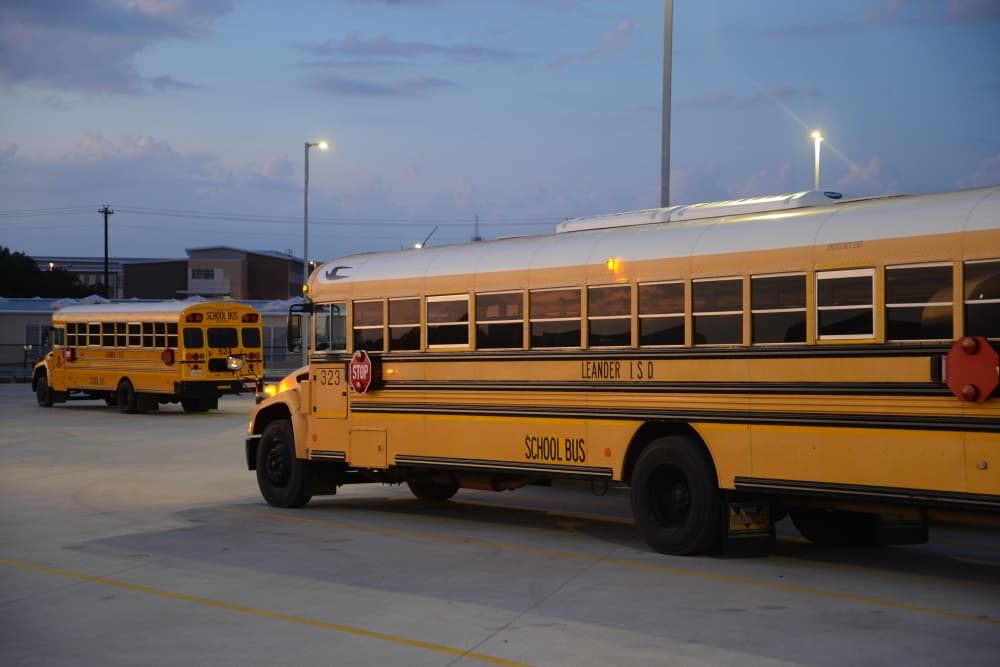
Leander ISD is set to use $2 million of 2017 bond savings to fund the replacement of 10 school buses in order to be in compliance with a school bus seat belt state mandate.
The board of trustees voted to reallocate the savings during its Nov. 19 meeting.
The details
Bond Oversight Committee chair Jon Lux recommended the $2 million reallocation as part of the first phase of replacements.
LISD will still have 96 buses not in compliance, but Chief Operations Officer Jeremy Trimble said the first 10 buses that will be replaced are at the end of their life cycle.
Additionally, replacing these 10 buses will act as a "financial bridge" until a future bond, he said.
"Right now, this is what we're committing to because of the bond savings we have access to," Trimble said. "If we realize additional bond savings, then there may be another opportunity to come right back here again and consider purchasing another 10, another 15, another 20."
Trimble also said that because the current diesel buses will be replaced with propane buses, the district will submit a grant application funded by Volkswagen, which could garner an additional $40,000 in savings per bus.
If received, this would go back into the 2017 bond fund, he said.
How we got here
The replacements follow a Senate Bill 546 mandate that requires all public school buses to be equipped with three-point seat belts, which feature both a shoulder and lap buckle, by Sept. 1, 2029.
The board previously discussed the mandate in April, when officials said that of LISD's current fleet of 318 buses:
212 are equipped with three-point seat belts
79 general education buses are not equipped with seat belts
27 special education buses are equipped with two-point seat belts
Officials also noted that buses currently not equipped with three-point seat belts are not deployed for daily school routes.
Replacing the buses is expected to cost a total of about $18 million. Trimble said the replacement process "would provide a longer runway to full compliance and allow for a more staggered replacement cycle."
If we replaced all 106 [buses] in one big order, that means that 106 buses will come up for replacement in 15 years all at the same time. The strategy here is to take our older school buses and start right now. ... That was the strategy even from the beginning—to do small incremental replace[ments] all the way up through 2029." — Chief Operations Officer Jeremy Trimble
The board also previously discussed retrofitting buses, which would be less expensive, but officials noted that the district's bus manufacturer will not warranty retrofitted buses.