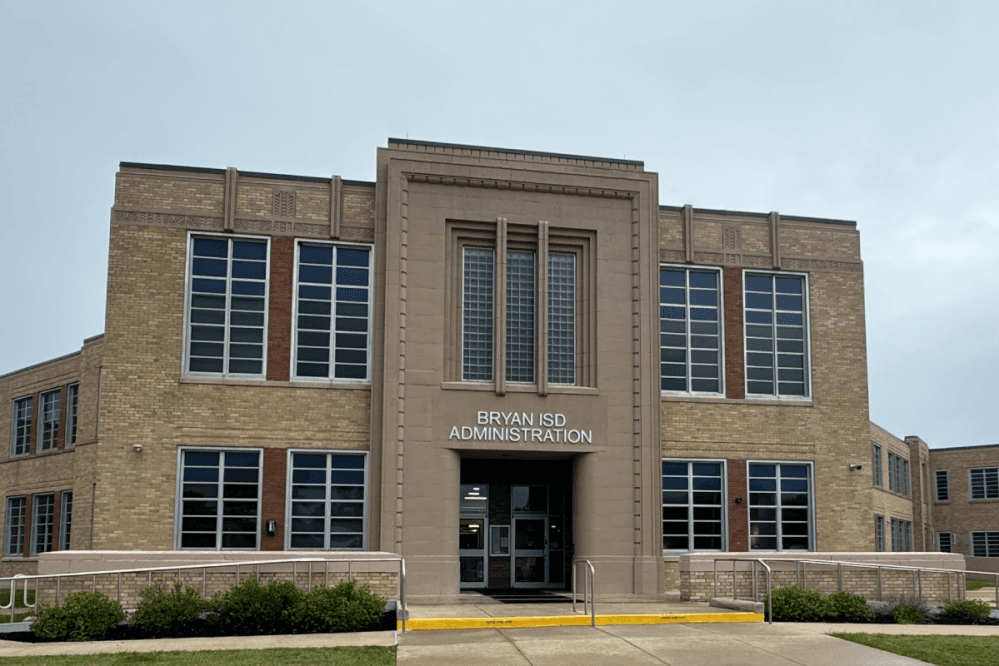
Bryan ISD’s voluntary efficiency audit revealed the district is bringing in less revenue per student than comparable school districts while spending more. Trustees received a presentation of the district’s audit Oct. 19, reviewing financial, staffing and academic data as the district prepares for its Nov. 3 voter-approval tax rate election, or VATRE.
What readers should know
The audit was conducted by Austin educational consultant MoakCasey, which the district contracted in May. The state requires the report as part of the VATRE process, but the district voluntarily launched the audit before formally calling for a VATRE this August, CFO Norma Friddle told Community Impact in April.
The report compared Bryan ISD with peer districts and statewide averages across several measures, including revenue, expenditures, enrollment, staffing and academic performance.
A closer look
Bryan ISD reported $12,577 in revenue per student, compared with a peer district average of $13,024. Per-student expenditures totaled $13,700, compared with the peer average of $13,132.
MoakCasey Senior Vice President of Finance Josh Haney noted that the district’s transition to a July 1 fiscal year beginning in 2024-25 affected comparisons with previous years, as the 2023-24 fiscal year reflected 10 months of expenditures.
The district received a C accountability rating with a score of 76 for the 2024-25 school year, compared with a peer average of 79.2. For 2025-26, the district received a C rating with a score of 77.
The highlights
Of the district’s 23 campuses, 13 received A or B ratings in 2024-25, while two received D ratings.
The district’s attendance rate was 94%, compared with a peer average of 93.3% and a state average of 93.9%.
Special education enrollment accounted for 20.8% of Bryan ISD students, compared with a peer average of 16.9%, according to the presentation.
The district’s staffing accounted for 81.2% of its expenditures from all funds, above the peer average of 80.4% and the state average of 79.5%.
BISD’s average teacher salary was just under $60,000, compared with a peer average of approximately $65,000. Teacher turnover was 16.9%, slightly above the peer average of 16.2% and below the state rate of 18.8%. This was one of the district’s main reasons for calling a VATRE.
Bryan ISD enrollment declined from 16,035 students in 2021-22 to 15,699 in 2025-26, which is an average annual decrease of approximately 0.5%, MoakCasey reported.
The audit also examined district staffing, administrator evaluations, academic programs and other practices.
BISD offers student programs considered attractive to families considering the district, including International Baccalaureate, Capstone, the collegiate high school, robotics, gymnastics and mariachi among others.
BISD reported having a teacher mentoring program and using student performance data to monitor instructional programs, make adjustments and identify professional development opportunities.
The presentation included information about the district’s self-funded programs. Bryan ISD’s employee health insurance program has a deficit of roughly $5 million, with $9.5 million in General Fund contributions made over the past 10 years. The district’s recovery strategy includes premium increases, plan design changes, claims management and employee education, according to MoakCasey. Haney noted in his report that BISD’s workers’ compensation and print shop programs are self-sustaining and do not require General Fund support.
Bryan ISD received an A rating under the state’s School Financial Integrity Rating System of Texas for both the 2024-25 and 2025-26 school years.
MoakCasey’s full efficiency audit of Bryan ISD can be viewed here.
On the ballot
Bryan ISD is seeking voter approval to increase its maintenance and operations tax rate by two pennies.
The election order states the VATRE would generate an additional estimated $5,595,641 in M&O revenue for the 2026-27 school year, representing a 2.10% increase over the previous year’s M&O tax revenue.
About $2.5 million would come from local property tax collections, while about $3 million would come from the state through the use of two golden pennies.
Early voting is underway now through Oct. 30.