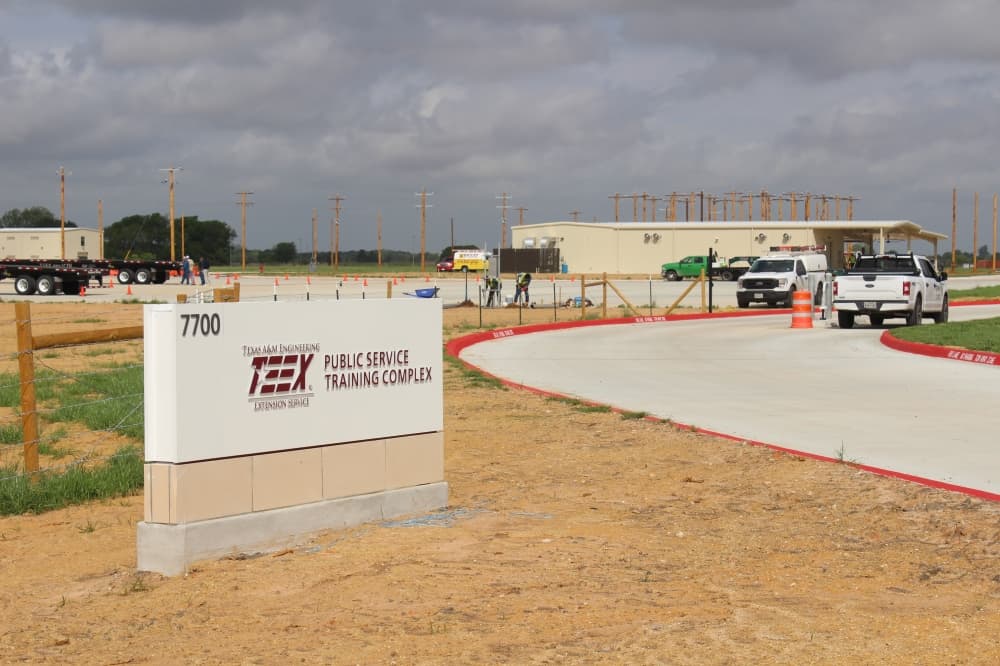
Leaders with the Texas A&M Engineering Extension Service say the new Public Service Training Complex at the Texas A&M-RELLIS campus is designed to solve a problem public safety agencies across the country have struggled with for decades: Responders learning their jobs separately, then being expected to work together seamlessly during emergencies. (Karley Cross/Community Impact)
The next generation of Texas first responders will soon train together in Bryan before they ever meet on a disaster scene.
The big picture
Leaders with the Texas A&M Engineering Extension Service, or TEEX, say the new Public Service Training Complex, set to open in May, at the Texas A&M-RELLIS campus, is designed to solve a problem public safety agencies across the country have struggled with for decades: Responders learning their jobs separately, then being expected to work together seamlessly during emergencies.
The $25.3 million project will consolidate multiple training programs onto an 86-acre site focused on realistic, multiagency scenarios.
“The first gap is the unity of training,” TEEX Agency Director David Coatney said. “Right now, most of these disciplines train independent of one another, and so there’s limited opportunities for them to get together and train in the same space together.”
How we got here
As the RELLIS campus has grown into a hub for research and other academic programs, Coatney said the training space that was once “free range” across RELLIS’ open areas had begun to shrink.
The solution was moving out a bit further and building a dedicated complex designed specifically for hands-on workforce and public safety education.
This facility will allow TEEX to consolidate programs while freeing central RELLIS space for academic expansion.
“It really focuses on three things,” said Tony Crites, deputy agency director for TEEX. “The technical skills of the people who are training, the workforce development side, and then the nexus of research.”
As the PSTC prepares for its grand opening, RELLIS held a groundbreaking ceremony for the state-of-the-art Texas A&M Semiconductor Institute on April 9, worth more than $200 million.
How it works
Unlike traditional academies that train firefighters, police officers or utility workers separately, the new complex emphasizes integrated response.
During real emergencies, Coatney said, success depends on coordination.
“When you have something really bad, like tornadoes or hurricanes, public utilities is in that space as well,” he said. “Those organizations have to understand how to work together through a unified command, and this is an area where we can teach that.”
PSTC’s urban grid, driving track and configurable training structures will allow responders to practice scenarios that mirror real communities, including simulated businesses, residential buildings and critical infrastructure.
TEEX officials say this goal is now realistic.
“You’re going to have law enforcement interacting with lineworkers that might interact with a fire apparatus,” Crites said. “[It] allows us to really become more realistic and relevant to the training and do different scenarios that we can’t currently do on the main campus.”
Assessing the need
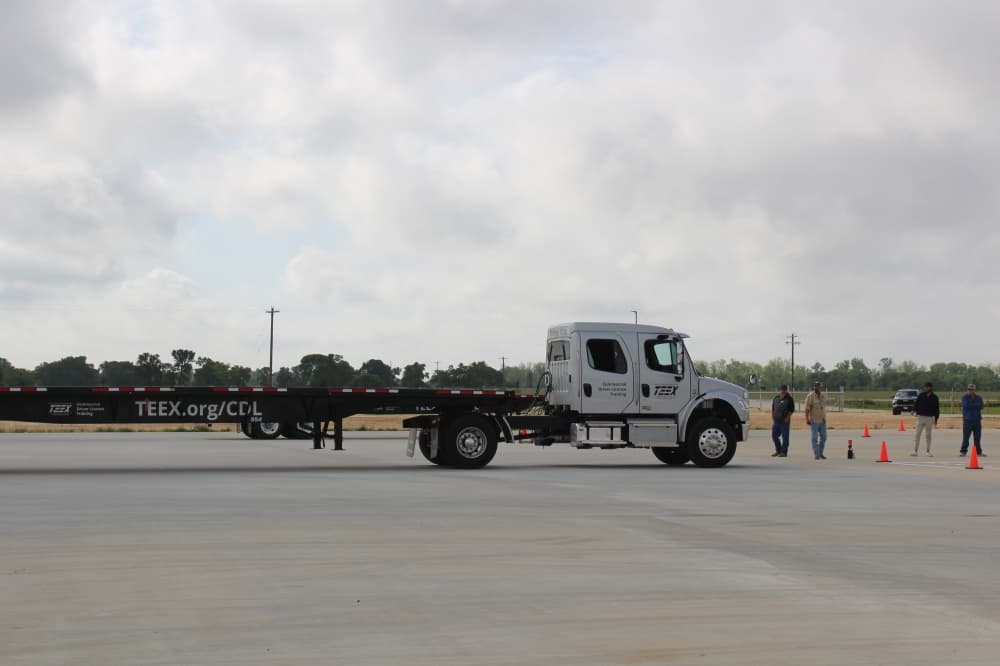
PSTC will support training pipelines for careers that remain consistently in demand across Texas, including commercial drivers. (Karley Cross/Community Impact)
PSTC will support training pipelines for careers that remain consistently in demand across Texas, including:
Peace officers
Electric line workers
Water and wastewater operators
Commercial and school bus drivers
Forensic investigators
Emergency responders and disaster teams
Unmanned aerial systems operators
Many of those careers face ongoing workforce turnover as experienced personnel retire.
“As they leave, you’re going to have to hire new people to replace people. That’s just the nature of the beast,” Coatney said.
Training demand has already outpaced available space at existing facilities, the TEEX leaders told Community Impact, with several academies operating at capacity and maintaining wait lists.
The complex, per TEEX leaders, expands Texas’ ability to prepare for hurricanes, winter storms and large-scale emergencies by simulating the full lifecycle of disaster response.
Coatney explained, “It can be a sunny day and we can say, ‘OK, it’s going to be a hurricane,’ and simulate the exercise.”
Training can begin in a safe staging environment before moving responders into disaster simulations at nearby facilities like Disaster City, replicating how real scenarios unfold.
“I don’t know of any place else that has the ecosystem that we have here with A&M,” Crites said.
Measuring the impact
TEEX trained roughly 226,000 people last year across every U.S. state and territory and more than 120 countries.
But leaders said the complex’s impact won’t be measured simply by enrollment numbers.
“We make a difference by developing training, practical solutions ... saving lives,” Crites said.
Coatney emphasized the multiplying effect instructors have on communities.
“When you’re an instructor and you’re training a class of 50 people, look at the exponential impact you have,” he said. “Those 50 people are going to go out and save people’s lives.”
Coatney and Crites said TEEX plans to track student input, employer feedback and new research partnerships as indicators of success once the facility opens.
Another point of view
Beyond workforce training, the complex is expected to strengthen collaboration across the Texas A&M System.
Researchers studying electric vehicles, lithium battery fires, smart infrastructure and emerging energy systems will be able to test technology alongside those who respond to real emergencies.
“That nexus of research ... provide us a proper opportunity to expand what’s happening on RELLIS,” Coatney said.
PSTC’s controlled environment also allows experimentation that would be impossible on a traditional campus.
“It’s kind of a neat playground that we can integrate pretty much what the A&M System does in an area where we can link a lot of things together for the benefit of the students that we serve,” Crites said.
Funding the project
Funding for the project includes $20 million from the Permanent University Fund and $5 million from TEEX.
When complete, about 98 full-time employees and around 200 part-time staff and instructors are expected to operate at the complex.
While the facility will serve local agencies, leaders expect it to draw trainees from across Texas, the nation and internationally.
Tracy Foster, chief financial officer for TEEX, said PSTC represents how workforce development fits into the broader mission of the campus.
“It strengthens the workforce training, the public safety training and the research side,” she said. “You can see all pieces of it at the campus.”
The takeaway
Ultimately, TEEX officials say Texans may never realize how often the facility affects their lives, but they will experience its results:
Better prepared officers
Safer disaster response
Faster recovery after emergencies
“The impact would be almost impossible to quantify," Coatney said.
A ribbon-cutting ceremony is expected in early May and will mark the facility’s opening. TEEX will make those details available in the coming weeks.
SURVEY: Waffle House still the most wanted College Station restaurant