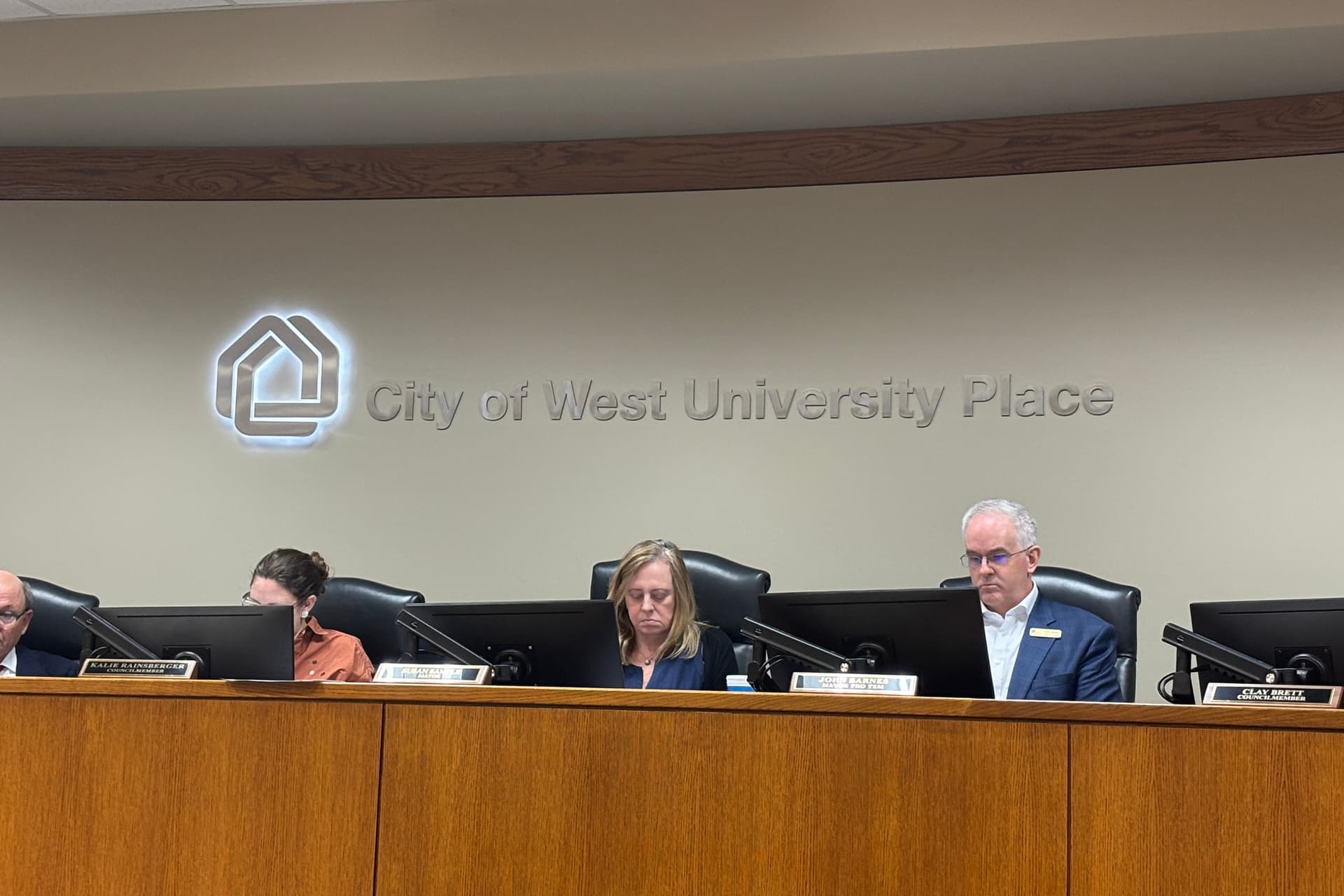
On Oct. 26, city staff solicited feedback from West University Place City Council that would establish the first steps of a project dedicated to widening Buffalo Speedway’s pedestrian sidewalks.
The high-volume route spans directly through West U and was identified as the center of these project efforts in the city’s 2027-2036 Capital Improvement Plan, which was approved Aug. 17, according to prior coverage from Community Impact.
In a nutshell
The scope of the sidewalk improvement project involves installing an 8- to 12 feet-wide sidewalk from Bissonnet Street to West Holcombe Boulevard, City manager Dave Beach explained to the council in a presentation.
The changes made under this project are expected to feed directly into West U’s larger ongoing pedestrian and traffic safety investigative work, which comprises five individual traffic studies conducted by civil engineering firm BGE Engineers, per agenda documents.
Updates on three of these studies were also presented at the Oct. 26 meeting, one of which involved signalized intersection evaluations of Buffalo Speedway at Bissonnet Street and at West Holcombe Boulevard.
CIP documents show that funding for the Buffalo Speedway Pedestrian Enhancements Project is allocated as follows:
$90,000 is programmed in 2026 to perform a feasibility study for the project
$995,000 is estimated for design costs
$11,240,000 is estimated for construction; 80% of this amount is slated to be paid via grant-sourced funding
Through further development of the sidewalk widening plans, West U officials will have the ability to designate portions of the sidewalk for different uses as they see fit, including, but not limited to, the creation of a bike lane, Beach said.
Council members will need to assess the limitations or problems that may arise as a result of the designations later on in the design process.
What they're saying
Upon conclusion of Beach’s presentation, Mayor Susan Sample opened council discussion by stating that, like many other routes in the community, the major arterial street lacks adequate walking pathways.
“The walking pattern you see is people walking in the street because our sidewalks are too thin, and that’s not safe,” Sample said. “And then everybody just avoids Buffalo Speedway, even though that’s the most direct route, because they can’t walk in the street.”
She added that she encourages pedestrian mobility throughout the community, and as such, supports any sidewalk improvement that would promote resident safety and enjoyability.
General comments were also made regarding the practicality of the city’s existing sidewalks as a whole, namely by Mayor Pro Tem John Barnes.
“I think the bigger issue with a lot of the pedestrian pathways that we have—whether they’re walking on the street or walking on the sidewalk—is people don’t like the breaking up of the path with it starting again across the street. They like continuous paths,” Barnes pointed out.
However, council members Clay Brett and Kalie Rainsberger expressed doubts that Buffalo Speedway was the most suitable route to undergo sidewalk widening as opposed to others in West U.
Those opposed
Brett pointed out that the “safest” streets to use for going north or south throughout the neighborhood are the ones located inside residential blocks, making them the ideal choice for improving pedestrian travel safety.
Rainsberger, on the other hand, said there are already “too many lanes on [Buffalo Speedway]” and does not see the value in encouraging more outside traffic down the major street, especially if the sidewalk work comes at the expense of removing neighborhood tree canopies.
Long-term, she noted the possibility of increased cyclist-related issues in the community, should officials choose to create a designated bike lane.
“We are going to kill the tree canopy, I fear… I personally think that walking with cyclists and without tree coverage sounds really unpleasant,” Rainsberger remarked.
Next steps
After hearing from others on the dais, council member John Bertini suggested that they put all of their questions and concerns into the planned feasibility study prior to pulling back on or, conversely, pushing the project forward.
In addition, he recommended that city staff request assistance from internal personnel to address some of the council's preliminary concerns. Specifically, he suggested an arborist review the trees along Buffalo Speedway and return with their findings at a later date.
City Council ultimately agreed with Bertini’s recommendation, feeling that internal review in advance would help officials better identify what Buffalo Speedway’s needs are with the current sidewalk conditions and how they should proceed with the project’s next steps.
Beach said that city staff would work to fulfill the request to find internal personnel. It was not specified at the meeting when the arborist’s findings will appear on a future agenda.