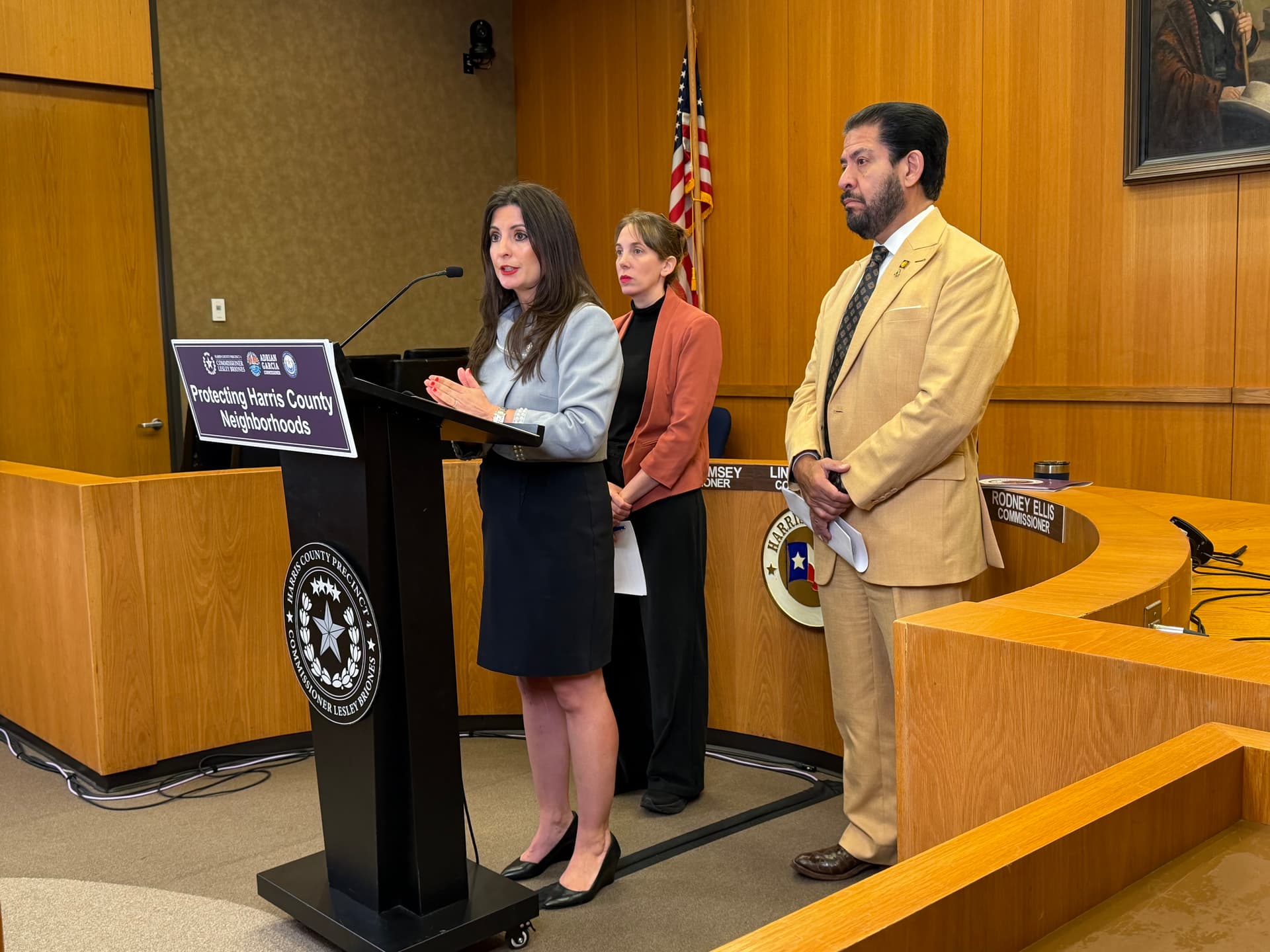
Three county leaders called for local data center development oversight and protections for Harris County residents during a press conference Oct. 15.
The overview
Harris County Attorney Abbie Kamin, alongside county commissioners Adrian Garcia and Lesley Briones, held a press conference to ask the state legislature to expand the county’s authority to oversee data center development. The three Democratic officials are seeking reelection in November.
Currently, counties have “little to no authority” to stop data centers from developing in the county, Briones said.
“We need to be informed so we can be leaning in to do everything we can to protect our community and environment,” Briones said.
During its Oct. 15 meeting, the Harris County Commissioners Court passed a motion to increase information on oversight. The court’s action will require:
County departments to notify the court when major data centers apply for permits
The County Attorney’s Office to report on the county’s existing authority and oversight over data center development
The county’s Office of Intergovernmental and Global Affairs to identify and advocate for statutory changes to strengthen county oversight in unincorporated areas during the next legislative session
Harris County has 55 operating, under construction or planned data centers, according to agenda documents. In Texas, Harris County is second to Dallas County in the number of data centers, per a press release.
The background
In September, Gov. Greg Abbott directed the Texas Commission on Environmental Quality to halt all data center permits until the state can complete an audit, per previous Community Impact reporting. The decision bars state agencies from advancing regulatory approvals on data center development until the audit is complete. Kamin said the findings are expected in December.
“We know data centers place a significant demand on our electrical grid, our water supply, air quality and impact the neighborhoods around them,” Kamin said. “Whether a project is a net benefit depends largely on where it’s located, how it’s designed and in terms under which they’re approved. The question is, ‘What can Harris County do about this?’”
Harris County is not permitted to regulate data center locations through zoning because the county does not have zoning laws, Kamin said.
According to agenda documents, residents near existing and proposed data center sites have raised concerns about:
Environmental impacts
Grid reliability
Noise
Property values
Public safety
Utility costs
Water and energy use
Kamin said CenterPoint Energy, the county’s primary utility provider, expects to connect eight gigawatts of new data center load in the Houston area by 2029, with about four additional gigawatts to follow. That would increase “peak demand” in the region by about half, she said.
Large data centers can generate significant tax revenue, but they require substantial land, electricity, water and supporting infrastructure while creating relatively few permanent jobs, agenda documents state.
Kamin said state law offers sales tax exemptions of 10-20 years to qualifying data centers.
“This isn’t about being against technology or new technology, but growth has to go hand in hand with accountability,” Kamin said. “And any facility that comes to our county should follow the rules, be a good neighbor and be transparent with the community that they are joining.”
What’s next
Garcia said the upcoming legislative session, which begins in January, will be an opportunity to regain some local control.
“We need real authority and the opportunity to have a real voice,” Garcia said.
Garcia, a board member of the Texas Conference of Urban Counties, said the group is working to bring “meaningful legislation” to obtain local control and “make sure that we are protecting the quality of life of our neighbors.”
“We are working to understand what opportunities the county has in terms of legal authority,” Garcia said. “But the reality is that there’s very little. That’s the bottom line. There’s very little that the county can do. However, we have to work toward legislation to make sure that local officials have an actual seat at the table.”