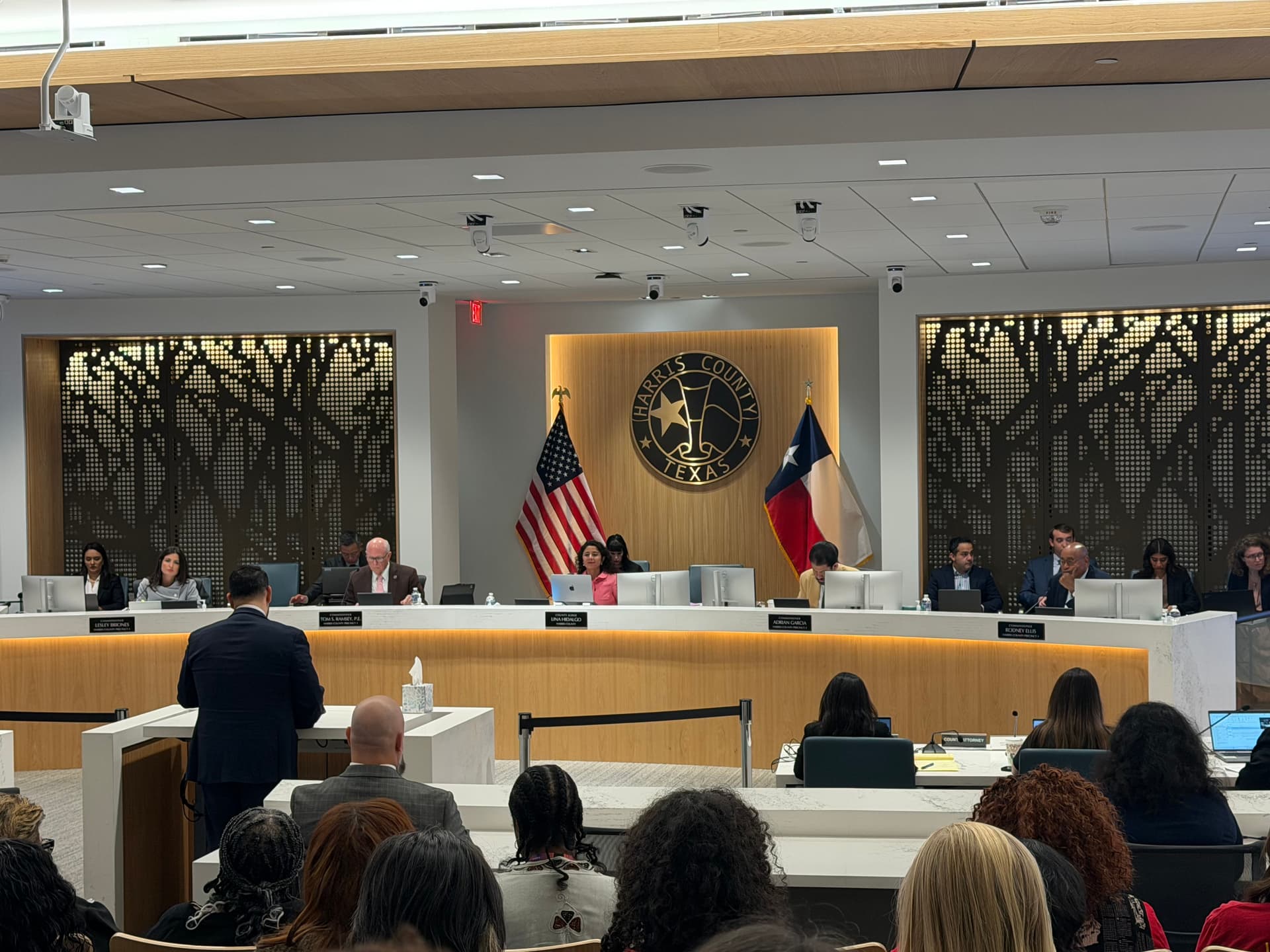
Oversight on countywide camera surveillance systems will be reviewed with a working group, the Harris County Commissioners Court approved in a 3-2 vote during its Oct. 15 meeting.
Commissioners Adrian Garcia and Tom Ramsey cast the dissenting votes.
The overview
The group, led by the county Sheriff’s Office, will create a governance framework for the county’s use of automated license plate readers, or ALPRs. The county currently has contracts with Flock Safety and Vigilant, which record and log vehicle locations, according to an Office of County Administration report.
The group will develop amendments to the county’s current ALPR contracts, including provisions for data retention and sharing. The proposed amendments and ALPR data use policy will be brought back to commissioners by February 2027.
Despite the move toward establishing oversight rules, County Judge Lina Hidalgo said the action is not as aggressive as she would like. She also said during a press conference that information about camera location, access and data retention, among other details, has been difficult to obtain. Hidalgo has sought this information since May, she said.
“We don’t know which agencies have access to those cameras,” Hidalgo said. “We don’t know what the queries have been into the cameras; we don’t know who has submitted those queries. We don’t know the policies that are out there.”
Ramsey, who did not vote for the work group, said the cameras are an “important tool” for public safety. He also said there needs to be a well-defined process for access controls, legitimate law enforcement purposes for searches, accountability and reasonable retention limits.
“I don’t know [that] the best practices in Chicago [are] necessarily the best practices down here,” Ramsey said. “We need to find that in the context of where we are in Harris County.”
The findings
The county’s report found there are 154 county-funded Flock cameras. Those in commissioners precincts account for 125, and county law enforcement agencies have reported 29.
OCA put together the 32-page report at County Judge Lina Hidalgo’s request. A portion of the report asked county law enforcement agencies for information on ALPR ownership and deployment; data access and sharing; and policies and safeguards. The Sheriff’s Office, Fire Marshal’s Office and Constable Precincts 1, 2, 3, 4, 5, 7 and 8 responded, per the report.
It identified about 3,500 ALPR cameras in the county that users have reported to DeFlock, a community-driven mapping project. Data from Flock published in December 2025 identified about 5,300 active cameras in the county, according to the report.
Many of the county’s cameras are contracted with municipal agencies and private organizations, like homeowners associations. The county does not have control over those cameras, the report states, but county law enforcement can administer third-party networks or access data through sharing arrangements.
The county’s Flock contract has the following restrictions:
Data must be deleted from the Flock system after 30 days
The county owns the data, and Flock cameras generate the data
Access to Flock data is limited to county employees, agents and contractors of county law enforcement agencies
The county also has an addendum to the contract stating that data cannot be shared without county authorization, per the report. However, standard Flock provisions “provide that data sharing is permitted by Flock when Flock has a good faith belief that the sharing is needed to comply with legal requests, protect the public, etc,” according to the contract.
The background
Harris County’s first ALPR cameras were introduced in 2023, when Garcia had them installed in the Cloverleaf area, according to the report.
Garcia said Thursday that law enforcement agencies nationwide have recognized how the technology got away from them. He said misuse is intolerable, and Sheriff Ed Gonzalez is working to hold his agency accountable for any wrongdoing.
“It is providing greater, greater success in solving crimes, in preventing the possibility of violent crimes and being able to apprehend violent and dangerous people nearly immediately,” Garcia said.
He added that the Sheriff’s Office is close to proposing a model policy to the court and expressed concerns that the county’s work group could prolong the sheriff’s work.
Briones, who voted for the work group, moved to decommission all Flock cameras on Precinct 4 property Oct. 8. That took 61 of the county-owned cameras offline.
During the meeting, Briones said she made the decision after delving into the contract’s provisions and noticing “a lot of loopholes and broad language.”
“The bottom line is we need to continue making Harris County as safe as possible, but part of safety is making sure that all people, from all communities and all backgrounds, feel safe,” Briones said.
Precinct 4 has joined Precinct 1 in not operating ALPRs. Commissioner Rodney Ellis maintained during the meeting that Precinct 1 has never had ALPR cameras on its property.
In a statement, he said that how the technology is used and who has access to its data affects every resident.
“Public officials across our county have a responsibility to make sure this mass surveillance technology does not put our constituents in danger,” he said.